Thursday, December 29, 2016

'Learning how to throw yourself at the ground and miss': the children's playground as a variable gravity environment

Despite the various rationales of playground design and equipment from the 1890s to the 1980s, one aspect remains constant: the physical engagement of the child with structures which require climbing, swinging, gripping and running. The ‘apparatus such as swings, slides and jungle gyms’ in public playgrounds were aimed at developing ‘confidence, muscular strength, co-ordination and skill in balance’ (Apps 1944: 33). What has previously gone without remark, precisely because it is so ubiquitous on Earth as to be unremarkable, is a certain relationship with gravity, which both made the equipment suitable for training bodies, and at the same time dangerous.

Each of the standard pieces of playground equipment – swings, jungle gyms, monkey bars, see saws, round-abouts, slides, merry-go-rounds etc, invites a child to elevate themselves, experience centrifugal force, or ballistic trajectories. These experiences also court risk – falling off the apparatus and feeling the full force of gravity in collision with the ground. A playground could thus be described as a 'variable gravity environment' (Doule 2014).

One interview conducted with a child suggests that this variable gravity is a desirable experience (Ota et al 1997:22).

Q: What does it feel like on the swings?
B: It feels like a rocket going backwards and forwards.
Q: Up in the air?
B: Yes
Q: Is it as good as the tree [another of B’s favourite places], or just different to the tree?
B: It’s different if you shut your eyes.
Q: Then how does it feel?
B: It feels scary. It’s black and looks like you’re in space.
Q: Do you imagine you’re going anywhere?...
B: Yes
Q: The swing that’s a rocket?
B: Yeh …..whoosh!”

Gravity is the unspoken subtext beneath the appeal of the apparatus which mimicked feelings of flying or microgravity, yet contained within it a fear of falling. Early Austrian rocket theorist, Hermann Noordung, noted that falling was a source of anxiety on Earth and raised the question of whether the fear of falling would be an impediment for astronauts operating in microgravity. He concluded that since pilots and ski jumpers adapt to falling, this fear was not an impediment to human operations in orbit (1929:79).

The fear was also a desirable part of the experience, with many adults regretting the demise of the ‘dangerous’ playground (Hattersley-Drayton 2013). Such desires and fears seem deeply rooted in the human psyche. Dreams of flying/falling are known as 'typical' dreams, in that they occur across all cultures, genders and age ranges (Maggiolini et al 2007, Nielson et al 2003). While falling dreams are often associated with a sense of dread or negativity, flying dreams are universally reported as positive experiences. Both playground equipment and flying/falling dreams express a relationship to gravity. 

Adults and children had other ways to engage with variable gravity environments on Earth, however, in the theme park or amusement park. These also feature gravity-defying rides such as roller coasters, another American obsession. While the playground invites the child to become familiar with the effects of gravity in a safe environment, the amusement park is aimed at evoking the visceral fear of falling at speed, coupled with the terror of the fairground accident. Amusement parks typically feature roller coasters, drop towers (scientific drop towers are used for microgravity experiments), and centrifuges. The most advanced version of this is the zero-gravity aeroplane rides known as 'vomit comets'.

It is ironic, then, that playground rockets were static. They did not move or ever take off, although they could be slid down and climbed. As one playground designer commented, 'The Rocket Ship in reality has very limited play value. It is basically a climber to a slide' (Hendy 2008). It seems one aspect of the rocket’s appeal was the height – surely the highest ascent available to a child in the playground (Hendy 2008), and by reasons of scale, appearing so much higher than to an adult. Perhaps this is also the appeal of climbing trees.
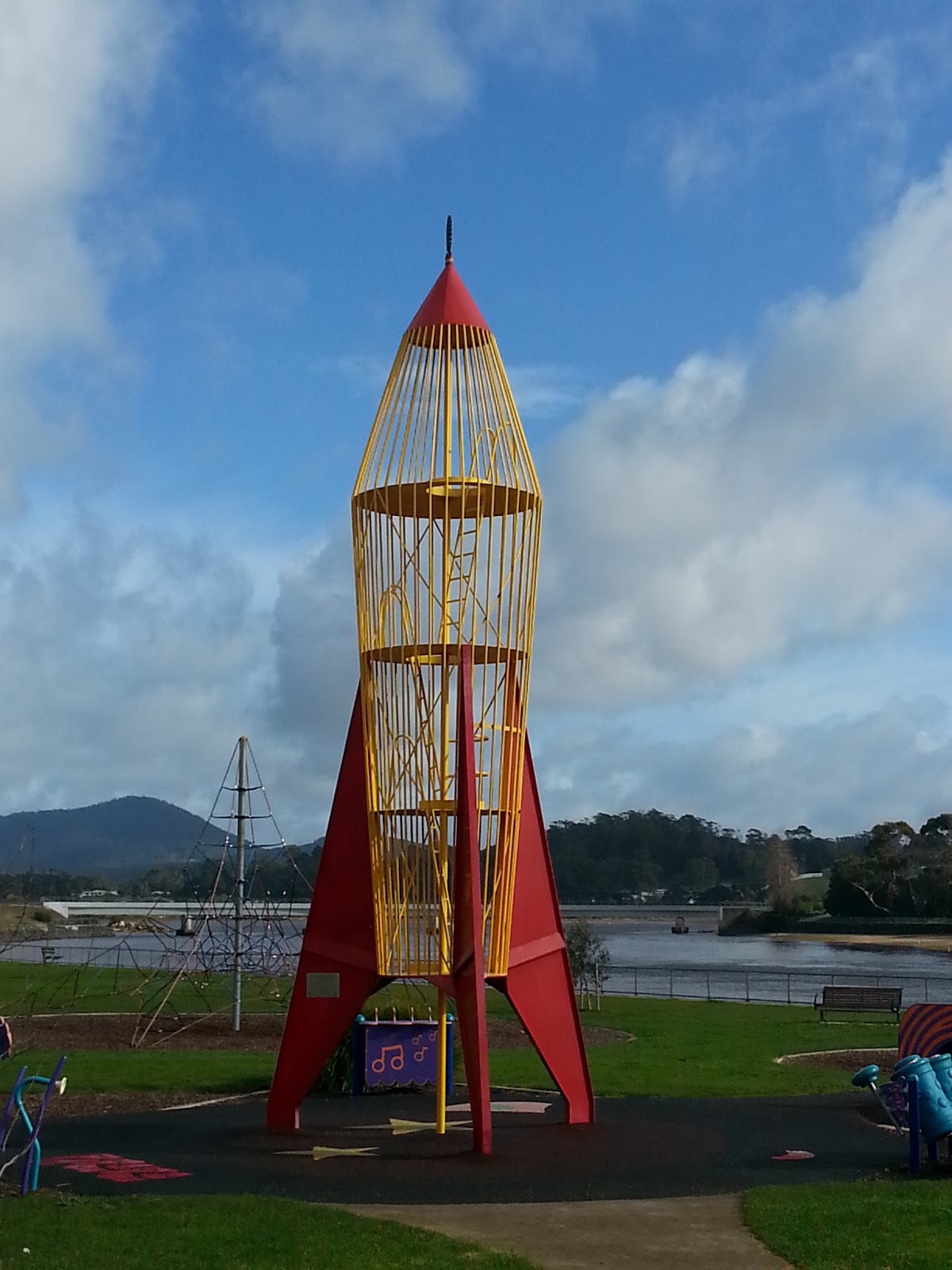
The Rocket Park in Ulverstone, Tas.
(Author's image)
Nevertheless, the rocket remained stubbornly popular. Only one thing can explain why, perhaps, rockets stood as space age monuments in the imagination of the child, and that is their intersection with what was actually happening in the real world of space exploration, accessible to children through other toys, children’s books, television and news.

Children’s literature of the 19th and early 20th century contained many accounts of bodies in microgravity eg in the wonderful Dr Dolittle in the Moon (Lofting 1929), and The Light Princess (MacDonald 1964). C.J. Dennis even imagined the first Australian in orbit, a schoolboy called Neville who was whisked around the Earth by a cloud-horse in one night (Dennis 1921, Gorman 2015). In the fantasy playground period from the 1950s to 1970s imagination met reality as first-hand accounts of spaceflight became available.


Note: this is a deleted section from a paper on rocket parks that I am currently writing. I realised that the gravity hypothesis didn't really belong in the main argument. But I still like the theory that I'm proposing here, and so thought I would share it with you.

Note 2 (2018): the published paper is Gorman, A.C. (2018). Gravity's playground: dreams of spaceflight and the rocket park in Australian culture. In Darran Jordan and Rocco Bosco, ed. Defining the Fringe of Contemporary Australian Archaeology. Pyramidiots, Paranoia and the Paranormal. Newcastle upon Tyne: Cambridge Scholars Publishing, pp. 92-107.

References

Apps, BFG 1944 Children’s Playgrounds. Canberra: National Fitness Council
Doule, Ondrej 2014 Ground Control. Space architecture as defined by variable gravity. In Neil Leach (ed) Space architecture: the new frontier in design research, pp 90-95 John Wiley and Sons Ltd
Gorman, A.C. 2015 The first Australian to orbit the Earth. Space Age Archaeology. http://zoharesque.blogspot.com.au/2015/01/the-first-australian-to-orbit-earth.html
Hendy, Terry 2008 Dynamic playground design. In Heights Park Master Plan Playground Task Force Recommendations Presentation. Richardson, Texas.
Lofting, Hugh 1929 [1968] Dr Dolittle in the Moon. Harmondsworth: Penguin
MacDonald, George 1864 [1994] The light princess. In Alison Lurie (ed) The Oxford Book of Modern Fairy Tales. Oxford: Oxford University Press
Maggiolini, Alfo, Anna Persico and Franca Crippa 2007 Gravity Content in Dreams. Dreaming 17(2): 87–97
Nielsen, A. T., Zadra, A. L., Simard, V., Saucier, S., Stenstro, P., Smith, C. 2003 The typical
dreams of Canadian University students. Dreaming 13(4): 211–235.
Ota, Cathy, Clive Erricker and Jane Erricker 1997 The secrets of the playground. Pastoral Care in Education 15(4): 19-24


Friday, November 25, 2016

A map of all the space junk that has re-entered over Australia

Today someone wrote to me to ask for help in identifying a piece of space junk which had been found in Queensland some years ago. Dr Space Junk is always happy to help, so I sent off a brief explanation.

This made me think, though, of how interesting it would be to map the location of all known re-entry events. There'd be a whole bunch of Skylab in Western Australia, some material from the Europa launches from Woomera in the 1960s in the Northern Territory and Queensland, and many pressure vessels used in rocket fuel systems - globally, these are the most common component to survive re-entry as they're usually made from titanium, stainless steel and/or carbon-carbon. Because of Australia's location, many rocket bodies fall back to Earth over our landmass. We're well situated for observing and tracking the LEOP (Launch and Early Orbit) phase of launch so it makes sense that the second and third stages are likely to re-enter in our vicinity.

You could compare the distribution of this junk with the meteorite entries being mapped by the Western Australian Fireballs in the Sky project, which asks citizen observers to send in data whenever they see some flaming object heading towards Earth. And of course there's also the tektite strewn fields.

I might just expand it to include anything that falls from the sky, as it's likely there's stuff that my Friday-arvo brain has forgotten about at the moment. The more I think about it, the more I think this could be an extremely interesting map to create and I wonder why I've not thought of it before. Such a deliciously simple idea that could lead to - well I don't really know just yet, but it's sure to be something!


Sunday, November 06, 2016

Do objects and people cast shadows inside the International Space Station?

Do astronauts cast shadows in space?

Astronaut Mike Hopkins casts a spoon shadow. Image courtesy of NASA.

I've been thinking about shadows a lot, and also space stations. This has involved reading about habitability studies, an area I started to investigate when I was writing about Skylab a few years ago. The point of this line of enquiry is whether shadows are considered when the interiors of space stations are designed. Perhaps they contribute to creating a feeling of homeliness. Perhaps a lack of shadows is something characterising a laboratory environment, or a solitary confinement cell, or a padded cell, and hence to be avoided. Astronauts are, after all, under constant surveillance. You can hide things in shadows. Things can hide themselves in shadows.

It's worth observing that a shadowless environment can occur when you have no light, or when you have too much light.

Part of the answer to this is how, when, where and with what the ISS is illuminated. It appears that the lighting at present is a combination of fluorescent and LED.  

A perusal of images of the interior shows that there are certainly shaded areas, and more highly illuminated areas. The restricted interior space, and the curvature will also have an impact on the appearance of shadows. Have a look at this one:

Image courtesy of NASA
Of course, when we see images of the inside, they are generally illuminated. But the space station is also darkened at 'night'.  Recently astronaut Alexander Gerst took a series of rather spooky pictures with the lights turned off. Clock this and tell me it doesn't send chills down your spine:

Image courtesy of NASA
Do you see that the helmets are hooded? Is this from fear of what you might see if you looked through the visor?

Perhaps illumination inside the ISS is designed to avoid the ever-present uncanny, always just out of sight, in another module, or outside the window....


Monday, October 03, 2016

Tsiolkovsky imagines the Earth seen from orbit in 1920

In 1920, the great Russian space visionary Konstantin Tsiolkovsky published Outside the Earth, in which Galileo, Newton, Franklin, Helmholtz, Ivanov and Laplace build a rocket. Along with a crew of 16 men, their colleagues elect Newton, Laplace, Franklin and Ivanov as first cosmonauts, while they stay behind in the Himalayan castle the scientists had built as a retreat from the world. 

It's a charming conceit, which Tsiolkovsky uses as a didactic device to explore all kinds of practical aspects of human spaceflight. What makes it especially interesting, from my perspective, is that he also creates a phenomenology of space through translating science into the experience of a human body. This is a theme which permeates his work, and he's rather brilliant at it.

In the passage below, he describes the Earth as it appears from orbit. I'll remark upon a few points of interest when you've finished reading it.

The Earth, taken from TIROS-1 in 1960.
Image courtesy of NASA
Men at the other portholes saw the Earth at a distance of a thousand kilometres. They didn't realise at first that they were looking at the terrestrial globe. But then they began to recognise the familiar contours of lakes and islands and continents amidst patches of clouds. It was like a huge, distorted map of a hemisphere. In actual hemisphere maps, the edges are clear and their scale is double that of the central portion. Here the reverse was true: the edges were reduced radially and very vague.
"...The edges are uneven and in some places they're jagged because of the mountain peaks. Something like a mist lies further in from the edges and there are many elongated grey spots - clouds darkened by the thick layer of the atmosphere. The spots stretch around the Earth's circumference. The further they are from the edges the lighter and broader they seem, and toward the centre they're rounded or irregular in shape, not stretched out".
"....Gentlemen," Newton said, "our rocket is circling the Earth once every 100 minutes. The solar day lasts 67 minutes, and the night, 33 minutes. In 40 or 50 minutes we shall enter the Earth's shadow. the Sun will set almost instantaneously. We'll hardly see the moonlit Earth, but its edges will shine brightly with all the colours of the dawn. This light will be our substitute for moonlight.
I'm warning you in advance what to expect to prepare people whose nerves are not strong..."
Meanwhile the Earth continued to wane and at the terminator the oblique shadows of mountains and elevations grew longer and longer. The impression was as if the stars were falling to the jagged sunlit edges of the Earth in tens, hundreds and thousands, so large was the portion of the sky occupied by the Earth and so great was the number of stars that could be seen in the void....they could see cities, large villages, rivers more than 100 metres wide. Sometimes the land below assumed one colour, as if covered with snow, and it was difficult to see anything....
The sky was so tightly packed with stars that there was hardly an empty space left: a black sky powdered with silver stardust, with the exception of the so-called coal-sacks, which were as black and empty as viewed from the Earth.
Binary, ternary, multiple and vari-coloured stars could be seen everywhere. The moment of eclipse, or night, was approaching.

It takes a little while for the rocket crew to realise that they are even looking at the Earth. Tsiolkovsky notes the difference from the world as portrayed in maps, which are always projections which have to be distorted in various ways to accommodate the globe to two dimensions. To these cosmonauts, it is the world which seems distorted rather than the more familiar map projections.

For us, in nearly 2020, the image of the blue Earth is so entrenched in our collective consciousness that it comes as surprise to see this feature absent from Tsiolkovsky's vision. However, right up until the 1960s, many depictions of the Earth from the outside were in grey tones. Even when Major Tony Nelson and Jeannie went into space, the Earth was greyscale. This was partially because many of the images from early human spaceflights and satellites, like TIROS 1, were taken with black-and-white film.

Tsiolkovsky argued that the atmosphere made the sky appear blue when on Earth, and outside the atmosphere, this effect was removed. Nonetheless, the Earth is in fact blue when seen from space, because of the oceans. This was something that he didn't predict, for all his feats of imagination.

From Tsiolkovsky's Album of Space Travel, 1933.
Image courtesy of the Russian Academy of Science

At a distance of 1000 km, especially in the 1920s, it is unlikely that our fictional cosmonauts would have seen many signs of human occupation. Large cities, perhaps, but probably not large villages. In 1962, Yuri Gagarin orbited at around 200 km. In a speech given after his return, he said that "Clearly distinctive are large mountain ranges, large rivers, large forest areas, shorelines and islands".  No Great Walls of China!

Newton issues a warning that the sight of the Earth passing into the shadow of night might be a bit much for some. I'm reminded of Asimov's classic story Nightfall (1941), in which the sight of the stars in the first black night for two thousand years causes madness. And indeed viewing this unfamiliar hyperobject does have its effects:

The men were stunned by the sight, some felt exhausted and moved away from the portholes. Other, alarmed by their cries, hesitated to look out. Many flew away to their cabins, drew the shutters, and lit dim electric lights. Others, however, darted excitedly from porthole to porthole with cries of surprise and delight.

I think this is what I like most about Tsiolkovsky's vision, that he takes into account the emotions, and allows for different reactions to this extraordinary experience. And there's no 'Overview Effect'. I have a healthy skepticism about the presumed universal experience of the Overview Effect - the feeling, described by so many astronauts when they go into orbit, of deep connection to a fragile world where humanity is united. There is no doubt something significant here, but the trope is so strong that you rarely hear dissenting views, such as those of African-American astronaut Mae Jemison. Astronauts are such a narrow and elite class; as diversity in their ranks grows, there will no doubt be more diverse reactions to the overview.

Finally, I note that our intrepid scientists and their crew do not appear on the rather wonderful Wikipedia list of fictional astronauts, for which they meet all the criteria. I might have to do something about this!


References
Tsiolkovsky, K. 1920 [nd] Outside the Earth. In V. Dutt (ed) The Call of the Cosmos, pp 161-332. Moscow: Foreign Languages Publishing House


Wednesday, August 24, 2016

From aerospace to everyday life: the trajectory of cable ties.

This is our poster for the World Archaeological Congress in Kyoto in a few days time! My co-author is the wonderful Aylza Donald, who has caught the cable tie love.


Saturday, July 30, 2016

A funny thing happened on the way to the spaceport

Back in 2005, I was lucky enough to visit the Centre Spatial Guyanais in French Guyana. This is where the Ariane rockets are launched. It was amazing. I spent a couple of days in the archives, and drank a lot of ti-punch. Later, I incorporated some of my research into an article.

There were a few other people on the official part of the visit, and we took a group shot at the end. An acquaintance thought it might be amusing to re-imagine the Kourou spaceport as a landing rather than a launching site.....