Showing posts with label rockets. Show all posts

Sunday, June 03, 2018

Seven reasons to love French aerospace

One of the happiest months of my life was when I rented an apartment in the 20th arrondissement of Paris, so that I could do some work in the archives of the Musee de l'Air et de l'Espace at Le Bourget. Every morning I'd go down to the boulangerie on the ground floor of my apartment building for fresh pain and delight in the simple pleasure of perfect bread and butter. I may not have spent quite as much time in the archives as I intended, but what the hell.

Here are a few reasons to love French aerospace.

1. Asterix 1

Asterix 1. Image source: unknown.
When France launched Asterix 1 on a Diamant rocket from Algeria in 1965, it became the third nation in space. Asterix 1 is named for the plucky Gallic bande dessinee character who successfully holds the Roman invaders at bay against all the odds. His namesake, the sub-conical striped-and-antennaed satellite, is quite simply super-cute, and one of my all-time favourites.


Image source: author.

2. Alexandre Ananoff

While working in the archives, I became aware of an influential French space visionary. The name Alexandre Ananoff (1910 - 1992) came up over and over again. He wrote about the mechanics of spaceflight, the kinds of spaceships we might see in the future, and social aspects of space exploration. This article, by Pierre-Francois Mouriaux and Philippe Varnoteaux, appraises his contribution to French space exploration. They say:
A. Ananoff was a real ambassador for astronautics and a pioneer in space education for the general public—probably the first one in France.
In addition, he advised Herge about aspects of spaceflight for the two Tintin volumes where the boy adventurer goes to the Moon.


3. Tintin walks on the Moon


Image source: Tintin.com
To be honest, I wasn't interested in Tintin as a child, and don't have any memory of the books being around. But when I became aware, as an adult, that Tintin had travelled to the Moon, that was a different story! Objectif Lune and On a marche sur la Lune (Objective Moon and We have walked on the Moon) tell the story of Tintin and Co's encounter with rocket scientists and spies at the central European launch site in the mythical country of Syldavie and their journey to the Moon on a very V2-like rocket. As far as I can tell, it's one of the earliest depictions of footprints on the Moon.


4. Kourou

Image source: Guyane Evasion
Kourou, in French Guiana, is where the launch site of the European Space Agency is located. It has an excellent museum and a huge amount of spaceflight history. I spent a week there in 2005, also working in the archives. I touched a rocket in the assembly building, and perhaps a tiny portion of my DNA survived launch and is now in space! (Stop having a conniption, this was not a clean room situation). I also visited the famous Iles de Salut, where best-selling author and escapologist Papillon was incarcerated. I didn't see an actual launch, although I did sit in the control room viewing area and imagine the hum and chatter when it was full of people. Every day I sipped Ti-punch and thought, read and talked space.  It was fabulous.


5. Cool space words

One day, as my plane descended into Adelaide airport, I noticed a plane without wings lying in the grass near the runway. Oh, I thought, it looks like a rocket. Then I realised. Fusee - the French word for rocket -  is the same root as fuselage, commonly used to describe the body of a plane. D'oh.

The cool wordage doesn't stop there, though. My friend Alexandre Ananoff has a word for spaceship: Astronef. This, I think, it the same root as navy, and the French word for space shuttle is navette.

Scaphandre is space suit, also used for diving suit. To me, it has a Homeric ring. Or it could be a character in Aeon Flux

French has a word for landing and taking off FOR EACH PLANET AND MOON. This is beyond cool, a new galactic level of cool. You've possibly heard the terrestrial version of these words if you've flown a French airline - aterrissage. Terre is Earth, and aterrissage is landing on the Earth. Alunissage is landing on the Moon, and amarsissage is landing on Mars. In a future multi-planet solar system economy, the precision of these terms could be very useful. 


6. Musee de l'Air et de l'Espace, Paris


Just check out these babies. Image source: Capcom Espace
This museum, located at Le Bourget in Paris, is amazing. I don't pay much attention to the aeroplane side of it, to be honest, but as well as all the aerospace you could want, there are BALLOONS. Yes, balloons. This is not a Monty Python drill: you can learn all about the golden age of French ballooning right here. Asterix 1 is there too. And there's all the French animals in space: spiders, kittens, rats. One of the things I love about this museum is that we're so used to seeing US-dominated space material culture. It really is striking when you see another national style of technology, and a useful reminder to remain critical of US space hegemony.


7. Le Petit Prince


By Antoine de Saint-Exupery


Continuing the entanglement of air and space, this classic work of children's literature was published in 1943 and is still a favourite with kids across the world. It's really a moral tale, but it has the enchanting conceit of tiny planets or asteroids which grow roses. It was illustrated by the author, Antoine de Saint-Exupery. 

The little prince says:
I love listening to stars at night. It sounds like a hundred million bells.



Monday, December 04, 2017

The right stuff: how archaeologists come to be.

Am I an archaeologist because I'm interested in the stuff? Or am I interested in the stuff because I'm an archaeologist? Which came first?

Some time ago, I was talking with the erudite Dr Duncan Wright about how common it was for archaeologists to have been collectors as children. I collected fairly ordinary things - shells, stamps, feathers, and tram tickets, and had hoards of apricot stones stashed in hollows of trees. Nothing more exotic than that. Today, I have a possibly unhealthy interest in lids, pencil cases, tiny spoons, and the fairies-on-sticks that you buy at agricultural and horticultural shows. (There's a whole cabinet at the Pitt Rivers Museum full of tiny tiny spoons for removing ear wax! Oh the splendour! And there is nothing more satisfying than a well-fitting lid, not a screw-top like on a jar, but a tea pot lid, for example). Healthier collecting interests are space things (obviously), icons, fans, gloves and hats, 1960s tea cups and other ceramics, and stone tools. (This feels a bit confessional. Don't judge me).

The tactile and aesthetic qualities of things are important. I think I like tiny spoons because of the scale; perhaps this a child's interest in the miniature. Gaston Bachelard has a whole chapter on the miniature in The Poetics of Space.

With the 1960s tea cups, it's the asymmetric ones that appeal; they seem subversive and space age-y.  And they are lovely to drink from too.

Fans and gloves are elegant (Dr Space Junk is all about elegance) and old-fashioned; but they are also bloody useful things to own in hot or cold weather, so I love that they can be both beautiful and functional. The mark of a perfect fan is how silent it is when you use it. 

Pencil cases partake of that too, and they are of course receptacles for treasured pencil stubs and beautiful pens that are a pleasure to write with. These days I store assorted USB sticks in my pencil case as well.

So perhaps I was interested in the stuff first.  Perhaps that's why I'm an archaeologist, apart from, as Heather Burke says, being nosy.

I guess what I'm getting at here is partially the difference between history and archaeology.  Would I be content to just read about places and things? I remember the experience of being at the Centre Spatial Guyanais at Kourou, and my delight and satisfaction at placing my palm flat on the surface of an Ariane 5 rocket booster, leaving an invisible hand print of bacteria and oils. The physicality of things, the materiality, does matter to me. I want to touch them. (The continual temptation of art galleries and museums).

In historical archaeology, one of the underlying principles is that the artefacts and places can tell the stories of people who get left out of histories, often the oppressed and poor. So it has a political dimension of giving forgotten people a voice through the material traces they leave behind. It's not just stuff any more; it's stuff that speaks.


Saturday, June 24, 2017

'Ah, that was a beautiful piece of engineering and archaeology!'. Cordwainer Smith's IOM rocket.

I'm always fascinated by how science fiction writers portray archaeology.  A couple of weeks ago, I was wandering through the Adelaide Central Markets on my way to work, and I spied a second-hand book sale. There was a box of old science fiction, and one leapt out at me: Cordwainer Smith's Space Lords, which I did not have.

To my delight, this volume of short stories contained one that I'd never read either. Drunkboat is the story of how the Lord Crudelta precipitated the discovery of Space3. I knew of the story as some critics have discussed it in reference to the evolution of the Vomact family. 

Leaving the plot aside, here is how Cordwainer Smith imagines a kind of space archaeology:
We had put him in a rocket of the most ancient style. We also wrote writing on the outside of it, just the way the Ancients did when they first ventured into space. Ah, that was a beautiful piece of engineering and archeology! We copied everything right down to the correct models of fifteen thousand years ago, when the Paroskii and Murkins were racing each other into space. The rocket was white, with a red and white gantry beside it. The letters IOM were on the rocket, not that the words mattered.

IOM, of course, stands for the Instrumentality of Mankind. The national symbols that adorned spacecraft in the 20th and 21st centuries are mystifying to the denizens of the future, but they copy them anyway.

Fifteen thousand years on from the Cold War space race - I assume the Paroskii and the Murkins are meant to represent the USSR and the USA - there's sufficient documentation and models of the early rockets to replicate them. The IOM rocket is thus a facsimile of old technology. If we think about what was happening 15 000 years ago for us, one of the principle technologies was the manufacture of stone tools. So perhaps this was like something archaeologists might do today in replicating a Magdalenian retouched point.

Magdalenian flaked stone artefacts, from Debout et al 2012
http://www.sciencedirect.com/science/article/pii/S1040618212003436
Such technology is often called 'primitive' in popular accounts, but it was very far from that, requiring a highly sophisticated knowledge of geology and engineering too - understanding the mechanical, chemical and fracture properties of stone are essential to making stone tools. Learning how to actually make and use ancient technologies is sometimes called ethnoarchaeology, and the idea is that you can learn something about how people lived in the past that simply analysing the artefact as an object cannot reveal.

Similarly, the facsimile of the rocket demands both engineering and archaeology to make it more than just another model. The rocket is launched from its red and white gantry - cheerful picnic colours - and if you want to know the rest, you will have to read the story.


Thursday, December 29, 2016

'Learning how to throw yourself at the ground and miss': the children's playground as a variable gravity environment

Despite the various rationales of playground design and equipment from the 1890s to the 1980s, one aspect remains constant: the physical engagement of the child with structures which require climbing, swinging, gripping and running. The ‘apparatus such as swings, slides and jungle gyms’ in public playgrounds were aimed at developing ‘confidence, muscular strength, co-ordination and skill in balance’ (Apps 1944: 33). What has previously gone without remark, precisely because it is so ubiquitous on Earth as to be unremarkable, is a certain relationship with gravity, which both made the equipment suitable for training bodies, and at the same time dangerous.

Each of the standard pieces of playground equipment – swings, jungle gyms, monkey bars, see saws, round-abouts, slides, merry-go-rounds etc, invites a child to elevate themselves, experience centrifugal force, or ballistic trajectories. These experiences also court risk – falling off the apparatus and feeling the full force of gravity in collision with the ground. A playground could thus be described as a 'variable gravity environment' (Doule 2014).

One interview conducted with a child suggests that this variable gravity is a desirable experience (Ota et al 1997:22).

Q: What does it feel like on the swings?
B: It feels like a rocket going backwards and forwards.
Q: Up in the air?
B: Yes
Q: Is it as good as the tree [another of B’s favourite places], or just different to the tree?
B: It’s different if you shut your eyes.
Q: Then how does it feel?
B: It feels scary. It’s black and looks like you’re in space.
Q: Do you imagine you’re going anywhere?...
B: Yes
Q: The swing that’s a rocket?
B: Yeh …..whoosh!”

Gravity is the unspoken subtext beneath the appeal of the apparatus which mimicked feelings of flying or microgravity, yet contained within it a fear of falling. Early Austrian rocket theorist, Hermann Noordung, noted that falling was a source of anxiety on Earth and raised the question of whether the fear of falling would be an impediment for astronauts operating in microgravity. He concluded that since pilots and ski jumpers adapt to falling, this fear was not an impediment to human operations in orbit (1929:79).

The fear was also a desirable part of the experience, with many adults regretting the demise of the ‘dangerous’ playground (Hattersley-Drayton 2013). Such desires and fears seem deeply rooted in the human psyche. Dreams of flying/falling are known as 'typical' dreams, in that they occur across all cultures, genders and age ranges (Maggiolini et al 2007, Nielson et al 2003). While falling dreams are often associated with a sense of dread or negativity, flying dreams are universally reported as positive experiences. Both playground equipment and flying/falling dreams express a relationship to gravity. 

Adults and children had other ways to engage with variable gravity environments on Earth, however, in the theme park or amusement park. These also feature gravity-defying rides such as roller coasters, another American obsession. While the playground invites the child to become familiar with the effects of gravity in a safe environment, the amusement park is aimed at evoking the visceral fear of falling at speed, coupled with the terror of the fairground accident. Amusement parks typically feature roller coasters, drop towers (scientific drop towers are used for microgravity experiments), and centrifuges. The most advanced version of this is the zero-gravity aeroplane rides known as 'vomit comets'.

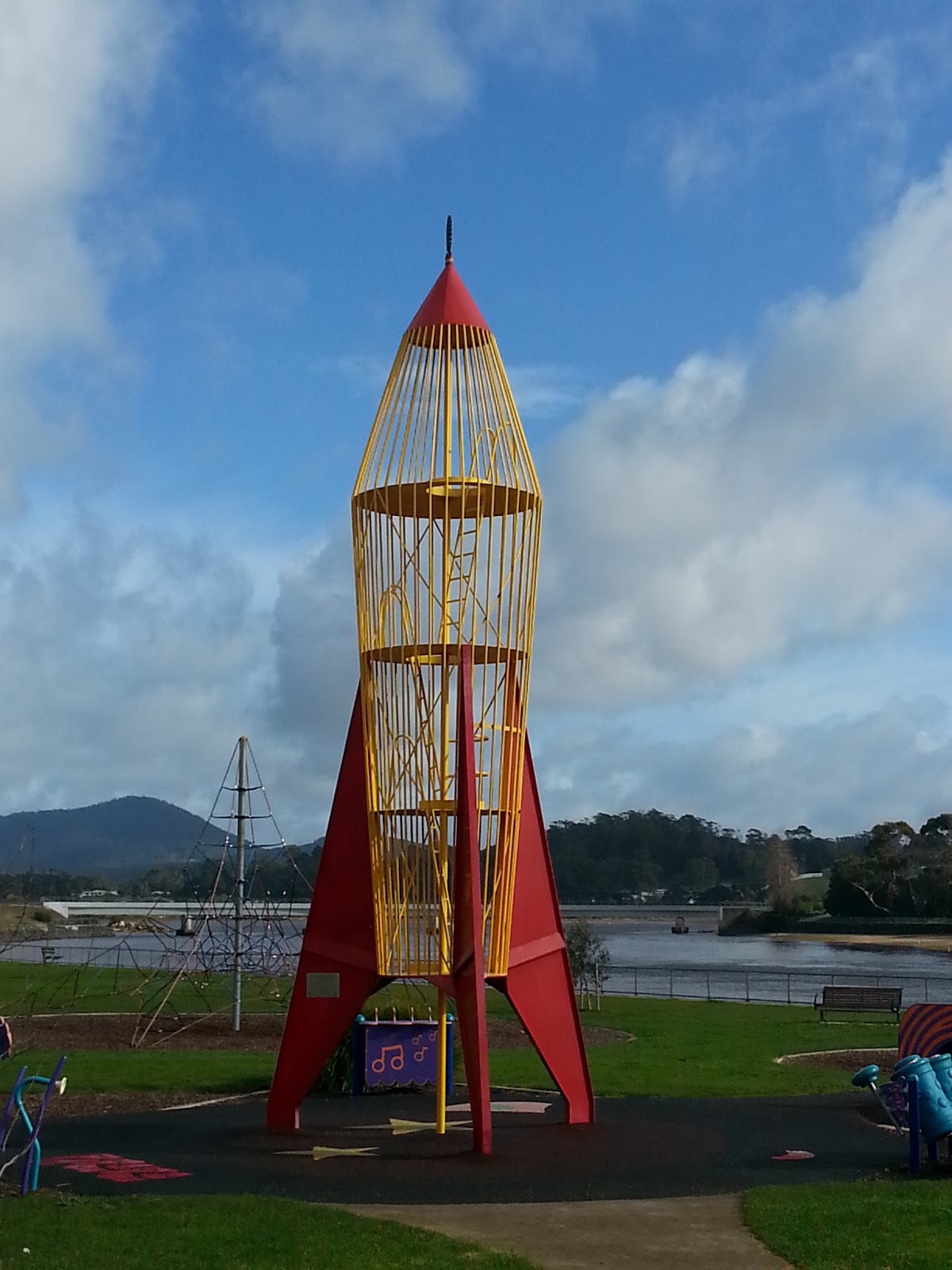
It is ironic, then, that playground rockets were static. They did not move or ever take off, although they could be slid down and climbed. As one playground designer commented, 'The Rocket Ship in reality has very limited play value. It is basically a climber to a slide' (Hendy 2008). It seems one aspect of the rocket’s appeal was the height – surely the highest ascent available to a child in the playground (Hendy 2008), and by reasons of scale, appearing so much higher than to an adult. Perhaps this is also the appeal of climbing trees.

The Rocket Park in Ulverstone, Tas.
(Author's image)
Nevertheless, the rocket remained stubbornly popular. Only one thing can explain why, perhaps, rockets stood as space age monuments in the imagination of the child, and that is their intersection with what was actually happening in the real world of space exploration, accessible to children through other toys, children’s books, television and news.

Children’s literature of the 19th and early 20th century contained many accounts of bodies in microgravity eg in the wonderful Dr Dolittle in the Moon (Lofting 1929), and The Light Princess (MacDonald 1964). C.J. Dennis even imagined the first Australian in orbit, a schoolboy called Neville who was whisked around the Earth by a cloud-horse in one night (Dennis 1921, Gorman 2015). In the fantasy playground period from the 1950s to 1970s imagination met reality as first-hand accounts of spaceflight became available.


Note: this is a deleted section from a paper on rocket parks that I am currently writing. I realised that the gravity hypothesis didn't really belong in the main argument. But I still like the theory that I'm proposing here, and so thought I would share it with you.

Note 2 (2018): the published paper is Gorman, A.C. (2018). Gravity's playground: dreams of spaceflight and the rocket park in Australian culture. In Darran Jordan and Rocco Bosco, ed. Defining the Fringe of Contemporary Australian Archaeology. Pyramidiots, Paranoia and the Paranormal. Newcastle upon Tyne: Cambridge Scholars Publishing, pp. 92-107.

References

Apps, BFG 1944 Children’s Playgrounds. Canberra: National Fitness Council
Doule, Ondrej 2014 Ground Control. Space architecture as defined by variable gravity. In Neil Leach (ed) Space architecture: the new frontier in design research, pp 90-95 John Wiley and Sons Ltd
Gorman, A.C. 2015 The first Australian to orbit the Earth. Space Age Archaeology. http://zoharesque.blogspot.com.au/2015/01/the-first-australian-to-orbit-earth.html
Hendy, Terry 2008 Dynamic playground design. In Heights Park Master Plan Playground Task Force Recommendations Presentation. Richardson, Texas.
Lofting, Hugh 1929 [1968] Dr Dolittle in the Moon. Harmondsworth: Penguin
MacDonald, George 1864 [1994] The light princess. In Alison Lurie (ed) The Oxford Book of Modern Fairy Tales. Oxford: Oxford University Press
Maggiolini, Alfo, Anna Persico and Franca Crippa 2007 Gravity Content in Dreams. Dreaming 17(2): 87–97
Nielsen, A. T., Zadra, A. L., Simard, V., Saucier, S., Stenstro, P., Smith, C. 2003 The typical
dreams of Canadian University students. Dreaming 13(4): 211–235.
Ota, Cathy, Clive Erricker and Jane Erricker 1997 The secrets of the playground. Pastoral Care in Education 15(4): 19-24