Showing posts with label space archaeology. Show all posts

Sunday, August 11, 2019

An archaeological perspective on orbital stratigraphy

One of the things I've been thinking about for a while is the the structure of the archaeological record of Earth orbit - all the spacecraft that have been launched over the last 60 years, and their decay products, fragments and molecules of Earth-manufactured materials. Something people ask me occasionally is how you can do archaeology when there is no stratigraphy. In terrestrial archaeology, everything eventually falls to the ground and becomes buried as winds, water and human activities erode higher places and move the sediment to lower places. Generally, the deeper you dig, the older the remains that you find.

This isn't how it works in Earth orbit. Everything's falling, for sure - but a large proportion of stuff never reaches the ground. It's all up there, the new mixed up with the old, the functioning with the defunct, the living with the dead. It's not a mirror of stratigraphy on Earth. The lower something is says nothing about how recent it is.

With one exception - everything in geostationary orbit is younger than 1963, when Syncom 3 became the first satellite to successfully reach this critical orbit, the importance of which for telecommunications had been predicted since the early 20th century. This is just seven years after the first satellite though - not very long. And there's only about 40 satellites left in orbit which date from this period.

Multigravity environments

It's more useful not to think of Earth as the standard, but as a special case in a solar system comprising many different levels of gravity and many different ways of experiencing it. For example, when we talk of microgravity in Earth orbit, it's not really that there is no gravity. The Earth is still there, pulling everything towards it as usual. It's the acceleration of falling towards it that creates the sensation of microgravity. You can experience the same thing in a droptower ride at an amusement part or the zero-gravity 'Vomit Comet'. You don't even have to leave Earth to have different gravity experiences!

The nature of the archaeological record varies according to the gravity you're in. In full Earth gravity, a powerful attractor, things fall. In Earth orbit, things float but can get pulled back to Earth by atmospheric drag. On the Moon, things fall, but more slowly, and less energy is needed to throw them up into orbit. At the five Lagrange points in the Earth-Moon-Sun system, things bounce around. (Indeed, just recently, they have been shown to be massive dust traps).

Lagrange points in the Earth-Moon-Sun system. Image credit: NASA


I prefer to conceptualise the way artefacts respond to variable gravity environments as a dynamical system. This is a visual, mathematical way of representing how objects move over time when certain boundary conditions are set. Objects are the recipients of energy through various sources, and gravity determines how much energy the objects need to move. The dynamical system is a map of places where objects end up as they lose energy - the process of entropy. Effectively, such a map is also an archaeological plan of a site or the surface of an excavation unit. (Now I wonder if we should be regarding our plans as frozen moments in a dynamical system, just one that is generally moving a lot more slowly than orbit. So the critical difference between the two regimes is not speed, but time).

These places are points of stable or unstable equilibrium. When an object falls to the ground, it's in a stable equilibrium place of low energy. To get off the ground, energy has to be added. The energy might come from someone kicking it, or a stream of water which moves it on. The Lagrange points include both stable (L4 and L5) and unstable equilibria (L1, L2 and L3). Unstable equilibrium is like balancing an egg on its pointy end: you can do it, but it's going to fall over pretty quickly. (Also, it helps if the egg is hard-boiled). Using this as a framework, Earth and Earth orbit are not completely different places with different rules, but places within the same system with different amounts of energy.

It also helps to visualise this as an Einsteinian gravity well. The bottoms of the wells are points of low energy and stable equilibrium.
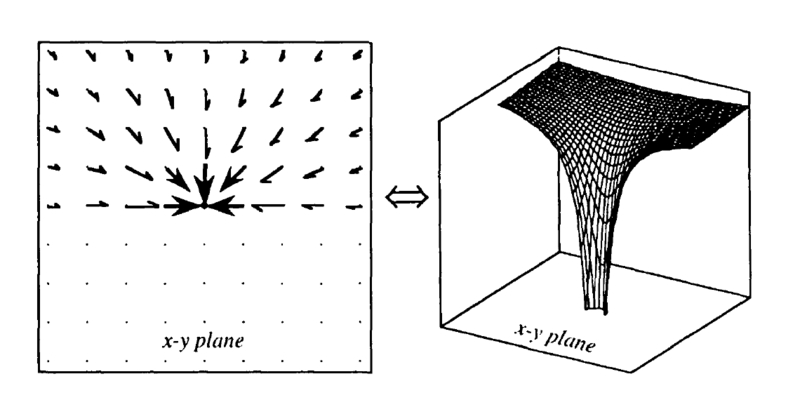
A 2-D slice of a gravitational force vector field (left) is interchangeable with a 3-D gravity well (right), with the z-axis showing energy (potential). Image courtesy of Invent2HelpAll

How junk disperses, or a taphonomy of orbit

In fact, the stratigraphy of space junk does include a terrestrial component. The lowest point of energy in the orbital dynamical system is the surface of Earth: an orbit of zero apogee and perigee. The atmosphere is a barrier or boundary between different gravity regimes, as space objects can bounce off its upper surface, and those that get pulled into it tend to incinerate. However, some spacecraft parts are made of materials like stainless steel and titanium alloys, which have high melting temperatures. Other parts may have carbon-carbon insulation which provides some protection from temperature extremes. Sometimes these components scream at high speed into the atmosphere, with their flesh burning, and fall with a smoking thud to the surface. The so-called 'space balls', titanium pressure vessels, are one of the most common spacecraft parts to survive re-entry. These spheres are the best gravity travellers; they get to come back.

Of course little of the spacecraft is likely to remain in orbit after the main body has re-entered - perhaps some molecules or broken-off bits. When we find the space balls or other Earthbound space junk, it's most likely that this is all that remains of the spacecraft. They've fallen to the point of lowest energy. This includes the spacecraft graveyard at the bottom of the ocean. Earth orbit is bookended by graveyards, if you take into account the graveyard orbit a few hundred kilometres above the geostationary ring. This is where old GEO satellites go to rest in their undead way, as they can still drift down and across the orbits of living satellites.

In general the the structure of space junk is not vertical layers as we're accustomed to in archaeology. Instead, spacecraft decay fragments have an elliptical or cloud geometry. When a spacecraft is whole, all its components are on the one orbital trajectory. Now imagine a solar panel detaching from the main body. Initially, its speed and orbit will be pretty much the same as the main body. But as time passes, the orbits will diverge. If the panel is tracked by one of the Earth-based telescopes, then we will have all the data about it's orbit into the past and will be able to trace it back to the original spacecraft - as long as we keep tracking it.

If a spacecraft explodes, the debris initially forms a cloud around it. The cloud travels together for a little while and then the individual pieces, all with their own weight, size, shape and velocities, start to disperse. If you look at the orbital tracks of Fengyun 1C, the Chinese satellite which was the target of a test missile shot in 2007, the debris rapidly moves apart and starts to spread out as you see here:
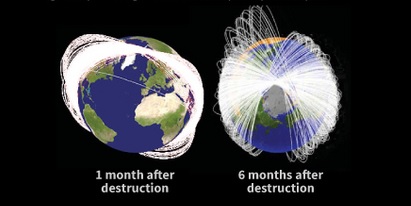
Image result for fengyun 1c
Fengyun 1C debris evolution. Image by Karl Tate @space.com

Position in orbit is described using a set of six equations devised by Johannes Kepler. Usually what people use, however, is Two-Line Elements - a bit like Eastings and Northings. The position is simplified into two strings of numbers. But because of the non-linear unpredictability of orbits, the reliability of the TLEs diminishes pretty fast. After 30 days you can't be sure that the TLE will accurately predict where something is. What this means in practice is that objects have to be continually watched or tracked to know where they are. This is called persistent observation and it's not generally something archaeologists worry about on Earth. However, artefacts on the surface do move around, although very slowly. You can record a concentration of stone artefacts on the surface, but if you revisit the same site a year later, half of them might be missing. Some have worked their way underground; some are covered by vegetation; others have moved under the influence of wind, water, animal movement or land use and industrial activities. Ten years into the future, there may be nothing to see. So perhaps I should apply the principle of persistent observation to terrestrial archaeology after all...

Objects in space are, of course, moving at incredibly high speeds - an average of 7-8 km per second. It's not that objects within archaeological deposits don't move; soils can act as liquids over a long time period, with a gravity-driven convection that gradually makes artefacts rise higher in the profile. Sometimes objects rise to the surface like a fish and get stranded there. Others, like stone tools with narrow sharp edges, slip back in for re-circulation. This is something archaeologists are very interested in as it says something about the integrity of the site and the relationship between objects. We're looking to that relationship to try and work out the human behavioural correlates, so we need to understand how the relationships decay over time due to natural or cultural factors, such as water movement or scavenger activity.

It's the relationship that matters

Both inside Earth and in orbit, the way the relationships between objects within a space evolves over time is critical to working out the human behavioural component. Looking at how the space debris environment evolves, it seems that after a certain amount of time it would be impossible to reconstruct the orbital path and work out what spacecraft a piece of junk came from, if you did not already have tracking records. Let's imagine the scenario of a future human archaeologist after the records have vanished (we can't assume they will survive in their current form) or even an alien archaeologist looking at space debris to get a handle on Earth culture. They will initially use materials and style to identify which space objects belong in the same time frame or to the same culture. They'll also have to work out what differences are due to style, and which to function.

Effectively, orbital archaeologists of the future will be 'recapitulating' a period of terrestrial archaeology before there was absolute dating, when similarities in style were used to posit chronological and social relationships. This period of investigation is known as culture history, and it worked on a number of premises. The first was the definition of culture, which as V. Gordon Childe phrased it, was a consistently occurring suite of artefact types, features and structures that you could attribute to an ethnic group. The second was the assumption that things change over time, coming in and out of fashion. Graphs of the frequency of occurrence of different artefacts types or styles resembled battleship curves, as they were known. Something starts out at a low frequency, then its numbers increase as it becomes popular. Soon the next big thing starts to supersede it and the frequency declines until no-one makes or uses the object any more. This is pretty much what happens in the fashion industry. Using changing frequencies to date an object is called seriation.

Because atmospheric drag pulls objects out of Low Earth Orbit all the time, things that survive there will be those with the greatest numbers, eg rocket bodies. This makes it a matter of sampling. Future archaeologists may not find the rare satellites as easily as the common ones. It's like the famous section in Kent G. Flannery's The Early Mesoamerican Village, a classic of the 1960s-1970s movement known as the New Archeology. A Real Mesoamerican Archaeologist laughs about another's failure to find the city of Teotihuacan using a particular sampling strategy. The Skeptical Graduate Student explains that this is not the purpose of a sampling strategy - and that the sample should produce results in proportion to what exists in the entire population of artefacts.

In another post I'll consider whether we can apply absolute dating techniques to space junk in orbit.


Topological stratigraphy

Terrestrial stratigraphy is locally linear and Euclidean, but orbits are non-linear and non-Euclidean. At larger scales, space is better described as the topological object called a manifold. Stratigraphy might simply be the wrong concept to describe the structure of orbiting objects. What kind of word would we use instead? Perhaps gravigraphy - written in gravity? Or orbitography, which is 'the determination and positioning of satellite orbits by a form of geodesy'?

Visualisations of space junk show Earth surrounded by white dots, like a cloud of silent bees. If you took Earth out of the middle, you would have a donut shape or torus where geostationary satellites are concentrated, and perhaps a series of intersecting tori for low to medium Earth orbit satellites. This is in stark contrast to terrestrial stratigraphy, which is conceptualised in a box-shape (even though Earth is spherical). Objects in this gravitationally-constrained tori move on elliptical paths inside the shape.

Let's put Earth back in. If we sliced a wedge vertically through through this cloud or swam, and froze the objects within it, what would we see? At the outer edge, the graveyard orbit, there'd be a thin smattering of defunct satellites. They are all dead. Below it, in the GEO range, there is thick ring of living and dead satellites. The 'type fossil' of this layer is the winged bird.

Then there is a sparse background scatter of satellites and junk until we hit the navigation satellites in the Medium Earth Orbit range. The US GPS network orbit at around 20, 000 km.

In LEO, we get the highest density of rocket bodies as well as satellites. There is a more diverse size range, from ENVISAT, the International Space Station, to cubesats and nanosats. There is the sparsest smattering of organic material.

There's a dead zone from LEO to the height of the tallest building or structure on Earth. Birds and aeroplanes fly at different altitudes, but they don't stay there or live there. There are gases, clouds, dusts.

On the surface of Earth, the ancient is mixed up with the modern. I suppose it is more like orbit than we might think, the living and the dead jostling side by side. Organic material is dense. Movement is slow. The deeper you go under the surface, the older things become. In this subterranean sphere, everything human is dead.

In all of these layers, the past and the present are mixed up to different degrees. The closer to the present you get, the higher and deeper human culture goes. Mines and building foundations cut into the dead deep past and overlay it with modern material. This is the variable borderland between the Pleistocene, Holocene and Anthropocene, a diachronous boundary that archaeologist Matt Edgeworth and his co-authors (2015) have discussed in an insightful paper (see below).

What is a place in orbit?

I'm relatedly curious about the concepts of setting or site in the orbital environment. Here, a 'place' is really a set of equations that defines the way an object moves - not just now but in the past and into the future. Place is a prediction, effectively. Place is movement, not stasis.

Could an orbital pathway, in and of itself, have heritage significance? Could it be 'preserved', and what would be the relationship between a culturally significant trajectory and the equations that define it? Could those equations, in and of themselves, also be considered culturally or archaeologically significant?

Perhaps in the future, there will be markers along the orbits of significant spacecraft that are not longer there, alerting anyone/thing who approaches that they are at a heritage orbit. Perhaps certain orbits - like Vanguard 1's - could be registered as significant so that nobody can launch something into the same orbit. An orbit has economic significance - so why not heritage significance too?

I think I have a lot further to go in this line of thinking. But it's a start anyway.


References

Matt Edgeworth, Dan deB Richter, Colin Waters, Peter Haff, Cath Neal, and Simon James Price 2015 Diachronous beginnings of the Anthropocene: the lower bounding surface of anthropogenic deposits.  The Anthropocene Review 2(1):33-58

Flannery, Kent G. (ed) 1976 The Early Mesoamerican Village. Academic Press


Friday, May 17, 2019

Key works in lunar cultural heritage: the essential reading list for Apollo 11's 50th anniversary

If you are interested in the issues around managing the cultural heritage values of archaeological sites located on the Moon, these are the key works that you need to read. A bibliography of the broader field of space archaeology and heritage can be found here.


Capelotti, P.J. 2010 The human archaeology of space: lunar, planetary and interstellar relics of exploration. Jefferson NC: McFarland and Company Inc

Capelotti, P.J. 2009 The culture of Apollo: a catalogue of manned exploration of the moon. In Ann Darrin and Beth O'Leary (eds) The Handbook of Space Engineering, Archaeology and Heritage pp 421-441 Boca Raton: CRC Press

Darrin, Ann and Beth O'Leary (eds) 2009 The Handbook of Space Engineering, Archaeology and Heritage. Boca Raton: CRC Press

Donaldson, Milford Wayne 2015 The preservation of California's military Cold War and space exploration era resources. In B.L. O'Leary and P.J. Capelotti (eds), Archaeology and Heritage of the Human Movement into Space, pp. 91-110. Heidelberg: Springer.

Fewer, Greg 2002 Towards an LSMR and MSMR (Lunar and Martian Sites and Monuments Records): Recording the planetary spacecraft landing sites as archaeological monuments of the future. In Miles Russell (ed) Digging Holes in Popular Culture. Archaeology and Science Fiction, pp 112-172 Oxford: Oxbow Books

Gibson, R. 2001 Lunar archaeology: the application of federal historic preservation law to the site where humans first set foot upon the Moon. Unpublished Masters thesis, Department of Anthropology, New Mexico State University, Las Cruces

Gold, R. 2009 Spacecraft and objects left on planetary surfaces. In Ann Darrin and Beth O'Leary (eds) The Handbook of Space Engineering, Archaeology and Heritage, pp 399-419 Boca Raton: CRC Press

Gorman, A.C. and Beth Laura O'Leary 2013 The archaeology of space exploration. In Paul Graves-Brown, Rodney Harrison and Angela Piccini (eds) The Oxford Handbook of the Archaeology of the Contemporary World, pp 409-424. Oxford: Oxford University Press

Gorman, A.C 2019 Dr Space Junk vs the Universe: Archaeology and the Future. Sydney: New South Books

Gorman, A.C. 2016 Culture on the Moon: bodies in time and space. Archaeologies, 12(1) pp. 110-128.

Gorman, A. 2014 The Anthropocene in the Solar System. Journal of Contemporary Archaeology, 1(1) pp. 89-93.

Gorman, A.C. 2013 Look, but don’t touch: US law and the protection of lunar heritage. The Conversation, https://theconversation.com/look-but-dont-touch-us-law-and-the-protection-of-lunar-heritage-20758

Hertzfeld, Henry R. and Scott N. Pace 2013 International Cooperation on Human Lunar Heritage. Science, 29 November, 342(6162): 1049-1050

Lunar Legacy Project, New Mexico State University. http://spacegrant.nmsu.edu/lunarlegacies

NASA 2011 NASA’s Recommendations to Space-Faring Entities: How to Protect and Preserve the Historic and Scientific Value of US Government Artefacts. Human Exploration and Operations Mission Directorate, Strategic Analysis and Integration Division, NASA https://www.nasa.gov/directorates/heo/library/reports/lunar-artifacts.html

O'Leary, B.L. and P.J. Capelotti (eds) 2015 Archaeology and Heritage of the Human Movement into Space. Heidelberg: Springer.

O’Leary, B.L., Bliss, S., Debry, R., Gibson, R., Punke, M., Sam, D., Slocum, R., Vela, J., Versluis, J. and Westwood, L. 2010 The artifacts and structures at Tranquility Base nomination to New Mexico state register of cultural properties. Accepted by unanimous vote by the New Mexico Cultural Properties Review Committee on 10 April 2010

O'Leary, Beth Laura 2015 'To boldly go where no man [sic] has gone before': approaches in space archaeology and heritage. In B.L. O'Leary and P.J. Capelotti (eds) Archaeology and Heritage of the Human Movement into Space, pp 1-12 Heidelberg: Springer.

O'Leary, B.L. 2009 One giant leap: preserving cultural resources on the moon. In Ann Darrin and Beth O'Leary (eds) The Handbook of Space Engineering, Archaeology and Heritage pp 757-780.Boca Raton: CRC Press

O'Leary, B.L. 2009 Evolution of space archaeology and heritage. In Ann Darrin and Beth O'Leary (eds) The Handbook of Space Engineering, Archaeology and Heritage pp 29-47 Boca Raton: CRC Press

O'Leary, B.L. 2009 Historic preservation at the edge: archaeology on the moon, in space and on other celestial bodies. Historic Environment 22(1): 13-18

Reynolds, Joseph 2015 Legal Implications of protecting historic sites in space. In B.L. O'Leary and P.J. Capelotti (eds), Archaeology and Heritage of the Human Movement into Space, pp. 111-129. Heidelberg: Springer.

Rogers, T.F. 2004 Safeguarding Tranquillity Base: why the Earth's Moon base should become a World Heritage Site. Space Policy 20(1): 5-6

Spennemann, Dirk HR and Guy Murphy 2011 [2020] Returning to the Moon Heritage issues raised by the Google Lunar X Prize. Institute for Land, Water and Society Report nº 137. Albury, NSW: Institute for Land, Water and Society, Charles Sturt University.

Spennemann, Dirk H.R. 2006 Out of this world: issues of managing tourism and humanity's heritage on the Moon. International Journal of Heritage Studies 12(4):356-371

Spennemann, D.H.R. 2007 Extreme cultural tourism from Antarctica to the Moon. Annals of Tourism Research 34(4):898-918

Spennemann, D.H. R. 2004 The ethics of treading on Neil Armstrong's footsteps. Space Policy 20(4): 279-290

Walsh, J. 2012 Protection of humanity's cultural and historic heritage in space. Space Policy 28(4):234-243 

Westwood, Lisa D 2015 Historic preservation on the fringe: a human lunar exploration heritage cultural landscape. In B.L. O'Leary and P.J. Capelotti (eds), Archaeology and Heritage of the Human Movement into Space, pp. 131-155. Heidelberg: Springer.

Westwood, L. and B. O'Leary 2012 The archaeology of Tranquility Base. Space Times Magazine 4(51)

Westwood, L., Beth Laura O'Leary and Milford Wayne Donaldson  2017 The Final Mission: Preserving NASA's Apollo Sites. Gainesville: University Press of Florida

Westwood, L., G. Gibson, B. O’Leary, and J. Versluis 2010 Nomination of the Objects associated with Tranquility Base to the California State Historical Resources Commission. Accepted by unanimous vote to the California State Register of Historical Resources on 30 January 2010


Saturday, May 04, 2019

All artefacts are anthropomorphic

I was reflecting on the phenomenon of anthropomorphising space technology.

Two social media-mediated incidents are central to my personal experience with this. From my early days on Twitter, I've followed Voyager 2. The account was not an official NASA account: it was run by scientist Dr Paul Filmer. During the now-forgotten US government shutdown in 2013, NASA closed it down. He was allowed to continue tweeting as the spacecraft, but using a different handle - @NSFVoyager2.

I found the impact of this quite informative. I woke up one morning to find people messaging me, wondering why Voyager 2 was silent on Twitter. We figured it had something to do with a recent tweet in which the spacecraft expressed a - very mild - opinion. We tried to reach Paul. I cried. I felt that I was cut off from the solar system, closed in like a fish caught in the ocean and transferred to a glass bowl on a table in the vestibule.

The second is the Rosetta/Philae mission to Comet 67P Churyumov-Gerasimenko. The European Space Agency's public outreach campaign was designed to get people emotionally invested, and it sure as heck worked on me. In 2016 the equipment used by the Rosetta orbiter to communicate with the Philae lander was turned off. As I've written here, knowing that Philae could no longer speak and be heard made me quite emotional, as if a friend had died.

Some are critical about this anthropomorphisation. They would say it's wrong to attribute our agency to things instead of letting them have their own, almost an oppression of things. 

Musing on my bus ride in this morning, it struck me that all artefacts are anthropomorphic, if only because they are made, shaped, used and discarded by humans. They're a non-flesh shadow, the reverse of our obverse, the mirror of our discontent. If they were not, how could we possibly use them to speak to us about absent humans?


Saturday, June 24, 2017

'Ah, that was a beautiful piece of engineering and archaeology!'. Cordwainer Smith's IOM rocket.

I'm always fascinated by how science fiction writers portray archaeology.  A couple of weeks ago, I was wandering through the Adelaide Central Markets on my way to work, and I spied a second-hand book sale. There was a box of old science fiction, and one leapt out at me: Cordwainer Smith's Space Lords, which I did not have.

To my delight, this volume of short stories contained one that I'd never read either. Drunkboat is the story of how the Lord Crudelta precipitated the discovery of Space3. I knew of the story as some critics have discussed it in reference to the evolution of the Vomact family. 

Leaving the plot aside, here is how Cordwainer Smith imagines a kind of space archaeology:
We had put him in a rocket of the most ancient style. We also wrote writing on the outside of it, just the way the Ancients did when they first ventured into space. Ah, that was a beautiful piece of engineering and archeology! We copied everything right down to the correct models of fifteen thousand years ago, when the Paroskii and Murkins were racing each other into space. The rocket was white, with a red and white gantry beside it. The letters IOM were on the rocket, not that the words mattered.

IOM, of course, stands for the Instrumentality of Mankind. The national symbols that adorned spacecraft in the 20th and 21st centuries are mystifying to the denizens of the future, but they copy them anyway.

Fifteen thousand years on from the Cold War space race - I assume the Paroskii and the Murkins are meant to represent the USSR and the USA - there's sufficient documentation and models of the early rockets to replicate them. The IOM rocket is thus a facsimile of old technology. If we think about what was happening 15 000 years ago for us, one of the principle technologies was the manufacture of stone tools. So perhaps this was like something archaeologists might do today in replicating a Magdalenian retouched point.

Magdalenian flaked stone artefacts, from Debout et al 2012
http://www.sciencedirect.com/science/article/pii/S1040618212003436
Such technology is often called 'primitive' in popular accounts, but it was very far from that, requiring a highly sophisticated knowledge of geology and engineering too - understanding the mechanical, chemical and fracture properties of stone are essential to making stone tools. Learning how to actually make and use ancient technologies is sometimes called ethnoarchaeology, and the idea is that you can learn something about how people lived in the past that simply analysing the artefact as an object cannot reveal.

Similarly, the facsimile of the rocket demands both engineering and archaeology to make it more than just another model. The rocket is launched from its red and white gantry - cheerful picnic colours - and if you want to know the rest, you will have to read the story.


Saturday, June 03, 2017

Cable ties in literature: from the boudoir to the post-apocalyptic

It's no secret that I have an obsession with cable ties. The nice thing is that when I explain their fascinating history to people, they often catch the bug as well, coming to appreciate the stunningly simple design of this monumentally successful piece of technology. If you want to know the full story, you can read my paper on cable ties here.

Anastasia Steel and Christian Grey in the cable tie section of the
hardware store. I mean seriously. What a depauperate population
of the popular plastic fastening device.
Sadly, cable ties have not yet set the world of literature alight, unless you count their famous appearance in Fifty Shades of Grey. I would say that E.L James paid insufficient attention to cable ties as critical material infrastructure in her novel; and the range of cable ties available in the hardware shop in the film version is frankly disappointing.


Hugh Howey's Wool is a different proposition. I was lent this book by a friend and was astonished that I hadn't heard of it before. It was immediately enthralling, and there really is nothing nicer than finding a new author whose work just makes you want to read more.

So you can perhaps imagine my breathless excitement when I started Chapter 21 of Wool to find a description of CABLE TIES OF THE FUTURE.

Oh yes.

So here, for your delectation, is the passage in question. I don't think there are any spoilers in it if you haven't read the book.

The next morning Juliette arrived early at her desk having stolen little more than four hours of sleep. Beside her computer, she saw a package waiting for her: a small bundle wrapped in recycled pulp paper and encircled with white electrical ties. She smiled at this last touch and reached into her overalls for her multi-tool. Pulling out the smallest pick from the tool, she stuck it into the clasp of one of the electrical ties and slowly pulled the ratcheting device apart, keeping it intact for future use. She remembered the trouble she'd gotten into as a mechanic's shadow the day she'd been caught cutting a plastic tie from an electrical board. Walker, already an old crank those decades ago, had yelled at her for the waste and then shown her how to tease the little clasp loose to preserve the tie for later use. 
Years had passed, and when she was much older, she had found herself passing this lesson on to another shadow named Scottie. He had been a young lad at the time, but she had had a go at him when he had made the same careless mistake she once had. ... 
She loosened the other tie crossing the package and knew the bundle was from him. Several years ago, Scottie had been recruited by IT and had moved up to the thirties. He had become 'too smart for Mechanical', as Knox had put it. Juliette set the two electrical straps aside and pictured the young man preparing this package for her. The request she'd wired down to Mechanical the night before must've bounced back up to him, and he had spent the night dutifully doing her this favour. 
She pried the paper apart carefully. Both it and the plastic ties would need to be returned; they were both too dear for her to keep and light enough to porter on the cheap. As the package came apart, she noticed that Scottie had crimped the edges and had folded these tabs under each other, a trick children learned so they could wrap notes without the expense of glue or tape.

Scottie leaves her a note: Keep the ties - I got plenty. 

Where do I start? There is so much going on here, and although I believe there are some technical unlikelihoods, on the whole Howey has paid the cable tie much greater respect as an artefact than E.L James.

At this point I must digress. I searched for a link to Wool to include and discovered something that astonished me. Another reviewer HAS ALREADY COMPARED WOOL TO FIFTY SHADES OF GREY.

What.

Science fiction's answer to Fifty Shades of Grey, the review in the Guardian says. Perhaps I missed the BDSM scenes in Wool. I'm pretty sure I did. And I may be wrong, but I'm also pretty sure that few reviewers take the cable tie approach to literature. Well there's nothing for it but to read this other review.

Ah, now I read that the comparison is made on the basis that both works were initially self-published. There is no mention of cable ties. So I shall continue.

Juliette's cable ties are described as 'white electrical'. This is the industrial context in which cable ties were first invented, when Maurus C. Logan visited the Boeing factory in 1956 and watched the workers tying up the electrical wiring in an aircraft. He was employed by US electrical outfitters Thomas and Betts. Since their first manufacture, cable ties migrated into everyday life and a myriad of uses securing every kind of thing. Here, in the isolated culture of the silo, sealed off against the toxic world outside, cable ties have retreated to their original use.


Colour is significant in cable tie manufacture. Black cable ties are generally intended for outdoor use; their carbon content makes them UV resistant. In the silo, the cable ties are white. They will never be used outside, as no-one can survive outside in the poisoned atmosphere. They're like little pale fishes trapped in an underground pool.

There are two types of cable ties, those which have to be cut off and can't be re-used, and re-usable ones, which need to be undone with a special tool. It's not entirely clear from Howey's account which is intended here. If you loosen the ratchet head, will it really be useable again as it won't engage with the ridged tail? Juliette doesn't seem to be using a specialised tool, just the smallest one from her panoply.

This is a minor point against the real implications of the passage however: that in the closed world of the silo, an artefact that was once mass-produced and discarded without thought is now precious and valuable.

The cable ties are symbolic here as well: Scottie is using them as a material allusion to the history that he and Juliette share, knowing that they will make her recall the past. They symbolise the passing on of knowledge: the creation of new bonds - as well as their dissolution. They are used to secure the parcel, but they are part of the gift as well.

Fastening is an art when materials to secure objects are in short supply. The parcel is a contradiction of meanings. Scottie has used the valuable cable ties to hold it all together, but in the first layer he has employed the technique learned from childhood to fold the paper together. Here we see a discipline of alternatives in an alternative world.

I particularly appreciate the thought that has gone into this passage, projecting a social and technological context for an artefact of the present into the future. It's what science fiction does best.

So my Cable Ties in Literature Award today goes to Hugh Howey for Wool. It is perhaps not quite on the level of other literary awards, given the small pool of nominees. Nevertheless, I regard it as an achievement. Congratulations, Hugh.


Sunday, February 12, 2017

Surveyor 3 - the only multi-occupation site on the Moon

I've been looking at the amazing pictures of astronaut Alan Bean visiting the Surveyor 3 robotic lunar landing craft to remove a camera for return to Earth, in 1969. Something so obvious suddenly struck me and I wondered why I had not seen it before.

Surveyor 3 was part of a series of landing missions that left seven craft on the surface of the Moon. In November 1969, Apollo 12 landed on the edge of a crater, just 180 m from Surveyor 3, launched two years before. The two astronauts, Pete Conrad and Alan Bean, walked over the Surveyor 3 and removed a camera and a couple of other pieces for analysis. (This analysis showed evidence of 'scouring' on the Surveyor surfaces, a result of dust stirred up by the Apollo 12 landing).

Image courtesy of NASA
All of the Apollo sites are of a particular type: there's a landing module, numerous places where samples were taken, cameras and flags set up, the 'toss zone' of discarded objects, the odd rover, and countless astronaut bootprints. 

Surveyor 3 is the only lunar site with astronaut footprints that was not a human landing mission. So you have an interesting mismatch of archaeological traces - a spacecraft which is not capable of containing human bodies, nor of moving, yet surrounded with the evidence of human movement.

You could argue that Surveyor 3 and Apollo are now part of the same site as they preserve evidence of interaction between the two locations. They're close in both time and space.

It's like a rockshelter with archaeological deposit, with only sparse evidence of occupation - some stone tools and a hearth - at 18 000 years before present (bp), followed 10 000 years later by a denser layer of stone tools, bones, and hearths. Imagine this time frame telescoped with the acceleration of modern technology and spread flat across the landscape instead of stratified.

In archaeology, it's not unusual to find evidence of people incorporating artefact and places from the past into their lives. Stone tools from older campsites are re-used and sharpened, sometimes thousands of years later; masonry is scavenged from old buildings to be incorporated into newer ones. This is a practice known as spolia

This isn't exactly re-use; it's more in the nature of a scientific sample. Still, it illustrates something about how artefacts often move between space and Earth and end up out of context.

So, unlike all other lunar landing sites at the present time, the Surveyor 3 site is the only one which is the result of multiple visits. It's a rare human-robot encounter on a far world, receding further into the past with each passing year.

And incidentally, 2017 is Surveyor 3's 50th anniversary. 


Friday, November 25, 2016

A map of all the space junk that has re-entered over Australia

Today someone wrote to me to ask for help in identifying a piece of space junk which had been found in Queensland some years ago. Dr Space Junk is always happy to help, so I sent off a brief explanation.

This made me think, though, of how interesting it would be to map the location of all known re-entry events. There'd be a whole bunch of Skylab in Western Australia, some material from the Europa launches from Woomera in the 1960s in the Northern Territory and Queensland, and many pressure vessels used in rocket fuel systems - globally, these are the most common component to survive re-entry as they're usually made from titanium, stainless steel and/or carbon-carbon. Because of Australia's location, many rocket bodies fall back to Earth over our landmass. We're well situated for observing and tracking the LEOP (Launch and Early Orbit) phase of launch so it makes sense that the second and third stages are likely to re-enter in our vicinity.

You could compare the distribution of this junk with the meteorite entries being mapped by the Western Australian Fireballs in the Sky project, which asks citizen observers to send in data whenever they see some flaming object heading towards Earth. And of course there's also the tektite strewn fields.

I might just expand it to include anything that falls from the sky, as it's likely there's stuff that my Friday-arvo brain has forgotten about at the moment. The more I think about it, the more I think this could be an extremely interesting map to create and I wonder why I've not thought of it before. Such a deliciously simple idea that could lead to - well I don't really know just yet, but it's sure to be something!


Sunday, October 11, 2015

Satellites are little knots of materiality in an invisible electromagnetic tapestry

Satellites go beyond the limits of human bodies to be our senses in the void. They are conduits of information in the form of signals in different wavelengths, mediated and managed by the hardware of transponders, antennas, modulators, processors, and data storage facilities. Without communication, they have no function, whether this is gathering data from the solar system or deep space to send back to earth, or transmitting terrestrial telephone and television around the planet. These signals are the real purpose of the hardware. Satellites are little knots of materiality in an invisible electromagnetic tapestry.

In the nearly 60 years since launch of Sputnik 1, the rara avis has become a veritable flock. There are over 23 000 tracked objects over 10 cm, and over 100 million particles less than a centimetre in size currently located between Low Earth Orbit and the so-called ‘graveyard orbit’, approximately 36 000 km above the surface of the Earth. A mere 6% of these objects are operational spacecraft. Their chronological range is from 1958 (Vanguard 1, the oldest surviving spacecraft, with its upper launch stage and a loose clamp) until the present time. In weight, the accumulated debris is estimated to be 6000 tons. But I argue that this ‘space junk’ represents far more than just a risk or hazard to operating spacecraft and satellites, as it is regarded by space industry, or an all-too-familiar pollution problem: it is the repository of human ideologies and values – capitalist, communist, mercantile, colonial, gendered, scientific, environmental and cosmological.  As junk, it is the proper study of archaeologists, who excavate through what is discarded in the garbage heaps of history, to find the significance in what people consider to be without value.


(This is a passage I removed from a recently submitted paper, but I quite like it despite that)


Saturday, September 12, 2015

The archaeology of not-quite-there: Pluto and the human gaze

why did you glance back?
why did you hesitate for that moment?
why did you bend your face
caught with the flame of the upper earth
above my face?

HD, Eurydice


In 2006, a spacecraft the size of an industrial fridge was launched on a remarkable mission: to zoom past the ninth planet in our solar system and show us its face for the first time. The New Horizons mission to Pluto caught the imagination of the world for a couple of epic weeks in July 2015. But as the spacecraft continues its journey beyond the formerly elusive and controversial planet and on to the Kuiper Belt, I’ve been thinking about what this means from an archaeological perspective.

This mission has turned Pluto from a fuzzy disc of reflected light into a place that we can see and read with our own signs and meanings. Already, there’s such a wide range of interpretations. Some are geological – craters, valleys, mountains. Others are geometric: rectangles, lines, circles, shapes, smoothness, spikiness. Then we have the zoomorphs: a whale’s tail, the head of a cartoon dog. Perhaps the most charming is that which sees the large icefields, now unofficially called Tombaugh Regio, as a heart.
Image from http://www.universetoday.com/121436/youthful-frozen-plains-cover-plutos-big-heart-spectacular-new-images-from-new-horizons/
We could also look at Pluto from a heritage/landscape perspective. Using the World Heritage Convention’s definitions of cultural landscapes, you could argue that that it is an associative landscape – with no actual physical human traces, it is still the repository of beliefs, dreams, visions and ideas. Some of these relate to its location so far from the light of the Sun. It’s said that midday on Pluto is as bright as Earth after sunset. It is a cold, dim planet, like a deep sea fish that lives and swims in darkness all its life. Since it was given the name of the ancient Roman god of the underworld, the International Astronomical Union has decreed that all place names on it will relate to this theme (which includes exploration). So already we have a set of metaphors and associations that shape the planet in our minds.

what was it that crossed my face
with the light from yours
and your glance?
what was it you saw in my face?
the light of your own face,
the fire of your own presence

HD, Eurydice

Our gaze creates Pluto as a place. I’ve written before about how the process of identifying distinct features and naming them creates a map of values. Assigning names to features on Pluto is a colonial process of mastery that draws the dwarf planet into a web of geopolitics. Despite the efforts of the International Astronomical Union to diversify the cultures represented in named things across the solar system, there is still a long way to go.

When telemetry showed that New Horizons had successfully completed its flyby, many in the mission control room waved American flags. Nationalism and national prestige are still among the main drivers of today’s space industry, despite the growth of private and crowd-funded space enterprises. As I watched the flag-waving, I thought that, for some people at least, the passage of a piece of space hardware has been the equivalent of planting a flag – as it was on the Moon – to stamp the outer solar system  as part of an American colonial landscape. And indeed, one of the ‘cultural artefacts’ on board the spacecraft was also a US flag, in stark contrast to the universal symbols on the Pioneer and Voyager spacecraft.

Against this is the discourse of space exploration as a global human endeavour which everyone shares, the undeniable excitement generated in social and traditional media across nations and age groups, and NASA’s always brilliant open access, with all materials available to anyone with an internet connection. Possibly more people than ever before have waited with bated breath for the unique experience of gazing on the face of another planet for the first time, like a distant relative they’d longed to meet.

what had my face to offer
but reflex of the earth,
hyacinth colour
caught from the raw fissure in the rock
where the light struck

HD, Eurydice

Pluto is a ‘natural’ object that existed for billennia (is that a word?) before there were sentient beings to observe it. But since its existence was first hypothesised in the 19th century, it has become a cultural artefact too. Like an archaeological excavation, the cameras of New Horizons excavated it from obscurity in the darkness of the night sky and brought it into the light. Space scientists and the public speculated about this strange new artefact: what was it made of? How had its surface markings been created? Its composition, history and appearance were compared to other planets and moons to gauge its character and hence the genesis of the landscapes captured by the LORRI camera. Deep time was being decoded from a surface of mountains, ice plains and craters: four dimensions being raised up from two.

The images, received as radio signals, converted and processed into pictures that we can view and understand, are a type of heritage or archaeological object in themselves. In one sense they are ephemeral, composed of numbers inside computers. In another sense, their endless duplication and proliferation gives them a digital resilience. Pluto, in our homes and at work, is a place we see and visit through a flat screen, almost as if we are inside our own spacecraft.

When we turn off the device, does Pluto still exist?

Pluto map by Snowfall-the-Cat
http://snowfall-the-cat.deviantart.com/art/Pluto-Map-Sept-10-2015-546286799

If you had let me wait
I had grown from listlessness
into peace
if you had let me rest with the dead
I had forgot you and the past

HD, Eurydice

New Horizons only came within 12 000 km of the planet’s surface. No human trace has been left there as a footprint of the Anthropocene. For a fleeting moment, New Horizons was part of the Pluto-Charon system. Perhaps a few molecules of material are left behind in a tenuous wake within the orbit. Now that the spacecraft has passed, there is nothing to indicate that it was ever there, save for the images, words and memories of people closer to the Sun.

I’m thinking about this ‘nearly there-ness’ of human interaction. Many planets in the solar system have only ever been ‘flown past’:  Saturn, Neptune, Uranus, and until the Messenger spacecraft crashed into the surface in April 2015, Mercury too. Similarly, there are places on Earth, like the deep sea, that we know only from remote sensing, probes, and flyovers. There are also places we could visit, but haven’t yet, like World Heritage sites. We feel it’s important that they exist, even if we haven’t had any personal encounter with them, and many people feel strongly about protecting such places.

This is what characterises space archaeology too, at least at the present time. It’s all an archaeology of ‘not-quite-there’, where we use historical and proxy data in order to make hypotheses about what lies beyond our reach in space.

Can there be an archaeology of the ‘not-quite-there’? How do you analyse something you can’t touch? It doesn’t bother planetary scientists: few of them will ever have anything other than data acquired from remote sensing. But as Matt Edgeworth has pointed out, archaeology is made of human dimensions. We dig using our bodies: the artefacts we scrutinise are made to fit in our hands, accommodate similar-sized human and animal bodies. This is partially why the pyramids, and other such wonders of the ancient world, seem so extraordinary and even, to some, alien. Their scale seems to defy the human capacity. In the modern industrial world, there are many such structures: bridges, buildings, mines, rockets, giant offshore gas rigs. Of these objects, Edgeworth (2010:140) notes that 'The sheer scale...is such that it is impossible to fully grasp either in a visual or tactile sense - to see all of it at once or to touch more than a tiny part of it'.
John Schofield, an archaeologist, and David Jenkins, a physicist, have written about the vast differences in scale between sub-atomic particles and the deep galaxy maps that almost show the beginnings of time, all coalesced around the CERN research facility on the border of France and Switzerland. This massive complex of buildings and installations, where the highest of high science takes place (such as the confirmation of the existence of the Higgs Boson in 2012) also contains dilapidated chairs and shabby rooms, forgotten corners where an archaeologist finds the empty space redolent of human presence.
Image courtesy of NASA

In a recent conference paper, I mused about the solar-system-scale Matrioshka Brain and how humans might interact with it as ‘natural-born cyborgs’. Something incomprehensibly large and complex, whether ‘natural’ or ‘cultural’, can still be held in our minds when it is what is called transparent technology: we use it intuitively, without thinking, as an extension of ourselves. This is pretty much what smart phones and other devices are for us now. We're not aware of the vast network of infrastructure that supports them, from satellites to the tiny chips inside - we use them as an augmentation of our bodies.
you who have your own light
who are to yourself a presence
who need no presence
HD, Eurydice
So what are we to make of this? At the end of this disquisition, I'm left with the feeling that we're becoming very good at bridging these differences of scale. Spacecraft like New Horizons give us dimensions of both time and space to get our heads around. They present the act of focusing, through the feeble jellies of our eyes, as a temporal act. We draw closer and closer to the planet's surface, like the process of focussing a microscope objective, and when the object precipitates into our field of view, we assess, name, categorise, analyse - and dream. Pluto becomes part of our personal solar system, the full extension of our gaze, and we are one step closer to becoming truly cosmic.
And then we stumble through and past, like Orpheus, and turn our gaze elsewhere.
Note: the full text of HD's extraordinary work Eurydice can be found here.


you who
who are to yo

Sunday, August 02, 2015

How would lunar mining affect the cultural significance of the Moon?

This is an excerpt from my (pre-revision) forthcoming publication Managing cultural heritage values in lunar mining? What are the issues?

Consultation with stakeholders is part of both assessing the social significance of cultural heritage and obtaining a Social Licence to Operate (SLO). Despite the best intentions, however, gaining free, prior and informed consent is frequently overlooked (Bice 2014). How could this be achieved for an entire celestial body, and with meaningful consultation with the ‘local’ community of Earth’s seven billion people? While the UN offers obvious mechanisms through the Committee on the Peaceful Uses of Outer Space (COPUOUS), UNESCO and the  advisory organisation the International Council on Monuments and Sites (ICOMOS), private commercial interests may prefer to undertake their own community engagement.
Lunar surface mining. Image courtesy of NASA
How will people feel if they look at the Moon in the night sky, and know that is being mined underneath their eyes? While diverse publics have been tolerant of scientific missions, commercial ventures may be received very differently. Mining and exploration will have impacts on the lunar environment much greater than the low level created by robotic and scientific missions to date.
While it is probably broadly true to say “humanity as a whole has embraced the historic events and objects associated with space research as part of our jointly held heritage” (Walsh 2012:234), this obscures deeply entrenched divisions between colonial/spacefaring nations and colonised/'developing' nations (Gorman 2005a, Gorman 2009b, Redfield 2005). These divisions have been very evident in the politics around the formation of the Outer Space Treaty (OST), the Moon Agreement even more so, and contribute to the impasse that resource utilisation on the Moon is currently facing (Hoffstadt 1994).
The reaction of, say, an Australian to a US-based profit-making mine in which they have no say or share could easily be negative. A First Nations Australian may have another layer of reaction, based on their experience of alienation from country and destruction of cultural heritage arising from terrestrial resource exploitation. Moreover, an assault on the integrity of a celestial body which belongs to what is commonly called the ‘Dreaming’ – a suite of cultural knowledge in which the past is simultaneously entwined with the creation of law, identity and land in the present – may be a matter of some concern. Aboriginal people are by no means the only First Nation to have such a relationship with the Moon.
Moon Dreaming, by Ronnie Tjampitjinpa, 2007
Ronnie Tjampitjinapa is a Pintupi man from the Western Desert  He was a founding member of the Papunya Tula Artists group. .
Image courtesy of Aboriginal Art Directory
http://gallery.aboriginalartdirectory.com/aboriginal-art/ronnie-tjampitjinpa/moon-dreaming.php
What is considered to be for ‘the benefit and in the interests of all countries’ (OST Article 1, see also Moon Agreement Article 4) depends very much on how regulation unfolds in this next critical period. Again a parallel with terrestrial mining industry may be instructive. Management strategies in SLO frameworks include the concept of ‘offsets’: compensating for impacts at one location through activities at another, either directly or indirectly. A direct offset might be setting aside a protected area of land to compensate for the loss of that impacted by mining. Increasing the value of a heritage place could be considered a direct offset – for example, committing resources to conserving Tranquility Base to compensate for ‘sacrificing’ a Lunar Orbiter impact site. Indirect offsets may include funding research or education around the environmental/heritage resource that will lead to benefits for it. Note though, that offsets are determined during the planning phase, not in retrospect ie they do not compensate for damage already caused.

Lunar mining will take place in an environment where social media are a major part of public engagement with space. Space agencies, private companies, astronauts, missions, and rovers have their own Twitter accounts and there is an expectation of public involvement. Crowd-funded space missions such as Lunar Mission One, a probe designed to drill a deep core in polar regions, is possibly the vanguard of more such projects. The investors in off-world mining companies are likely to be the same people who buy shares in terrestrial mining. The moon’s seeming remoteness will not protect industrial operations from the scrutiny of the public.


References
Bice, Sarah 2014 What Gives You a Social Licence? An Exploration of the Social Licence to Operate in the Australian Mining Industry. Resources 3:62-80
Gorman, A.C. 2009b Beyond the Space Race: the significance of space sites in a new global context. In Angela Piccini and Cornelius Holtorf (eds) Contemporary Archaeologies: Excavating Now, pp 161-180 Bern: Peter Lang
Gorman, A.C. 2005a The cultural landscape of interplanetary space. Journal of Social Archaeology 5(1):85-10
Hoffstadt, Brian 1994 Moving the heavens: lunar mining and the ‘common heritage of mankind’ in the Moon Treaty. UCLA Law Review 42:575-621
Redfield, P. 2005. Space in the Tropics. From Convicts to Rockets in French Guiana. Berkeley:
University of California Press.
Walsh, Justin 2012 Protection of humanitys cultural and historic heritage in space. Space Policy 28:234-243


Sunday, December 14, 2014

Shadows on the Moon: an ephemeral archaeology

A picture of the Apollo 17 astronauts in 1972 got me thinking about shadows on the moon as part of the archaeology of the six human landing sites.

Apollo 17 panorama. Image courtesy of NASA

The peculiar character of light on the Moon of course forms part of the corpus of conspiracy theories claiming the lunar landings were faked. It's argued that the shadows seen in photographs and film footage are caused by the lighting in the studio where actors lumbered about pretending to be in low gravity, rather than the Sun. Or something like that. To be honest, I don't spend a lot of time thinking about the conspiracy theories.

(But I will offer this gem from the sublime Mitchell and Webb).


Shadows on the Moon are, however, of great interest from a completely different perspective. Years ago, I was in the library at the Defence Science and Technology Organisation headquarters here in Adelaide, and found a book that has stuck in my memory. It was a study written for US Congress, in the 1980s, on warfare in space. The chapter on the Moon was all about how lunar conditions would affect hand-to-hand combat. The author, a military expert, noted that many of the properties of lunar light would make a sort of shoot-out situation particularly interesting. For example, if you hid from someone in a shadow on Earth, you would still be visible. Light diffuses through our heavy atmosphere and shadows can be all sorts of colours (vide Goethe: 'colour itself is a degree of darkness').

On the Moon, shadows are as black as Hades. Although reflection from the lunar surface will still illuminate objects in shadow, if you go deep enough into one, for example, under a boulder overhang or in a crater, you can be invisible to observation.

You're also cold. The temperature in shadow drops markedly.

In a battle with human protagonists, terrestrial instincts may lead you far astray.

But let's move on from this gloomy topic and get back to the archaeology.

One thing the astronauts from the Apollo missions brought to the Moon was new shadows, shadows that were cast by machines and bodies and flags and rovers, in an interplay of movement and stillness. The speed of the shadows differed depending on the activity being carried out. Some were solid black and some were textured. They crossed and uncrossed with the angle of the sun and the movement of the astronauts around the tiny landscapes that constituted their lunar experience.

The shadows were captured and frozen in many, many photographs of all Apollo missions; in these photographs, they became a different type of artefact. I would be curious to know if anyone (apart from conspiracy theorists) has analysed the shadows in these images.

Apollo 12 ALSEP instrument package. Image courtesy of NASA

Apollo 14. Note the beautiful transparent shadow of the mesh antenna, like a flattened sea creature. Image courtesy of NASA. 


And then some shadows left, never to return, and other shadows stayed to be swallowed by the lunar night and to emerge into day again. The shadows of the flags, descent modules, rovers, cameras, and other equipment are now cast over the lunar regolith until something causes the object to decay in tens, hundreds or thousands of years. The objects left behind don't move, but their shadows circle them in diurnal devotion, sundials without a mission.

The shadows may, however, be of more than passing interest in considering the taphonomy of lunar sites.  There's some evidence to suggest that dust levitates as the terminator passes over, due to changing electrical potentials. There may be small-scale surface dust movement as shadow boundaries change, creating sub-millimetre electrical fields that cause dust particles to accelerate and collide with each other (NASA 2011). So the dust environment of the objects left on the Moon may be not static, and we don't know what the long-term impacts on material degradation are.

Now, the Lunar Reconnaissance Orbiter uses the shadows to detect the presence of these orphaned items of material culture.

Apollo 15, photographed by the LRO. Image courtesy of NASA.

There's only one way to finish this post: with a quote from Cat Stevens' classic hit Moonshadow:
Did it take long to find me? I asked the faithful light.
Did it take long to find me? And are you gonna stay the night?


References
NASA 2011 NASA’s Recommendations to Space-Faring Entities: How to Protect and Preserve the Historic and Scientific Value of US Government Artefacts. Human Exploration and Operat6ions Mission Directorate, Strategic Analysis and Integration Division, NASA

Note: updated 16/12/2014 to include paragraph on photographs. Updated on 21/1/2015 to include paragraph on dust levitation.