Showing posts with label Bodies in space. Show all posts

Monday, September 03, 2018

Flying dreams and the human relationship to gravity

From time to time, I have flying dreams. Standing on my feet, just a tiny movement will launch me into the air, and I go soaring above the ground with my arms outstretched, as effortlessly as a bird, delighting in the freedom.

When I think about these dreams, they have certain elements in common. It's always sunny with a blue, blue sky - maybe a couple of white fluffy clouds. There is green, even grass below me. The ground is flat or gently undulating at most. There's always a house. Not a familiar house, more like a greeting-card house or a children's book illustration. There are no houses nearby, just the house on a wide green lawn. I fly above the house at a certain height. I can see trees and often there's a Hills Hoist clothesline in the garden. No fences, though. It's much lower than aeroplane height, and the view is always of the immediate environment of the house.

It's a domestic dream, and perhaps a child's dream, when your whole world revolves around the house and the extent of space is a concept you've yet to fully grasp.

When I wake up from a flying dream, I often still feel the lack of gravity. The sensation that I can just will myself into the air and fly stays with me until I put my feet on the ground and realise how heavy I am, and how adhesive gravity is. I feel intense sadness at this moment. Being heavy seems such a burden. After a few steps, the residues of the dream evaporate and I'm fully awake.

Thinking about these dreams has led me to a curious thought. What if they are part of a pre-adaptation to space?

Now it's true that the human body is not well adapted to microgravity, and we know a fair bit about this because of astronauts' experience in Earth-orbiting space stations. Blood pools in the upper body, muscles atrophy, bones lose their calcium and weaken. We probably don't really know enough yet about the long term health affects of living in space either - a year is a long, long time in space, and only a few people have spent that long up there.

Despite this, humans seem to have an urge to defy gravity, whether it's aeroplanes or rockets. This starts very early. Remember how you loved being thrown up in the air and caught when you were a little kid, and how it made you laugh? The thrilling sensation of a centrifuge, when an adult or older child held your hands and swung you around in a circle? And just how much fun swings in the local park were? Even little tiny babies love these things.

Swimming is fun because we can also defy gravity in water, moving in any direction we want with a twist and flap. In the water, our feet are not stuck to the clay of the Earth. There's nothing beneath them and our personal space expands to a sphere rather than a dome. It's just a shame that water exerts a drag that's absent in the air. Also, there are things that can bite you in water.

My desire to fly doesn't mean I'm drawn to sky-diving, or hang gliding, because that's not what this is about. It's about flight being in one's body, not a result of technology.

Having said that, I also have a slightly concerning desire to throw myself off heights just to experience the exhilaration of falling through the air. Maybe this is like Douglas Adams' 'learning to throw yourself at the ground and and miss'. I'm not afraid of heights, just afraid that if there isn't a barrier, the compulsion might become too great to resist. My lack of fear frightens me because I know logically that hitting the hard ground at acceleration is not going to have a good outcome.

I've learnt that this is called the High Place Phenomenon. One person described it thus: 'It was the opposite of vertigo. It was the urge to fly'.

I wonder how old this urge is, and if the much-vaunted 'urge to explore', when applied to space, is really just the echo of a flying dream.

Collage by Pilar Zeta.
http://www.emptykingdom.com/featured/pilar-zeta/


Tuesday, February 13, 2018

Historic images of the Earth from space - how the view from the Tesla Roadster compares.

On February 6th 2018, Elon Musk launched his own personal midnight cherry Tesla Roadster into space on a test Falcon Heavy rocket. The car went sailing away from Earth with a mannequin in a spacesuit, a copy of Isaac Asimov's Foundation series on a disc, a Hitchhiker's Guide the the Galaxy Don't Panic sign, and a plaque engraved with 6000 names of SpaceX employees. There may have been some other things, but finding a reliable source is harder than you'd think.

Now that the dust is starting to settle, I want to think about something else - some of the iconic, world-changing images of the Earth from outside, and the addition of this new one seen from the front seat of a car.

Here they are:

Apollo 8, 1968

Image credit: NASA


Apollo 17, 1972

Image credit: NASA

International Space Station, 2011


The Cupola on the ISS, 2014

Image credit: NASA

Tesla Roadster, 2018

Image credit: SpaceX

This is something that I'll have to think a lot more about, but here are a few initial impressions. 

Early conceptualisations of what the Earth looked like from outside tended to be greyscale: it was assumed that the blue sky would only appear so from the surface of the Earth (due to Rayleigh scattering). The blueness of the Earth was a surprise that came with the first human spaceflight missions. It was translated into the blue marble, and the pale blue dot, in a colour scheme including white, black, and muted tones. 

Another factor is the presence or absence of the photographer. In the Apollo 8 and 17 images, there's no hint of them. Their absence accentuates a separation of the natural and cultural, setting the human observers apart from the world they're capturing on film. In the case of the whole ISS, the image is taken by a service vessel approaching or departing. We still don't see the photographer.

So many images of the ISS show the space station in relation to the partially curved Earth. Space is closer to us, with people living just a few hundred kilometres above our heads. Then we get the astronaut's eye view, as if we are telepresencing from inside their bodies. These shots are often taken from the Cupola, and often there are people in them. It's a more intimate relationship to the Earth, but it's always looking down. We have a more integrated view of the interconnectedness of Earth and space.

So what about the Tesla Roadster? The addition of the red colour against the blue and white is striking. The effect is almost cartoon-like. 

The other big contrast is how dominant the human presence is - and it's not even human! The Earth is only a backdrop: we're meant to focus on the car in the foreground. I don't know where the camera filming was (this is a still from the video), but we have both a hidden observer and a portrait of the Starman. (We can't see the rocket body which is apparently still attached).

While the other images are related to sensibilities of the Earth's fragility, environmental awareness, the erasure of national borders and the insignificance of Earthly conflicts and struggles (aspects of the Overview Effect), I don't think this is what is going on here.

The faceless driver is not even looking at the Earth. They're focused on leaving. 

I think this is a radical paradigm shift. I don't fully understand what it means yet, but I'm pretty sure others are going to start analysing this as we get further away from the event. 


Sunday, November 19, 2017

Apollo 8: the shadow diaries

Mapping the shadows

Shadows on the Moon have many scientific implications, from temperature to the electrostatic properties of lunar dust. I'm more interested in the cultural and social aspects of lunar shadows, however, while noting that the lines are often blurred between these distinctions.

I've considered shadows as part of the fabric of the Apollo landing sites. In another post I looked at Apollo mission photographs in which the photographer is present only as a shadow. Here, I'm thinking about shadows cast by 'natural' features; light, perspective, and movement. 

This is a series of images taken by the Apollo 8 mission in 1968. (All these images are from the NASA archives). Apollo 8 was the first US human spaceflight mission to orbit the Moon. People usually remember this mission for the famous snap of Earthrise, claimed to be one of the most influential images of all time.

Over 20 hours, the Apollo 8 spacecraft with its three crew orbited the Moon 10 times. The aim was to map the lunar surface, supplementing data from the Lunar Orbiter in 1964. 

This wasn't all, though. The crew were scoping out possible future landing sites, and shadows were a factor. A little way into their sixth orbit, one of the astronauts says:
The sun angles that we see now from the first IP, second IP, and P 1 are just right, I think, for landing conditions. The shadows aren't too deep for you to get confused, but the land is - has texture to it, and there are enough shadows to make everything stand out.
Not too much shadow, but not too little either. So now let's look at the shadows as seen by Apollo 8.

A shadow sequence

I've chosen these images from different points in the magazine 17C roll to show how shadows change as the spacecraft flew over the surface from lunar day to lunar night. 


Figure 1: AS08-17-2813


The surface of the Moon is a bright mirror against the black of space (Figure 1).


Figure 2: AS08-17-2761


With a different camera angle, the brightness fills the entire screen. We can see even brighter white markings (Figure 2). If you didn't know this was the moon, it could almost be the surface of a stone tool under a Scanning Electron Microscope, the changes in colour representing incipient fractures too small for the naked eye to detect.

As the Apollo 8 spacecraft injected itself into lunar orbit and prepared to take the first photographs, the astronauts commented on the lack of shadows.


Figure 3: AS08-17-2704


The details start to be resolved. It's no longer a flat surface with markings or fissures; it's a raised surface where faint shadows give it depth and texture (Figure 3).

Here, we're moving away from the subsolar point where the sun is overhead. The angle of light does not produce shadows, much as on Earth.


Figure 4: AS08-17-2686


Now we see more detail, and gradations of shadows, as the Apollo craft heads towards the terminator. The craters look like footprints in deep sand interspersed with those of smaller animals and worms, such as you might see on the surface of a beach still wet from the retreating water of the tide. In fact, astronaut Jim Lovell compared the texture of the surface to greyish beach sand.

In each major depression there are two or three shades of shadow, with the deepest black on the left hand edge.


Figure 5: AS08-17-2674


The shadows are deeper and darker as Apollo 8 approaches the evening side of the Moon. They convey a sense of late afternoon with an oblique sun. At the base of the craters, the shadows are deep black and even a little sinister (Figure 5). There are surfaces on the Moon that are permanently shadowed, never exposed to sunlight.


Figure 6: AS08-17-2664


The proportion of light and dark is now starting to reverse. The shadows are taking over the craters, leaving a miniature new moon sliver of brightness on the right side (Figure 6). These are deep holes, perhaps the lair of a lunar worm waiting to propel itself towards the spacecraft with a snap and swallow it whole.


Figure 7: AS08-17-2660
It is night on the Moon and all lies in shadow. Only the rim of the craters catch residual sunlight - or is it Earthlight?

During the voyage, Bill Anders said 'There's not as much detail, of course, as in the sunlight, but you can see the - the large craters quite distinctly, and you can see the albedo contacts quite distinctly. And also, the - there's a good three-dimensional view of the rims of the large craters'.

In the debrief following their return Anders commented that 'night landing or landing on the moon in an earthshine condition would be acceptable from a visibility standpoint'.


Anders raised another interesting point in the official debrief:
I thought that the shadows were not nearly as black as there [sic] appeared to be in the simulations that I've seen on earth, particularly the Boeing simulation. We could even see the features that were on the shadowside of some rills and rims. So, although it's dark, it's not a complete black and white situation. 
Naturally I'm taken with the concept of the shadow simulation. These would have used images from the Lunar Orbiter, which was orbiting at a higher altitude. 

Shadow [moon] lander

So what's my point? These are so different to the shadows cast by the accoutrements of robotic and human landing missions on the Moon. All the ones I've shown here have a circular geometry, and they're mostly about 'bumps and holes', as one of the astronauts said (from the transcripts it's sometimes hard to tell who said what). There's a peculiar feature of these bumps and holes which is shared with microscope views: sometimes it's hard to tell which one it is. Depressions and hollows can look like hills and protruberances, and you have to 'get your eye in' to see them properly. It's a sort of optical illusion, I guess, but one in which the shadows are critical.

Most of the cultural shadows on the Moon are cast by objects resting on the surface rather than depressions into the surface (although there are some of those too). They're frequently angular or linear. More recently, the Lunar Reconnaissance Orbiter has used these shadows to identify features of the Apollo sites.

Shadows are a critical feature of the visual experience of the Moon, at least for the astronaut. I'm not sure whether we can see lunar shadows from the Earth with the naked eye, though. Light and dark areas are caused by the reflectance properties of different geologies (selenologies?), known as albedo features. I don't think we can see the movement of shadows as the light of the sun or the phases of the moon change. With a telescope, though, it's different. The elongation of shadows near the terminator can be seen and photographed. 

There's something about scale and distance here, and about technology and vision. I guess what I really want to say is that shadows aren't incidental to our experience of the Moon. They're signs that we can read, and translate into science, and into poetry too.


Numinous


A patch of the Moon
flanked by shadows: trembling sense
we shouldn’t be here.


Image and poem by @tychogirl


Monday, October 16, 2017

A gallery of shadow astronauts Part 1

For the last few years, I have been playing with the idea of shadows as part of a site's fabric. It's not just about the hard materials. It's about the soft, the fleeting, the ephemeral, and the symbolic: about the interplay of darkness and light, presence and absence, loneliness and companionship.

Apollo 11. Shadow: Neil Armstrong. NASA

Apollo 12. Shadow unknown. NASA

Apollo 12. Shadow: Pete Conrad. NASA

Apollo 14. Body + shadow: Alan Shepard. Shadow: Edgar Mitchell. NASA

Apollo 14. Astronaut shadow unknown. NASA

Apollo 15. Shadows: Dave Scott and Jim Irwin. NASA
In these images, I'm interested in the astronaut who is not in the picture, whose presence is revealed by their shadow. It's also about the insubstantial shadow in relation to the hard and solid objects. In the image immediately above, it looks like the shadow of Jim Irwin is attempting to capture the solid stick-insect shape of the tripod with a shadow net. 

There's a pattern of elongated legs. The bodies are distorted, and also cyborg: in the shadow, flesh and camera meld into one amorphous shape.

The photos are silent, although we do have a beepy staticky soundtrack to them in our heads, implanted by the Apollo 11 television footage. Somehow the shadows accentuate the silence.

I particularly like Pete Conrad's shadow cast in the crater as he stands on the edge looking down. The angle of his body makes the shadow appear as if in profile, creeping silently along a shadow ridge to what end we cannot know. It has a dream-like quality.

We could say that of all the shadows, perhaps. Were they not caught in the photograph like a fly in amber, they would have vanished without trace in seconds, as evanescent as the dream on waking.


Thursday, December 29, 2016

'Learning how to throw yourself at the ground and miss': the children's playground as a variable gravity environment

Despite the various rationales of playground design and equipment from the 1890s to the 1980s, one aspect remains constant: the physical engagement of the child with structures which require climbing, swinging, gripping and running. The ‘apparatus such as swings, slides and jungle gyms’ in public playgrounds were aimed at developing ‘confidence, muscular strength, co-ordination and skill in balance’ (Apps 1944: 33). What has previously gone without remark, precisely because it is so ubiquitous on Earth as to be unremarkable, is a certain relationship with gravity, which both made the equipment suitable for training bodies, and at the same time dangerous.

Each of the standard pieces of playground equipment – swings, jungle gyms, monkey bars, see saws, round-abouts, slides, merry-go-rounds etc, invites a child to elevate themselves, experience centrifugal force, or ballistic trajectories. These experiences also court risk – falling off the apparatus and feeling the full force of gravity in collision with the ground. A playground could thus be described as a 'variable gravity environment' (Doule 2014).

One interview conducted with a child suggests that this variable gravity is a desirable experience (Ota et al 1997:22).

Q: What does it feel like on the swings?
B: It feels like a rocket going backwards and forwards.
Q: Up in the air?
B: Yes
Q: Is it as good as the tree [another of B’s favourite places], or just different to the tree?
B: It’s different if you shut your eyes.
Q: Then how does it feel?
B: It feels scary. It’s black and looks like you’re in space.
Q: Do you imagine you’re going anywhere?...
B: Yes
Q: The swing that’s a rocket?
B: Yeh …..whoosh!”

Gravity is the unspoken subtext beneath the appeal of the apparatus which mimicked feelings of flying or microgravity, yet contained within it a fear of falling. Early Austrian rocket theorist, Hermann Noordung, noted that falling was a source of anxiety on Earth and raised the question of whether the fear of falling would be an impediment for astronauts operating in microgravity. He concluded that since pilots and ski jumpers adapt to falling, this fear was not an impediment to human operations in orbit (1929:79).

The fear was also a desirable part of the experience, with many adults regretting the demise of the ‘dangerous’ playground (Hattersley-Drayton 2013). Such desires and fears seem deeply rooted in the human psyche. Dreams of flying/falling are known as 'typical' dreams, in that they occur across all cultures, genders and age ranges (Maggiolini et al 2007, Nielson et al 2003). While falling dreams are often associated with a sense of dread or negativity, flying dreams are universally reported as positive experiences. Both playground equipment and flying/falling dreams express a relationship to gravity. 

Adults and children had other ways to engage with variable gravity environments on Earth, however, in the theme park or amusement park. These also feature gravity-defying rides such as roller coasters, another American obsession. While the playground invites the child to become familiar with the effects of gravity in a safe environment, the amusement park is aimed at evoking the visceral fear of falling at speed, coupled with the terror of the fairground accident. Amusement parks typically feature roller coasters, drop towers (scientific drop towers are used for microgravity experiments), and centrifuges. The most advanced version of this is the zero-gravity aeroplane rides known as 'vomit comets'.

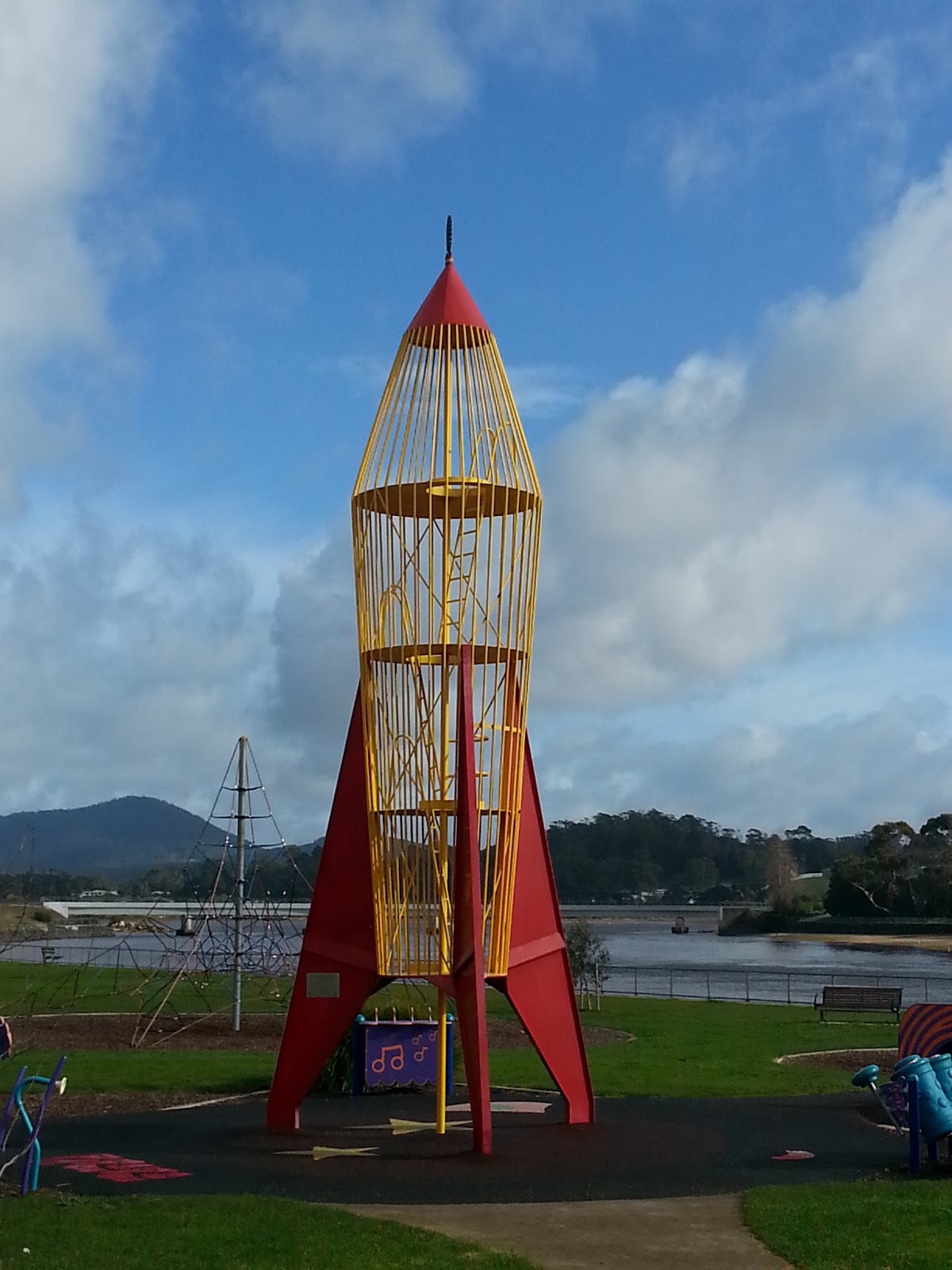
It is ironic, then, that playground rockets were static. They did not move or ever take off, although they could be slid down and climbed. As one playground designer commented, 'The Rocket Ship in reality has very limited play value. It is basically a climber to a slide' (Hendy 2008). It seems one aspect of the rocket’s appeal was the height – surely the highest ascent available to a child in the playground (Hendy 2008), and by reasons of scale, appearing so much higher than to an adult. Perhaps this is also the appeal of climbing trees.

The Rocket Park in Ulverstone, Tas.
(Author's image)
Nevertheless, the rocket remained stubbornly popular. Only one thing can explain why, perhaps, rockets stood as space age monuments in the imagination of the child, and that is their intersection with what was actually happening in the real world of space exploration, accessible to children through other toys, children’s books, television and news.

Children’s literature of the 19th and early 20th century contained many accounts of bodies in microgravity eg in the wonderful Dr Dolittle in the Moon (Lofting 1929), and The Light Princess (MacDonald 1964). C.J. Dennis even imagined the first Australian in orbit, a schoolboy called Neville who was whisked around the Earth by a cloud-horse in one night (Dennis 1921, Gorman 2015). In the fantasy playground period from the 1950s to 1970s imagination met reality as first-hand accounts of spaceflight became available.


Note: this is a deleted section from a paper on rocket parks that I am currently writing. I realised that the gravity hypothesis didn't really belong in the main argument. But I still like the theory that I'm proposing here, and so thought I would share it with you.

Note 2 (2018): the published paper is Gorman, A.C. (2018). Gravity's playground: dreams of spaceflight and the rocket park in Australian culture. In Darran Jordan and Rocco Bosco, ed. Defining the Fringe of Contemporary Australian Archaeology. Pyramidiots, Paranoia and the Paranormal. Newcastle upon Tyne: Cambridge Scholars Publishing, pp. 92-107.

References

Apps, BFG 1944 Children’s Playgrounds. Canberra: National Fitness Council
Doule, Ondrej 2014 Ground Control. Space architecture as defined by variable gravity. In Neil Leach (ed) Space architecture: the new frontier in design research, pp 90-95 John Wiley and Sons Ltd
Gorman, A.C. 2015 The first Australian to orbit the Earth. Space Age Archaeology. http://zoharesque.blogspot.com.au/2015/01/the-first-australian-to-orbit-earth.html
Hendy, Terry 2008 Dynamic playground design. In Heights Park Master Plan Playground Task Force Recommendations Presentation. Richardson, Texas.
Lofting, Hugh 1929 [1968] Dr Dolittle in the Moon. Harmondsworth: Penguin
MacDonald, George 1864 [1994] The light princess. In Alison Lurie (ed) The Oxford Book of Modern Fairy Tales. Oxford: Oxford University Press
Maggiolini, Alfo, Anna Persico and Franca Crippa 2007 Gravity Content in Dreams. Dreaming 17(2): 87–97
Nielsen, A. T., Zadra, A. L., Simard, V., Saucier, S., Stenstro, P., Smith, C. 2003 The typical
dreams of Canadian University students. Dreaming 13(4): 211–235.
Ota, Cathy, Clive Erricker and Jane Erricker 1997 The secrets of the playground. Pastoral Care in Education 15(4): 19-24