Showing posts with label gender. Show all posts

Wednesday, July 31, 2019

Cat-Women of the Moon: ideas of space travel in the 1950s.

Introduction

No woman has yet set foot on the Moon in reality; but in science fiction there have been plenty of female lunar explorers.

This 1953 black-and-white science fiction classic is credited with introducing the genre of female-only enclaves in space. It starred Marie Windsor as astronaut Helen Salinger, Carol Brewster as Alpha, leader of the cat-women, and Susan Morrow as Lambda.

The remaining cat-women were played by the Hollywood Cover Girls: Betty Arlen, Suzann Alexander, Roxann Delman, Ellye Marshall and Judy Walsh. The Hollywood Cover Girls seem to have been a vaudeville act.

I'm interested in this film for how it represents views of space and space travel in the early 1950s, four years before the launch of the first object into Earth orbit, and fifteen before humans really landed on the Moon. And also, because cat-women.

Why must we wait?

The movie opens with with a thrilling declaration. The Freudian symbols in this passage are not subtle.
The eternal wonders of space and time, the faraway mysteries and dreams of other worlds, other life, the stars, the planets. Man [sic] has been face to face with them for centuries, yet is barely able to penetrate their unknown secrets. Some time, some day, the barrier will be pierced. Why must we wait? Why not now?
The scene then cuts away to a pale rocket ascending vertically - a very visual reinforcement of the symbolism! The rocket appears to have been launched from White Sands Missile Range in New Mexico, and this is certainly where their mission control is. In the early 1950s, White Sands was one of just a few locations in the world where rockets could be launched into space.

Surely it can't be just me who sees the resemblance.

The propulsion method isn't entirely clear, but it has an 'atom chamber' and some kind of acid fuel.  At this time, there was a lot of interest in nuclear-powered rockets. The US Atomic Energy Commission (remember there was no NASA in those days) started developing a Nuclear Thermal Rocket in 1955. While we've gone on to have numerous nuclear-powered spacecraft, this method has not been used for Earth-to-space rocket propulsion, although it seems that there is renewed interest in this technology at the moment.

'White Sands calling Moon Rocket 4 Code 63. Can you hear us?', says mission control. Looking through the window to the outside, the crew see raw space - an inky blackness dotted with stars.

This is not a stunt!

Helen is the navigation officer. Upon waking up from the sleep of launch (they recline on banana lounges), her first action is to take a comb and hand-mirror from a drawer. 'Remember', says the manly blond captain Laird, 'this is a scientific expedition and NOT a stunt!', looking very pointedly at Helen combing her hair. This implies that her presence is regarded by some as gimmicky - that is, she doesn't belong there, and was only included for the sake of publicity.

Helen of Troy?
So much to pick apart here! There's the implication that a woman couldn't have got there for her skills alone; that science and femininity are opposed (so Helen should be 'one of the boys' and pay no attention to her appearance). These were certainly issues later in the rocky road to US women getting access to space. In 1978, when they were finally admitted to NASA's astronaut programme, the lads obligingly made a make-up kit for the girls. Even in space we have to be beautiful! But like, not too much, or you can't be taken seriously as a scientist.....

Public consumption and commercial space

Laird makes their first report to White Sands. 'Over and out', he says. 'Wait a minute, commander', says White Sands. 'There's a world full of people listening in. Are you alright - could we have a few words from the crew?' 'No!' says Laird, but Helen persuades him to let them talk to the people of Earth. This foreshadows an important part of the Apollo missions, and later the International Space Station - engagement with the public. The television broadcast of the Apollo 11 landing has become legendary. However, it wasn't a priority for NASA in the planning, as cameras would add weight, and the filming was a whole work sequence that would take up time. In 'Cat-Women' we see a similar tension between satisfying the public curiosity and getting on with the job.

Each of the crew introduces themselves and speaks a few words for the radio audience. The engineer Walt Walters is exercised by the opportunities for a space side-hustle. When he talks to Earth, he seizes his chance. 'We're humming along folks!' he says. 'That new lubrication by the Delphite Oil Company sure turned the trick. [off air] That plug ought to make a couple of grand, huh?' This stunt establishes Walt's character as a venal money-grubber and also introduces a new theme into the film: the commercial exploitation of space. I think it's very interesting that this aspect of space - making profit from it - is evident even before the launch of the first satellite.

Finally they arrive! As the navigator, Helen chooses the landing site. To the surprise of the other crew, it's on the dark side of the Moon. Unbeknownst to them, the cat-women have telepathically guided her here.

Walters is still on the take: prior to their moonwalk, he pulls out a box. 'What are those?' asks radio operator Doug. 'First letters from the Moon; I've even got my own cancellation stamp. Ought to be worth a couple of hundred bucks apiece'. This amused me no end, as there's a long and slightly bizarre relationship between space and philately. In 1972, the Apollo 15 astronauts took unauthorised postal covers with them for later sale. It turned into a scandal, with much discussion about whether astronauts should seek to personally profit from their profession. You can read more about the incident here. (Also see update at the end of this post).

Where does a city end?

Doug has a sign from the Los Angeles Police Department that he wants to leave on the surface of the Moon. Note that this is a local symbol, not a national one: there is no US flag proposed here. The sign says "Los Angeles City Limits". It's not explained, but the visual reference is clear. The placement of this sign on the Moon extends the limits of the city of Los Angeles into space, making the Moon part of its geography. There's obviously a humorous element to this, but it's also serious: a territorial claim, the extension of a terrestrial jurisdiction. In 1953, you could technically make a territorial claim in space, as there were no international conventions forbidding it. The Outer Space Treaty was not signed into being until 1967.

I thought I had better look into the US concept of city limits, which I have to confess I've only paid attention to before in the context of the Tina Turner dance classic 'Nutbush City Limits'. This is an American local government concept. The area within the city limits is governed by the Mayor of Los Angeles and the City Council, who provide services and collect tax. The city limits, however, can extend over county lines.

Why Los Angeles, though? In the early 1950s, White Sands was a focus of military space activity, but Los Angeles was the centre of aerospace industry, with CalTech in nearby Pasadena. The Jet Propulsion Laboratory was established in 1944 and became a key institution in developing space technology. You can read more about its fascinating history in Escape from Earth, by Fraser MacDonald. We might presume that Doug came from one of these organisations.

Spiders and dust

The astronauts suit up and venture outside. Here's the first step on the Moon, 1953-style:


Prompted by the telepathic cat-women, Helen encourages them to enter a cave. Inside they are attacked by GIANT MOON SPIDERS. It's not the first time the Moon has been inhabited by giant insects - Dr Dolittle in the Moon (one of my all-time favourites) has giant moths and grasshoppers. The reduced gravity allows them to grow far larger than on Earth.

No you can't have a picture, just watch the movie for yourself.

Of course the GIANT MOON SPIDERS go after Helen and then get slaughtered by the men.  Despite this setback, Helen wants to keep going. 'We don't know what's ahead', says one of the crew. 'Well I'll tell you then', says Helen. 'Adventure, discovery, knowledge! Isn't that why we came?' I like that that a woman gets to own these qualities.

They find, to their surprise, that the cave has breathable air, and take off their spacesuits. The enterprising Walters immediately leaps to a new idea for lunar industry: 'Maybe we can bottle this stuff for sale: Moon Mist for chronic coughs and asthma'. Moon mist would be pure and uncontaminated by terrestrial toxins!

It's not as far-fetched as it sounds. Of course there is no atmosphere to provide mist, but there is plenty of dust to be had. Not great for human lungs; but I could imagine a time in the future where people are making remedies out of lunar dust. What claims will be made for its healing properties? At the moment, you can buy basalt dust at plant nurseries to put on your garden. The dust comes from quarries, but it's similar to the lunar dust in its chemical and mechanical properties. Perhaps people will salt their garden beds with lunar dust instead and grow moon gardens!

I have seen advertisements for lunar mineral make-up (Note: not containing actual lunar minerals). Perhaps the very wealthy will drink champagne with lunar dust in it, just as they once did with gold. Lunar mineral waters will be a thing! Indeed conceptual philosopher and artist Jonathon Keats has already done this. By extension, you may be able to go to a spa and have an exfoliating skin treatment in which the abrasive qualities of lunar dust are put to good use. If lunar missions become more common in the decades to come, there may be all kinds of terrestrial commercial ventures making use of the one thing the Moon has plenty of. Probably I should get in first with the spa thing before Gwyneth Paltrow does.

Polity and politics among the cat-women

On the other side of the cave, the astronauts find themselves in a sort of bubble with a microclimate, a sky with clouds above them. They enter the city of the cat-women, with its architecture of columns, statues and black-and-white tiles. It's a little bit Aelita Queen of Mars, and also kind of classical culture - indeed, the cat-women have Greek names like Alpha, Beta and Lambda. The women themselves are slinky and sexy, dressed in one-piece catsuits. All have black hair, curled up in a big bun behind their head. They have pale faces with dark eyebrows and a curved hairline - they look a little like the Thermians in Galaxy Quest.

Bit by bit we piece together the story of the cat-women (incidentally a derogatory name applied to them by one of the crew, who is suspicious of them) and a glimpse into how their world came to be. 'We have no use for men' says cat-woman Beta, scornfully. The more diplomatic Alpha explains: 'What Beta means is that we have no contact or control over them as we do among ourselves. It seemed rather difficult to get a crew composed entirely of women.' Huh! Then as now..... this is interesting though. Their telepathic powers work only on other women; men are immune. Perhaps this is an extension of the much-vaunted and mythical quality of feminine intuition, which does not work on men because they lack it. Pure speculation on my part, and of course there is no need to explain all these plot devices, which do not need to be logical.

So how did the cat-women get on the Moon? Their ancestors, men and women both, travelled there two million years ago, when the Moon still had an atmosphere. I'm wondering here if the classical Greek complexion of their culture is meant to be a reference to Atlantis.

At a certain point the atmosphere started thinning, and they had to do something to conserve oxygen. It was not pleasant. Planned genocide was one of the strategies they employed. The other was to wait for a spaceship to arrive.

We find out more about the genocide when the gentle Doug falls in love with cat-woman Lambda. 'Incidentally', Doug asks her, 'where are your menfolk?'. 'Ours died off when I was still a child' replies Lambda. The implication here is that they were the subject of the genocide - a gender-cide, in fact.

Alpha has a plan to steal the spaceship to travel to Earth. There, she says, 'We will get their women under our power, and soon we will rule the whole world'. Before you might be tempted to think this could be a good thing for the future of Earth, Alpha disabuses Lambda of the idea that she can make a life with Doug. 'There is no room in your life for love. We will choose your man eugenically'.

I interpret this as an indictment on the cat-women's culture. By the 1950s, eugenics, which had a long history in the US, was becoming unacceptable.

The moral of the story

The Moon has other resources that would be valuable on Earth, as Walt discovers. Over a meal, he converses with Beta. 'Say, you wouldn't have any small works of art that I could take home with me as a souvenir, would you?', he asks her. Beta gives him her silver arm band. Walt says that on Earth such jewellery would often be made of gold, and Beta says 'but it's so common'! Walt's greed is aroused. Beta reveals the existence of a cave of gold, 'with more gold than you could carry away in your rocket ship in 100 years'. Naturally, he wants to see it, so they sneak off without the others. In the cave of gold, Beta kills him.

Perhaps there is a moral here: that looking to profit from the Moon will end badly.

This film, as cheesy as it is, covers a number of themes that become important in the later reality of space travel, such as lunar mining and profiteering in space; territorial claims; gender relations; and public engagement. It's remarkable prescient in this regard. 

Update, June 2020: City limits and stamps

I was reading Robert A. Heinlein's classic novella The Man Who Sold the Moon, written in 1949 and published in 1950, when this caught my attention.
'How are things going in Florida, Monty?' 
'I thought we were going to have to buy the whole damn legislature until we got the rumour spread around that Los Angeles had contracted to have a City-of-Los-Angeles sign planted on the Moon for publicity pix. Then they came around'.
This, as it turned out, wasn't the only similarity with Cat-Women of the Moon. Delos Harriman, star of Heinlein's story, also sends first day covers to the Moon. As already mentioned, there is a bizarre space-philately thing, and it seems this emerged very early on.

Coincidence? The Los Angeles City Limits does seem very specific. If there is a connection here, then Cat-Women was cleverly playing with science fiction references and it does make one wonder what else is hidden in there.

Heinlein was not involved in Cat-Women, but he was kicking around the film industry in the early 1950s. Probably there is some deeper story here if anyone had the time to pursue it.


You can watch the whole movie here:


Sunday, March 17, 2019

Space Age Suds: women, washing machines and the astronautics of everyday life

'Space Age Suds' is a charming and slightly alarming little vignette which is about the seeping of the Space Age into domestic life, machines and technology and how they structure social relationships, and gender roles in the Space Age. It's meant to be humorous, of course, but there is so much going on here!

The author isn't just anyone - it's beloved South Australian writer and journalist Max Fatchen. I found the article on Trove and now can't relocate it, but it seems likely it was published in the Advertiser, Adelaide's daily broadsheet. The date is a bit uncertain but it's clearly Apollo era.

I like that the Space Age reverses gender roles and that by the analogy of the washing machine with the space capsule, the wife is accorded the power of technology. After some searching I was able to find her first name but not her original surname, so we will have to call her Jean Fatchen here.


Because the image is a little fuzzy, here is the text.

Space Age Suds: the script


So the Russians are developing a low-orbital bomb. Well, it's just one more complicated space-age development, like our washing machine.

Our washing machine has a shape like a capsule and it is computer programmed and uncanny.

I was never much of a one with technology, and as a member of the avant garde laundry set, I'm all washed up.

There's no longer the simple meshing of gears as with our old washing machine. The cheerful days when I got my tie caught in the wrangler are past.

Our washing machine is automated in a cold, impersonal way, and my wife now calls herself a laundry technician.

She subscribes to advanced scientific journals, keeps up with the Apollo space project and runs off at the mouth on everything from transistors to laser beams.

I have been given the title of junior wash and garment line adherer, which means I hang out the clothes. I suppose I should be grateful.

Yet I dread washing mornings. I belong to a generation of boiling coppers and copper sticks, the hot sudsy smell of saturated sheets, and of bars of yellowed soap.

Now there's an air of bristling technology in the laundry, with split-second timing and ruthless efficiency.

"Load", my wife rasps. I stuff the clothes into the washing machine.

She consults her watch. "Four minutes to wash off," she says.

She looks at the console. "Close hatch," she orders. I shut the washing machine. She begins the countdown, "Five.....four.....three..."

"Look, dear," I interrupt, "I've forgotten a couple of my shirts...."

"Clear the complex", she says icily. "Two.....one.....". She throws a switch.

I humbly take up my position.

"Motor running", I report.

Strange, uncanny sounds come from the interior of the machine.

'Hot water entering,' I chant, consulting my check sheet.

"All systems are go," says my wife.

I sit back and light a cigarette with clammy hands.

Time goes by. The washing machine murmurs, thumps, sighs and gurgles. Its programme goes its relentless way.

"Check machine and report," rasps my wife from the kitchen.

"Machine on course, entering spin-dry period," I say.

"Check systems," she says.

"Check, check, check," I cry. "Hoses running. Pump stops ... four...three...two ....one...NOW."

"Clothes touch down, five minutes," says my wife. "Stand by."

"Machine spinning," I cry.

"Fire retro-rockets," she says absentmindedly.

At last the machine is silent.

My wife climbs to her feet.

"Open hatch!" she orders. "Alert clothes waggon".

She begins unloading the washing machine.

She lets out a shriek. "These clothes still look dirty".

"You didn't," she says, "put in the washing powder, did you?".

"Well," I bluster, insubordinate and defiant to the last, "this machine is supposed to think of everything. If it hasn't enough brains to use washing powder....."

"That's all," she snaps. "We'll have to do another orbit. Get the powder".

No, I haven't been on the moon but there are times when it sounds attractive!


Exegesis

So much to say about this little piece! I'm only going to scratch the surface here.

There's the idea that the Space Age changes how we do small domestic things on Earth: more like machines than messy humans. Both the wife and the washing machine are now operating as Space Age robots (it's a little bit Stepford Wives-ish tbh). It shows how the public interpreted the machine-human interfaces of space technology, down to checklists just like those that the Apollo astronauts used. It's also very cybernetic, getting status updates and adjusting the conditions.

The washing machine drum is a little gravity machine in itself, spinning like a space station or a centrifuge such those astronauts train in. Front loading washing machines with a glass porthole resemble spaceships too. 

The countdown has permeated into the domestic level: precision timing is the key to Space Age efficiency. As a domestic astronaut in her small domain, Jean has assumed power: she commands and Max obeys. She is a robot herself, icy and distant, intolerant of human foibles like forgetting a few shirts - and also the washing powder. (Thanks a bunch, Max. I would have been far more annoyed were I Jean).

The irony is that the power of astronaut Jean is illusory. While Max is pretending to help, he's actually demonstrating a typical trope of the inept male. He boasts about hanging out the clothes, but in this scenario, he forgets the washing powder and sits about smoking a casual ciggie (as people did in those days) while Jean multitasks, back in the kitchen. He finishes with that golden oldie, the nagging wife. It's a perfect illustration of the separate gender spheres of the 1960s, when women were excluded from being astronauts in the US.

'Fire retro rockets,' Jean says, absentmindedly. Doesn't this seem at odds with the ruthless robot housewife, all hard, streamlined efficiency? It took me a few reads before I realised what the subtle Max was implying with this sentence. She is absent-minded and talking about retro-rockets - which the washing machine does not have - because she is dreaming. Standing in her apron at the kitchen sink washing the breakfast dishes, while Max lounges around in the laundry, she is an astronaut. She is in command of a space mission, brave and true. The washing machine is as close as she can come to realising this dream. It makes me feel a little sad.

Once upon a time in France (well probably about 2005), I saw a washing machine advertisement in which a rather attractive nude man crouched in front of the washing machine's porthole, presumably waiting for the spin cycle to finish. The caption read 'One small step for man, one giant leap for women' or something to that effect in French: the idea was that is was a bloody big leap to get a bloke to do any housework, so nude dude's efforts at laundry were going to emancipate women and allow them to leave the house, even go to space! In effect, the effort involved in getting a man to do the laundry was equivalent to landing on the moon!


Gallery of Space Age Suds

As it turns out, there are quite a few connections between washing machines and the Space Age. Here's a small sample.

A space-age shop front in Sheffield, UK. Used with permission, from
https://shopfrontsofsheffield.com/2013/09/30/apollo-appliances-ltd-12-meadowhead/
Look at those rocket portholes lined up outside this charming shop!


https://www.doorsteps.com/search/carson-city_nv?property_id=1004635807


A rental property in Carson City, NV, USA, was advertised with a Space Age Laundry!


From Freaking News,
http://www.freakingnews.com/Tom-Hanks-in-Washing-Machine-Spaceship-Pictures-110109.asp
This is a reference to the Apollo 13 mission.


Source: unknown
This advertisement from 1900 explicitly references the gravity of spinning.


I'm sure I could find many more examples if I kept searching. Le me know if you find any!

And I'd like to finish by saluting astronaut Jean Fatchen. Here she is with Max in 2004.

Jean, with Max. Picture: Grant NowellSource:adelaidenow


Thursday, March 15, 2018

In the future, women still do all the cooking

Nothing annoys me quite so much as science fiction writers who can imagine almost any aspect of human existence transformed, and yet still have women stuck in the bloody kitchen.

Sometimes it's not even overt. The biases and limitations of a writer emerge in reading between the lines.

Let me show you some examples from a book I'm reading at the moment. (Which I'm enjoying, I should add, apart from this).

The two main characters are addressed as 'Miss G' and her boyfriend 'Mr M', by other characters in the book. So her age, marital status and sexual history are still considered relevant in this future society on another planet, while he is simply an autonomous male adult. Business as usual.

Her mother is 'Mrs G', implying that she has changed her name on marriage. She works full-time; her husband works off-world. Mr M spends a lot of time at her place and she feeds him. Why? Because his mother 'isn't around' and his dad is a 'Bad cook. Worse jokes. You know. A dad'.

A dad who lets another woman take care of his son, because dads don't do kitchens and young men couldn't possibly fend for themselves. Please.

Lift your game, science fiction writers.


Saturday, March 10, 2018

An anatomy of street harassment

This is something that happened to me a couple of years ago, and it's absolutely text book. I'm writing about it as men sometimes ask how women tell the difference between someone who's interested in them, and someone who's harassing them. So I'm going to tell this story to elucidate some of the finer points. I'd be very surprised if every female reader didn't immediately recognise this experience.....

It starts in the early evening on a university campus, where I've been attending a conference. I'm waiting at the bus stop, by myself, in order to go into the city for the conference dinner. I've got a book to help pass the time. But it's starting to get dark, and I'm a little unsure about how to get to my destination. 

A man walks into the bus shelter.

WATCHPOINT
Do I acknowledge his presence? Do I keep my head in my book and pretend he's not there?

DECISION
Acknowledge. It's not that dark, he's most likely a university student, there's no reason not to be friendly.

ACTION
'Good evening!' he says. 'Hello!' I say, and return to my book. I've been polite to a fellow traveler, and the interaction could end here.

But he keeps talking. Asks me if I'm a student here too, what I'm studying. I'm at a conference, I tell him, and explain a bit about it. He tells me about his thesis. All very pleasant and light-hearted. I would actually be rather reading my book, this is a little intrusive into personal time and space, but hey, why not? Sometimes you meet nice people in random places, and it's no big deal after all. Ten minutes of my time to learn about someone else's life. He also advises me not to catch the bus the online journey planner recommended; his local knowledge is useful here. Catch the next bus, he says, it's a more direct route to the city.

The bus arrives.

WATCHPOINT
This is also the bus he is catching. Do we sit together to continue the conversation or not? Does he expect me to? Do I owe him more conversation for telling me about the bus?

DECISION
No. We have had a pleasant conversation already. I have been in too many of these situations before, and feel that this is the logical disengagement point. I will sit in a different part of the bus, if I can.

ACTION
He boards the bus, sits halfway down. I sit near the front and continue to read my book. Someone boards and sits beside me. Excellent, no spare seat.

So we travel on. It's dark by now. As we draw closer to the city, the person sitting next to me gets off. I'm aware that he has seen this and I'm now exposed again. Sure enough, he comes up and says, 'Do you mind if I sit with you?'

WATCHPOINT
OK. This is where I really know where this is going. I'm 50 years old. I can say no. But it seems ungrateful. After all, he did help give me advice about which bus to catch. On the other hand, I know this script all too well.

DECISION
It's another ten minutes of conversation. He's pleasant enough. It would feel mean to say no. I'll make leaving the bus the definitive cut-off.

ACTION
'Sure', I say to him.

So we chat away, and finally we're in the city. We both get off the bus. 'Well', I say, 'it was lovely to meet you, good luck with your thesis, and have a great evening'. 'Oh', he says, 'are you sure you know how to get to your conference dinner? I could walk you'. 'No, really, it's fine. I have my phone and I'm perfectly fine by myself. Thank you though, it's very kind of you to offer'. But he doesn't give up. We go over this point a number of times, he's got plenty of time, he's very happy to walk with me, no I'm fine, how kind, but no, I don't need him to walk me, I'm sure he's keen to get home, no really he has heaps of time, he doesn't mind, it's on his way home anyway.

WATCHPOINT
Short of being even blunter, there is no way out of this impasse.

DECISION
I don't really want to be brutal, even though I know what the consequences are likely to be. But perhaps I'm wrong. He may just be a kind person. And what if I do get lost in the dark streets?

ACTION
'OK', I say, 'if you're sure it's not out of your way'.

WARNING WARNING WARNING

It's not that I feel in any physical danger from this person, although one can never rule it out. I'd also feel differently if I was on my way home, and he would find out where I lived. I'm just going to a function centre. But I'm a few too many steps down the decision tree now. All I've done is postpone the moment where I have to shut it down. I've been soft and cowardly in order to avoid the horrible experience of feeling you've been mean to someone. The one thing you can't do, which you've been trained not to do since girlhood, is hurt their feelings. It's really hard to overcome, especially if you're a young woman.

So we walk and chat. He tries on a few compliments. 'I'm sure you're a great teacher'. Things like that. I respond non-committally, trying to give him no encouragement. What else can I do? Soon we're in the street where the function centre is, and I can see where I need to go. 'OK', I say, 'there it is over there. Thank you so much, it was lovely to meet you, I don't want to hold you up any more'.  'No problems', he says. 'What are you doing tomorrow? Would you have time to meet for a coffee?'. 

WATCHPOINT
This is a polite request, and there's no harm in meeting someone for a coffee, is there? But will he interpret it as a green light to press for more? Of course he will - he hasn't paid attention to a single 'no' I have given him so far.

DECISION
I don't want to have coffee with him, and moreover, I simply don't have time to skive off from a professional conference to meet with a stranger. If I had this time to spare, I'd rather spend it with my Canberra friends.

ACTION
'I'm afraid not', I tell him, 'the conference starts at 8.30 am, and I'm flying out directly after. I simply won't have time'. 

But he won't leave this one. He asks again. I say no. He asks again. This is getting tedious. I'm really starting to be annoyed.

WARNING WARNING WARNING

And here I make the biggest mistake of all. Even as I did it, my brain was screaming WHAT ARE YOU DOING. I think I wanted to make clear that I was a professional, that we were simply two people in the academic world talking about academic things, and to make an obvious break that will allow me to walk away.

I give him my card. I say 'If you're ever in Adelaide, look me up'. Then I realise, holy shit, my mobile phone number is on the card.

By now a few other conference delegates I recognise are on the street, converging on the door. One of them, Andy, looks at me quizzically; very perceptively, he has sensed the vibe that I'm not comfortable (this, believe me, is rare). I use the look to escape, and join Andy thankfully at the door of the venue. I wave goodbye to my new 'friend', and finally, at last, he walks away. It's hard not to think that this is because I am now with another man and so no longer fair game.

So, you might think, nothing happened here. The man was not offensive, I did not feel in actual danger at any point. It was just annoying. What's the big deal?

What the big deal is, is that he forced me to manage the situation. At every point along the way, I had to judge his intentions and decide when to pull the pin. And yet at no time did he do anything overt enough for me to call it out. Taken individually, each single watchpoint was insignificant. But at every point where I did not shut him down, he took it as tacit permission to continue. 

I had to be responsible for his actions. I had to assess them and make decisions about what to do. And you know what, it's fucking exhausting. It's exhausting playing cat and mouse, it's exhausting managing someone else's shit. Instead of a straightforward bus trip into town, I spent 45 minutes dealing with this bloke. I made rookie mistakes, all with the desire of not hurting his feelings. And the consequences were exactly what I knew they would be.

That night, after the conference dinner, he rang my mobile.

I received many phone calls and texts over the next weeks. Mostly I didn't respond. Once I did answer and told him I was very busy. A second time I was just fed up with it. I told him that it had been nice to meet him, that I was grateful for his assistance in my journey, but that I didn't want to talk to him. Nothing personal, perhaps I'd get in touch if I was in that city again.

More calls. I didn't respond.

They've stopped now, thank heavens.

He didn't respect me reading my book at the bus stop, sitting by myself on the bus, refusing his offer to walk me, telling him I didn't want to talk. Oh, he's done this before, and probably wondered why women won't talk to him because he's a 'nice guy'.


Saturday, January 07, 2017

The bright and hollow sky: a review of Passengers


WARNING: THIS REVIEW CONTAINS SPOILERS

I went to see the new science fiction film Passengers this week. This is the synopsis from the official web site:
Jennifer Lawrence and Chris Pratt star in an exciting action-thriller about two passengers who are on a 120-year journey to another planet when their hibernation pods wake them 90 years too early. Jim and Aurora are forced to unravel the mystery behind the malfunction as the ship teeters on the brink of collapse, with the lives of thousands of passengers in jeopardy.
The film has been controversial because
  • Jim watches, cyberstalks and then wakes Aurora from hibernation, even though he knows it's wrong and
  • the trailers conceal this 'plot twist', leading you to think that the two main characters were in it together by mutual choice or accident.

I was aware of the critiques of the film, but just wanted to see starships.

The starship Avalon. Avalon is the island where King Arthur sleeps, waiting to return. Credit: Sony Pictures


The ethics of choice

But, I'm sad to say, the film can't escape its rotten core.  The plot is divided into roughly three parts. In the first, the aim is to build sympathy for the character of Jim Preston, awake 90 years too early and destined to die alone on the colony ship. Then he starts becoming obsessed with the sleeping Aurora - and oh, I've just got that one, as Aurora is also the name of the Disney Sleeping Beauty, woken by a kiss from the prince - and despite knowing that waking her is condemning her to the death of his choosing, he decides to do it. 

Of course Aurora is beautiful, blonde, and eminently fuckable. This is what he chooses. I'm not the only person to reflect on a different choice - the computer Holly's selection of the obnoxious Rimmer as Lister's companion on board the mining ship Red Dwarf, after all the crew have perished. Holly does not bring back Lister's crush Kristine Kochanski (who didn't know he fancied her), but the person most likely to keep him sane. Lister has a similar unhealthy obsession with Kochanski, but at least he knew her in real life.

Aurora. Credit: Sony Pictures


The second part is when Aurora finds out what he's done and repudiates him. In typical stalker fashion, he's as incapable of recognising her agency and leaving her alone as he was when he formed his one-sided attachment to her. The situation seems irreparable. Now both of them will be alone on the huge ship, avoiding each other until, one presumes, death.

The accidentally woken Gus agrees with Aurora's assessment of murder, but in an action a billion women will recognise, minimises the seriousness of Jim's deed and brushes aside her claim because there are bigger problems. Now I'm not saying the imminent death of 5000 people isn't a bigger problem; it's rather the dismissive attitude that rankles. It's the beginning of the persuasion process to bring Aurora to heel.

To move things along, the ship starts to malfunction. This is a crisis manufactured (plot-wise) to allow Jim the opportunity to redeem himself and make himself worthy of her love by acting in a heroic manner. He has to offer to sacrifice himself to save the remaining 4997 souls aboard the ship. Now it's her turn to contemplate 90 years of solitude. She begs him not to do it, because, we are to understand, that little murder thing is just a minor obstacle in the way of true love. Is this supposed to be her equivalent moral dilemma?

Needless to say they save the ship and survive, living happily every after.

As many people have pointed out, there are numerous ways you could have still had a really gripping plot with all the suspense of the final race to save the ship, without Jim stealing Aurora's life. The heroics of the final scenes ring hollow when you realise their purpose is to provide a reason for her to stop hating him and allow him to "get the girl" in the end.

For my money, one of the most interesting aspects of the film is the character of Arthur the android bartender. Arthur clearly has the ability to develop and react to people and situations, learning over time. His dialogue is finely done, revealing the limitations of a personality run by algorithms. There is a black hole in some areas which correspond precisely to the points where a human has to make a moral decision, such as to lie or to do something that affects another person adversely. He can't advise Jim as he is unable to reconcile the unreconcilable opposites on the horns of the dilemma.

Arthur the Android Bartender. Arthur, hovering between life and death on the island of Avalon. Do I detect a theme here? Credit: Sony Pictures


Why do shopping malls and concourses all look the same?

There's many things to appreciate about the way technology and society have been imagined in this future world. Commentary on capitalism and class, automation and autonomy is minimal but illuminating. Like the best fantasy, the underlying logic and philosophy is just hinted at. We know that corporations rule; it is an uber-capitalist society, perhaps the end result of the present growth of the commercialisation of space. 

On board the ship, cabins and services appear to be strictly stratified by what level people have paid for. First class get fancy suites and crepes for breakfast; the hoi polloi get small cabins and generic coffee. Everyone comes together in the concourse and the dining rooms, though. There also appears to be no differentiation in the hibernation pods. Jim and Aurora come out of identical pods despite the fact that she's a first class passenger and he's a mechanic.

The concourse. Credit: Sony Pictures

The concourse looks every bit of the same non-place as an airport (Changi springs to mind). As in a casino, there are no windows to let you know what time of day it is; or in this case, to remind you that you're light years from a solid planetary surface. But you can see out of the spaceship, as there appear to be numerous viewing decks.

Does the overview effect exist when you can't see the Earth?

There are some just breathtaking views of outer space far, far from Earth. The infinity pool, where one end is enclosed in a transparent bubble so the swimmer appears to be swimming out into open space, is stunning. It's a simple but effective visual play on the concept of the infinitude of space.

What is also interesting is the human reactions to being in naked space. Jim and Aurora venture outside the spaceship suited up and safely tethered, looking into a limitless abyss filled with stars. The stars are unfamiliar - they are not the night sky of Earth, which is 36 light years or so behind them.

This is an experience we don't yet have on Earth. There is, in fact, no human experience of space which is not dominated by the Earth and moon. Sure, you can look away from the Earth, but astronauts are always situated in relation to it or within view of it, or in its gravity well. There are many accounts of the reaction known as the 'Overview Effect': a feeling of united humanity and the insignificance of petty terrestrial wars and politics when the whole fragile Earth is seen in perspective from outer space. Now I'm a bit skeptical of claims that this would be a universal human reaction (if only all humans had the opportunity to do it). But perhaps we need to understand the Overview Affect against something we can only imagine at this point, the feeling when the Earth is out of view - not even the pale blue dot, just absent.

Wouldn't you feel adrift, unmoored, with no way home? Wouldn't this inspire an existential terror that would threaten to overwhelm your very being?

I am a passenger
I stay under a glass
I look through my window so bright
I see the stars come out tonight
I see the bright and hollow sky

Iggy Pop, The Passenger


Monday, April 25, 2016

Culture on the Moon: bodies in time and space

This is an excerpt from my just-published paper Culture on the Moon: Bodies in Time and Space (Archaeologies 12(1):110-128

This was very much an arena where masculinity was defined for the future of space. Automation and lack of control were equated with femininity. US experts cited Valentina Tereshkova’s successful orbit in 1963 to mean that the heavily automated Vostok vehicle did not require a skilled operator. MargaretWeitekamp argues that 'Demonstrating that a woman could perform those tasks would diminish their prestige' (2004:3). So strong was this ideology that the USA did not send a female astronaut into space until Sally Ride became a crew member of the space shuttle Challenger for STS-7 in 1983. 

By contrast, cosmonauts were the epitome of the ‘'new Soviet man’' (Gerovitch 2007), the ‘cog in the machine’ celebrated in Bolshevik political and poetic imagination. Sergei Korolev, the leader of the Soviet space program, was opposed to any active role for the cosmonauts, but as they, like the astronauts, were drawn from a test pilot background, the battle to preserve the aviation role of pilot was similarly played out. The unknowns and technological constraints of creating a successful lunar mission led to the development of similar human–machine interfaces and similar levels of autonomy in both programs (Gerovitch 2007). At this level, at least, evidence suggests that a hypothetical USSR lunar landing site might reflect many similarities to the US series. 

The Apollo 11 surface mission was highly choreographed and scripted (NASA 1969), but at that point no person of Earth knew exactly what the experience of being on the lunar surface would be like. In the gaps between the script and the actual actions of the astronauts, there is a window where minds and bodies express their individual and cultural differences. Where there was choice, what did the astronauts choose to do? What determined those choices?
(Gorman 2016:122)


References
Gerovitch, S. 2007. ‘New Soviet Man’ Inside the Machine: Human Engineering, Spacecraft, Design, and the Construction of Communism. Osiris 22:135–157.

NASA Lunar Surface Operations Office Mission Operations Branch Flight Crew Support Division 1969. Apollo 11 Lunar Surface Operations Plan. Houston: Manned Spaceflight Centre June 27, FINAL version of document.

Weitekamp, M. 2004. Right Stuff, Wrong Sex: America’s First Women in Space Program. John Hopkins University Press, Baltimore.


Sunday, January 31, 2016

He said, she said, and what the dictionary said

Friend! When a woman answers your question, don't believe her; but if she keeps silence, believe her even less.
(Polish proverb from Women in Proverbs Worldwide http://www.womeninproverbsworldwide.com/ )

He said, she said


There's an aphorism frequently applied to rape cases. In the absence of witnesses, detectable physical injury or, these days, DNA evidence, people say it comes down to a matter of 'he said, she said'. At which point they throw up their hands and exclaim it's too hard: what are we to do?

But think about it. Although the words are symmetrical, this is not a balanced equation. The problem is not what he said. It's what she said. Because she is likely to lie or exaggerate. And if you believe her, a man's life will be ruined. 

Only, in reality, she is more likely to be disbelieved, and his life is rarely ruined. Her life, clearly, is of lesser consequence. This is because women's speech, how it sounds, what they say, and its relation to 'truth', is suspect and problematic. There is no similar expectation that men will lie about committing rape or sexual harassment. Everyone, on the contrary, is in a hurry to believe them. They're a 'good man',  they wouldn't hurt a fly, and so it goes on.

Nothing demonstrates the hidden foundations of this discourse better than the so-called provocation defence, still accepted in a few Australian states and in other countries. It allows men to literally get away with murdering their female partners. The principle is that if provoked, it is understandable that a normal person may 'snap' and lose control of their actions, so that they don't realise what they are doing. It is most frequently used as a defence by men who kill women (but also for what has been called 'gay panic').

In one case, which happened in the last decade, a man murdered his wife because she had told him she was leaving him for someone else. As he reported it in court, she had taunted him and said her new boyfriend was a better lover. At this point, he killed her.

There were no witnesses. No-one can corroborate that she said those words to him. She was not there to tell her side of the story. But what 'he said she said' was enough for the judge to rule that he had been provoked. He was convicted of manslaughter, and given a light sentence. She stayed dead.

There's been too many of these over the years, including the high profile case of Vicky Cleary, that turned her heartbroken brother Phil Cleary into a campaigner against male violence and the complicity of the law.

When he speaks, it's credible. When she speaks, it's not.

The twittering of birds


The very sound of women's voices is questionable. Many people (including some women) can't stand hearing women's voices on the radio. They're too high. They sound like children. They don't have enough gravitas to read the news. The number of comments online which run along the lines of 'I'm not sexist, but I can't listen to a female sports commentator' are legion. 


Women's speech has been compared to the twittering of birds. (Perhaps this is partially why Twitter has been such a huge factor in invigorating new feminist activism). There's even evidence to suggest that as women progress into higher positions, they lower their voice in order to fend off these sorts of reactions.

Over the last couple of weeks the language used to describe women's speech has been in the spotlight. In July 2014, Nordette Adams pointed out that the online Oxford Dictionaries used 'a rabid feminist' as an example of usage in the definition for 'rabid'. You can read her post about it here. In January 2016 Michael Oman-Reagan also noticed this and began tweeting about a number of other examples of usage that were .....dodgy, to say the least.  His account is here.

It turned out that there were many negative words that were associated with women's speech. The included rabid, shrill, grating, nagging, bossy, shrew, gossip. As a theme, they all add up to support this very, very old idea that there's something wrong with what 'she said'. 

What's in a name? Or an adjective?


What a feminist says is like a slavering, diseased dog: full of violence, unable to discriminate between friend and foe, taken by madness, unintelligible, not obeying orders to sit, stay. She is a bitch, after all.


Women's voices are shrill, high-pitched, grating, piercing, unpleasant to listen to. It's even worse when there's a group of them. You can't distinguish between one woman and the next, they all sound alike.


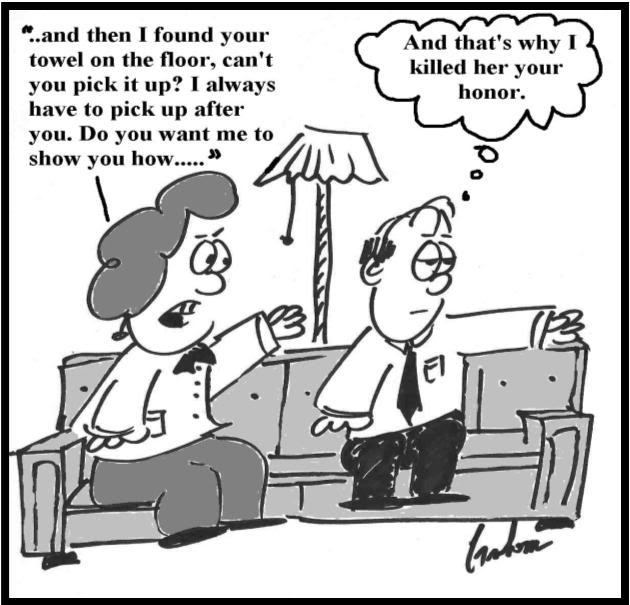
When women speak, they are nagging men, harassing them 'to do something'. Isn't this rich territory for comedians and those dreadful cartoons that appear in the sort of magazines you used to read in the doctor's waiting room? Like Readers Digest and, oh yes, the New Yorker? They are being unreasonable, asking the man to do something that's not important, or he'll do when he's ready. And they've asked him more than once! Wives, if you nag, you'll annoy your husband, he'll leave you for a younger woman.

This trope is accepted without considering the power dynamics behind it - the man annoyed that he is expected to pull his weight in the house instead of having everything done for him, the woman trying to manage house, children and frequently a job in which she is not supported or treated as an equal. Women think they are sharing family responsibilities equally but as their labour is not recognised as such, their partners think they are being unfairly asked to do additional work. The use of the term 'nagging' to describe requests to share work makes it the woman's problem. I could go on.


She's not the boss, she's just bossy. Her authority is not accepted. You don't have to do what she says. 


She gossips. With other women. It's idle, frivolous, malicious. She might be talking about men, about YOU! with the other women. You can't believe anything she says, it's just gossip. It's not true. Those women, when they get together.....

I grew up learning that men talk, women gossip. One day, I think I was at high school, as I waited for my father to stop talking to someone so we could leave, I realised that it wasn't true. He was not talking about serious matters. HE WAS GOSSIPING. It was one of those baby steps on my way to becoming a RABID FEMINIST.

Grrrr.


Or perhaps I became a shrew. Girls start out nice and docile, but they become shrews and harridans, with opinions, nagging, always wanting their own way. The other women got to them, you see. Don't listen to what the other women say.

Don't listen when they say it happened to them too. It's rumour, speculation, hearsay. It's not evidence. It's just what 'she said'.

Women. Don't talk. Your words are dangerous. Your words can get you in trouble. Your words are the reason you die.


Image courtesy of http://www.halfthedeck.com/


Acknowledgements: many thanks to Michael Oman-Reagan for his fearlessness and strong support of women's voices.
Note: screenshots are taken from Oxford Dictionaries (http://www.oxforddictionaries.com/) on 30 January 2016. As a result of the discussion, they are undertaking a review of the examples used.


Thursday, September 22, 2011

Shades of Skylab: the re-entry of the UARS satellite, and the psychological effects of orbital debris

This Friday, debris from NASA's Upper Atmosphere Research Satellite (UARS) is predicted to re-enter the Earth's atmosphere. Twenty six components are expected to survive, with a 1-in-3200 chance of hitting someone or something. Where it will re-enter is not precisely known. 

Artist's impression of UARS. Image courtesy of NASA

When Skylab was about to re-enter, there was a great deal of speculation and fear across the world. In the early days, NASA did not give much thought to managing public expectations, only establishing an information centre towards the end. Some thought that it was best not to give the public the impression that NASA was in control (only partially true) as it would reduce the blame if anything went wrong! People thought the world might blow up, or that the spacecraft would descend upon them in vengeance for their misdemeanours (see also my previous post here). Psychologist Talma Kushnir investigated how people in Israel perceived the risk.  This is how she summed up the situation:
The anticipation of the fall of Skylab was a worldwide event. Several features of that situation might have caused confusion and emotional arousal in at least part of the population. For example, catastrophes usually occur without prior notice, but in this case the whole world was alerted for weeks beforehand. While the fall was inevitable, its exact timing, location and consequences were unpredictable. For many people it represented a risk of unknown magnitude. The public was constantly bombarded by the mass media with bulletins of confusing information. Moreover, the information provided at the time was mainly probabilistic and varied from moment to moment, within and between available sources. On the whole, many individuals might have perceived the situation as stressful. (Kushnir 1982:85)
Among her conclusions were that 
1. The media played a role in exaggerating the risks; and presented statistics about the risk that were not very accessible;
2. Stress was higher among women, youth and uneducated people - the less education the person had, the more unrealistic their expectations;
3. Fear of science and technology may have contributed to higher levels of stress.

The gendered dimension is interesting here. Kushnir noted that:
in almost any sample, females are more likely to have less years of formal education and less knowledge of scientific and technological matters. These reasons may contribute to their stronger feelings of helplessness. (Kushnir 1982: 92) 
Moreover, they may also be more likely to express their anxiety than men (Kushnir 1981:112), thus skewing the results.

What was the ultimate result of Skylab's fall on public attitudes?  Back in the 1980s, Kushnir felt that Glass's gloomy prediction of 1970 had only been reinforced by Skylab. Glass argued that there would be:
more and more massive resistance to technological change. I predict in equal measure a growing hostility to science .... Hence the fifth .... limiting factor in the growth of science - the psychological resistance of and the restricted support by a population inadequately educated in the understanding of science and militantly opposed to it because of its identification with the technological annihilation of the human environment. (Glass 1970:75)
Sure, it's very Cold War, but one could argue that at least part of this prediction has been played out in subsequent decades. How will re-entries like the UARS, which are highly publicised across forms of media that didn't exist back in the 1980s, in an environment where the public are increasingly aware of the problems created by orbital debris, affect attitudes towards space industry, exploration and science?

You can watch the UARS tumbling in its decaying orbit in the video below, shot by Thierry Legault with a 14 inch telescope in France on September 15th.


References
Glass, B.  1970  The timely and the timelessness. New York: Basic Books 
Gorman, A.C. 2011 The sky is falling: how Skylab became an Australian icon.  Journal of Australian Studies 35(4): 529-546
Kushnir, Talma 1981 Anticipating Skylab: subjective probability of injury in relation to birth order, anxiety and affiliation.  European Journal of Social Psychology 11:109-113
Kushnir, Talma 1982  Skylab effects:  psychological reactions to a human-made environmental hazard. Environment and Behaviour 14:84-93


Wednesday, August 04, 2004

At last: a study on how microgravity affects women

The European Space Agency has put out a preliminary call for women to take part in a two month bed-rest study, the first such undertaken in order to understand the longer term affects of microgravity on women. (For more details see http://www.esa.int/export/esaCP/SEMVPXV4QWD_Life_0.html).

We know that the Mercury 13 women, in 1960, performed better at many tests than their male counterparts, the Mercury 7. However, the gender imbalance in space has not really shifted that much: after Valentina Tereshkova's historic spaceflight in 1962 (the poor dear had to do it with period pain too, what a heroine), it was another TWENTY YEARS before another woman was allowed into the bloke zone. So in effect, despite a growth in women astronauts and cosmonauts, the boffins still don't really know how women's bodies adjust to space. Good on the ESA for doing something about it.

So bring on two months in bed with trashy magazines and cable television. If I lived in Europe I'd be there.


Tuesday, July 27, 2004

Our German scientists, your German scientists

I went searching for the script of Ice Station Zebra on the web. As you might imagine, you can find the scripts of any amount of rubbish, but Ice Station Zebra is not available. The film had some fantastic lines, including one about German scientists. I fear I shall just have to rent the video again and transcribe it myself. Or perhaps I should find the novel by Alistair McLean.

There is some fascinating literature on Cold War gender politics about. I wasted my money on the new version of the Stepford Wives on the weekend (I don't recommend it) but it did make me want to see the very fine original again. I think it was made in the 1970s? It certainly reflects a Betty Friedan, World War II backlash.