Showing posts with label Anthropocene. Show all posts

Sunday, August 11, 2019

An archaeological perspective on orbital stratigraphy

One of the things I've been thinking about for a while is the the structure of the archaeological record of Earth orbit - all the spacecraft that have been launched over the last 60 years, and their decay products, fragments and molecules of Earth-manufactured materials. Something people ask me occasionally is how you can do archaeology when there is no stratigraphy. In terrestrial archaeology, everything eventually falls to the ground and becomes buried as winds, water and human activities erode higher places and move the sediment to lower places. Generally, the deeper you dig, the older the remains that you find.

This isn't how it works in Earth orbit. Everything's falling, for sure - but a large proportion of stuff never reaches the ground. It's all up there, the new mixed up with the old, the functioning with the defunct, the living with the dead. It's not a mirror of stratigraphy on Earth. The lower something is says nothing about how recent it is.

With one exception - everything in geostationary orbit is younger than 1963, when Syncom 3 became the first satellite to successfully reach this critical orbit, the importance of which for telecommunications had been predicted since the early 20th century. This is just seven years after the first satellite though - not very long. And there's only about 40 satellites left in orbit which date from this period.

Multigravity environments

It's more useful not to think of Earth as the standard, but as a special case in a solar system comprising many different levels of gravity and many different ways of experiencing it. For example, when we talk of microgravity in Earth orbit, it's not really that there is no gravity. The Earth is still there, pulling everything towards it as usual. It's the acceleration of falling towards it that creates the sensation of microgravity. You can experience the same thing in a droptower ride at an amusement part or the zero-gravity 'Vomit Comet'. You don't even have to leave Earth to have different gravity experiences!

The nature of the archaeological record varies according to the gravity you're in. In full Earth gravity, a powerful attractor, things fall. In Earth orbit, things float but can get pulled back to Earth by atmospheric drag. On the Moon, things fall, but more slowly, and less energy is needed to throw them up into orbit. At the five Lagrange points in the Earth-Moon-Sun system, things bounce around. (Indeed, just recently, they have been shown to be massive dust traps).

Lagrange points in the Earth-Moon-Sun system. Image credit: NASA


I prefer to conceptualise the way artefacts respond to variable gravity environments as a dynamical system. This is a visual, mathematical way of representing how objects move over time when certain boundary conditions are set. Objects are the recipients of energy through various sources, and gravity determines how much energy the objects need to move. The dynamical system is a map of places where objects end up as they lose energy - the process of entropy. Effectively, such a map is also an archaeological plan of a site or the surface of an excavation unit. (Now I wonder if we should be regarding our plans as frozen moments in a dynamical system, just one that is generally moving a lot more slowly than orbit. So the critical difference between the two regimes is not speed, but time).

These places are points of stable or unstable equilibrium. When an object falls to the ground, it's in a stable equilibrium place of low energy. To get off the ground, energy has to be added. The energy might come from someone kicking it, or a stream of water which moves it on. The Lagrange points include both stable (L4 and L5) and unstable equilibria (L1, L2 and L3). Unstable equilibrium is like balancing an egg on its pointy end: you can do it, but it's going to fall over pretty quickly. (Also, it helps if the egg is hard-boiled). Using this as a framework, Earth and Earth orbit are not completely different places with different rules, but places within the same system with different amounts of energy.

It also helps to visualise this as an Einsteinian gravity well. The bottoms of the wells are points of low energy and stable equilibrium.
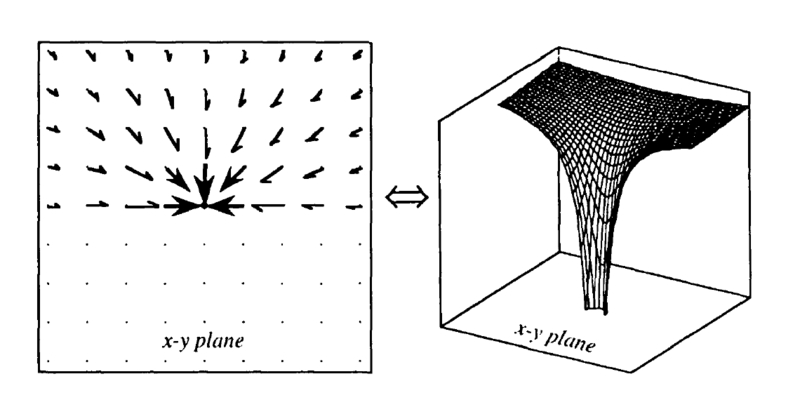
A 2-D slice of a gravitational force vector field (left) is interchangeable with a 3-D gravity well (right), with the z-axis showing energy (potential). Image courtesy of Invent2HelpAll

How junk disperses, or a taphonomy of orbit

In fact, the stratigraphy of space junk does include a terrestrial component. The lowest point of energy in the orbital dynamical system is the surface of Earth: an orbit of zero apogee and perigee. The atmosphere is a barrier or boundary between different gravity regimes, as space objects can bounce off its upper surface, and those that get pulled into it tend to incinerate. However, some spacecraft parts are made of materials like stainless steel and titanium alloys, which have high melting temperatures. Other parts may have carbon-carbon insulation which provides some protection from temperature extremes. Sometimes these components scream at high speed into the atmosphere, with their flesh burning, and fall with a smoking thud to the surface. The so-called 'space balls', titanium pressure vessels, are one of the most common spacecraft parts to survive re-entry. These spheres are the best gravity travellers; they get to come back.

Of course little of the spacecraft is likely to remain in orbit after the main body has re-entered - perhaps some molecules or broken-off bits. When we find the space balls or other Earthbound space junk, it's most likely that this is all that remains of the spacecraft. They've fallen to the point of lowest energy. This includes the spacecraft graveyard at the bottom of the ocean. Earth orbit is bookended by graveyards, if you take into account the graveyard orbit a few hundred kilometres above the geostationary ring. This is where old GEO satellites go to rest in their undead way, as they can still drift down and across the orbits of living satellites.

In general the the structure of space junk is not vertical layers as we're accustomed to in archaeology. Instead, spacecraft decay fragments have an elliptical or cloud geometry. When a spacecraft is whole, all its components are on the one orbital trajectory. Now imagine a solar panel detaching from the main body. Initially, its speed and orbit will be pretty much the same as the main body. But as time passes, the orbits will diverge. If the panel is tracked by one of the Earth-based telescopes, then we will have all the data about it's orbit into the past and will be able to trace it back to the original spacecraft - as long as we keep tracking it.

If a spacecraft explodes, the debris initially forms a cloud around it. The cloud travels together for a little while and then the individual pieces, all with their own weight, size, shape and velocities, start to disperse. If you look at the orbital tracks of Fengyun 1C, the Chinese satellite which was the target of a test missile shot in 2007, the debris rapidly moves apart and starts to spread out as you see here:
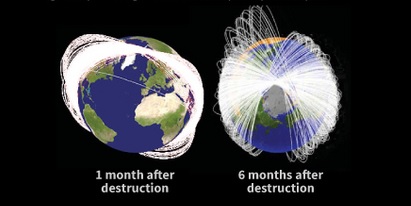
Image result for fengyun 1c
Fengyun 1C debris evolution. Image by Karl Tate @space.com

Position in orbit is described using a set of six equations devised by Johannes Kepler. Usually what people use, however, is Two-Line Elements - a bit like Eastings and Northings. The position is simplified into two strings of numbers. But because of the non-linear unpredictability of orbits, the reliability of the TLEs diminishes pretty fast. After 30 days you can't be sure that the TLE will accurately predict where something is. What this means in practice is that objects have to be continually watched or tracked to know where they are. This is called persistent observation and it's not generally something archaeologists worry about on Earth. However, artefacts on the surface do move around, although very slowly. You can record a concentration of stone artefacts on the surface, but if you revisit the same site a year later, half of them might be missing. Some have worked their way underground; some are covered by vegetation; others have moved under the influence of wind, water, animal movement or land use and industrial activities. Ten years into the future, there may be nothing to see. So perhaps I should apply the principle of persistent observation to terrestrial archaeology after all...

Objects in space are, of course, moving at incredibly high speeds - an average of 7-8 km per second. It's not that objects within archaeological deposits don't move; soils can act as liquids over a long time period, with a gravity-driven convection that gradually makes artefacts rise higher in the profile. Sometimes objects rise to the surface like a fish and get stranded there. Others, like stone tools with narrow sharp edges, slip back in for re-circulation. This is something archaeologists are very interested in as it says something about the integrity of the site and the relationship between objects. We're looking to that relationship to try and work out the human behavioural correlates, so we need to understand how the relationships decay over time due to natural or cultural factors, such as water movement or scavenger activity.

It's the relationship that matters

Both inside Earth and in orbit, the way the relationships between objects within a space evolves over time is critical to working out the human behavioural component. Looking at how the space debris environment evolves, it seems that after a certain amount of time it would be impossible to reconstruct the orbital path and work out what spacecraft a piece of junk came from, if you did not already have tracking records. Let's imagine the scenario of a future human archaeologist after the records have vanished (we can't assume they will survive in their current form) or even an alien archaeologist looking at space debris to get a handle on Earth culture. They will initially use materials and style to identify which space objects belong in the same time frame or to the same culture. They'll also have to work out what differences are due to style, and which to function.

Effectively, orbital archaeologists of the future will be 'recapitulating' a period of terrestrial archaeology before there was absolute dating, when similarities in style were used to posit chronological and social relationships. This period of investigation is known as culture history, and it worked on a number of premises. The first was the definition of culture, which as V. Gordon Childe phrased it, was a consistently occurring suite of artefact types, features and structures that you could attribute to an ethnic group. The second was the assumption that things change over time, coming in and out of fashion. Graphs of the frequency of occurrence of different artefacts types or styles resembled battleship curves, as they were known. Something starts out at a low frequency, then its numbers increase as it becomes popular. Soon the next big thing starts to supersede it and the frequency declines until no-one makes or uses the object any more. This is pretty much what happens in the fashion industry. Using changing frequencies to date an object is called seriation.

Because atmospheric drag pulls objects out of Low Earth Orbit all the time, things that survive there will be those with the greatest numbers, eg rocket bodies. This makes it a matter of sampling. Future archaeologists may not find the rare satellites as easily as the common ones. It's like the famous section in Kent G. Flannery's The Early Mesoamerican Village, a classic of the 1960s-1970s movement known as the New Archeology. A Real Mesoamerican Archaeologist laughs about another's failure to find the city of Teotihuacan using a particular sampling strategy. The Skeptical Graduate Student explains that this is not the purpose of a sampling strategy - and that the sample should produce results in proportion to what exists in the entire population of artefacts.

In another post I'll consider whether we can apply absolute dating techniques to space junk in orbit.


Topological stratigraphy

Terrestrial stratigraphy is locally linear and Euclidean, but orbits are non-linear and non-Euclidean. At larger scales, space is better described as the topological object called a manifold. Stratigraphy might simply be the wrong concept to describe the structure of orbiting objects. What kind of word would we use instead? Perhaps gravigraphy - written in gravity? Or orbitography, which is 'the determination and positioning of satellite orbits by a form of geodesy'?

Visualisations of space junk show Earth surrounded by white dots, like a cloud of silent bees. If you took Earth out of the middle, you would have a donut shape or torus where geostationary satellites are concentrated, and perhaps a series of intersecting tori for low to medium Earth orbit satellites. This is in stark contrast to terrestrial stratigraphy, which is conceptualised in a box-shape (even though Earth is spherical). Objects in this gravitationally-constrained tori move on elliptical paths inside the shape.

Let's put Earth back in. If we sliced a wedge vertically through through this cloud or swam, and froze the objects within it, what would we see? At the outer edge, the graveyard orbit, there'd be a thin smattering of defunct satellites. They are all dead. Below it, in the GEO range, there is thick ring of living and dead satellites. The 'type fossil' of this layer is the winged bird.

Then there is a sparse background scatter of satellites and junk until we hit the navigation satellites in the Medium Earth Orbit range. The US GPS network orbit at around 20, 000 km.

In LEO, we get the highest density of rocket bodies as well as satellites. There is a more diverse size range, from ENVISAT, the International Space Station, to cubesats and nanosats. There is the sparsest smattering of organic material.

There's a dead zone from LEO to the height of the tallest building or structure on Earth. Birds and aeroplanes fly at different altitudes, but they don't stay there or live there. There are gases, clouds, dusts.

On the surface of Earth, the ancient is mixed up with the modern. I suppose it is more like orbit than we might think, the living and the dead jostling side by side. Organic material is dense. Movement is slow. The deeper you go under the surface, the older things become. In this subterranean sphere, everything human is dead.

In all of these layers, the past and the present are mixed up to different degrees. The closer to the present you get, the higher and deeper human culture goes. Mines and building foundations cut into the dead deep past and overlay it with modern material. This is the variable borderland between the Pleistocene, Holocene and Anthropocene, a diachronous boundary that archaeologist Matt Edgeworth and his co-authors (2015) have discussed in an insightful paper (see below).

What is a place in orbit?

I'm relatedly curious about the concepts of setting or site in the orbital environment. Here, a 'place' is really a set of equations that defines the way an object moves - not just now but in the past and into the future. Place is a prediction, effectively. Place is movement, not stasis.

Could an orbital pathway, in and of itself, have heritage significance? Could it be 'preserved', and what would be the relationship between a culturally significant trajectory and the equations that define it? Could those equations, in and of themselves, also be considered culturally or archaeologically significant?

Perhaps in the future, there will be markers along the orbits of significant spacecraft that are not longer there, alerting anyone/thing who approaches that they are at a heritage orbit. Perhaps certain orbits - like Vanguard 1's - could be registered as significant so that nobody can launch something into the same orbit. An orbit has economic significance - so why not heritage significance too?

I think I have a lot further to go in this line of thinking. But it's a start anyway.


References

Matt Edgeworth, Dan deB Richter, Colin Waters, Peter Haff, Cath Neal, and Simon James Price 2015 Diachronous beginnings of the Anthropocene: the lower bounding surface of anthropogenic deposits.  The Anthropocene Review 2(1):33-58

Flannery, Kent G. (ed) 1976 The Early Mesoamerican Village. Academic Press


Sunday, April 02, 2017

Barometers, dip compasses, pressed flowers, dead birds: Alexander von Humboldt and multidisciplinarity

The name Alexander von Humboldt (1769-1859) first crossed my eyes as a pre-teen, when, after pestering my mother for something good to read, she gave me The Kon Tiki Expedition. I was instantly hooked and read it over and over again as a teenager. Thor Heyerdahl's daring 1947 expedition to South America on a balsa wood raft relied on the Humboldt Current to carry them part of the way. Thus I learned of the existence of this legendary scientist and humanist.

There seems to be a lot of Humboldt around at the moment, and I'm currently reading a round table critique of a 2009 book about him, The Passage to Cosmos, by Laura Dassow Walls.  

Humboldt had what seems to be a rather modern view of the planet Earth, which prefigured the vision of the International Geophysical Year. He saw grand global processes and the connectedness which created a unitary Earth; this was reflected in his final (unfinished) five volume work entitled simply Cosmos.

He was so famous in his time that the state of US state of Nevada was almost named after him! This is how round table contributor Felipe Fernández-Armesto describes him:
He had started his scientific career like an encyclopaedist of the Middle Ages, gathering the learning of the world. He became the last magus of the Renaissance, attempting the blasphemy of comprehending the cosmos.
Michael F. Robinson notes his collecting obsessions: Barometers, dip compasses, pressed flowers, dead birds: they fill the Baron’s world. This is the kind of list which appeals to my archaeologist's heart through the contrast of artefacts hard, soft, dead, half-alive and never alive: equal weight given to the cold scientific instrument and the petals of an ephemeral flower.

Part of what resonates in this round table is the discussion of how Humboldt defied divisions between science and humanities, which were not as hard and fast then as they are now. I have been pondering this lately because, as a space archaeologist, I make it my business to read the relevant literature in the space science and engineering journals. I need to in order to pursue my research; it's as simple as that.

I notice, however, that this is often a one-way flow. Numerous of my colleagues in the space world will happily write and publish on themes of history, social sciences and environmental sciences without referring to the research carried out by scholars in those fields. Hence a lot of it reads as rather naive with undergraduate assumptions about human behaviour and the nature of scientific enquiry. They get away with it because their peer reviewers are equally unaware of scholarship outside their own fields. So it's nice to contemplate a great thinker who would have had none of these silos - even if he inadvertently helped create them.

Walls argues that Humboldt invented 
a way of speaking, about nature that we now call ‘environmental’: namely, a planetary interactive causal network operating across multiple scale levels, temporal and spatial, individual to social to natural, scientific to aesthetic to spiritual (2009:11).
Human impacts - clearing vegetation, altering water flows through irrigation - were also part of Humboldt's conceptualisation of the world: very Anthropocene, we would now say. 

The message of Walls' book is that the divisions between science and the humanities no longer serve the world well. As someone trying to bridge these divisions myself, I cannot but agree.


Reference
H-Environment Roundtable Reviews Volume 2 No. 4 (2012) www.h-net.org/~environ/roundtables Laura Dassow Walls, The Passage to Cosmos: Alexander von Humboldt and the Shaping of America (Chicago: University of Chicago Press, 2009). 


Saturday, January 16, 2016

The Anthropocene, the nonhuman and the solar system are grand challenges for archaeology

What are the grand challenges for archaeology? Last year, a group of mostly US researchers (Kintigh et al 2014) published the results of a survey conducted in order to find out. The result was a series of general research areas and specific questions, most of which are core issues in what we do, but with some inevitable blind spots and holes.

Here's a few that resonate with me in terms of my own research in space archaeology (thanks to Publishing Archaeology for extracting them from the paper in a nice list):


  •  Why and how do social inequalities emerge, grow, persist, and diminish, and with what consequences?
  • How do humans occupy extreme environments, and what cultural and biological adaptations emerged as a result?
  • How have human activities shaped Earth’s biological and physical systems, and when did humans become dominant drivers of these systems?
  • How do spatial and material reconfigurations of landscapes and experiential fields affect societal development?


Archaeology blogger Doug Rocks-Macqueen thinks there's quite a bit more to be said on these grand challenges. He's asked his fellow bloggers to respond in what ever way they choose, and that's a challenge I can't refuse (bursts into song a la Gilbert and Sullivan).

Challenges are often something that we let others define for us. Something I've gradually learnt over the last decade of being an academic (I was a heritage consultant before, and actually during, this time as well), is to trust my voice.  Part of this is allowing deeply buried or incoherent thoughts to rise to the surface and be given shape. Another part of it is turning things you think you're stupid for not understanding properly upside down and making them into questions or problems to be investigated. So I've delved into my brain to work out what I really think, and this is what emerged.

Put actual people back into the Anthropocene

The Anthropocene is a challenge, because despite the brilliant Matt Edgeworth being on the Anthropocene Working Group, there doesn't seem to be a great deal of awareness among that community that there is already a discipline devoted to human-environment interactions in the past. Kintigh et al (2014:15-16) say:
Despite producing key data, archaeologists have largely been left out of this discussion. This is a major limitation, since archaeology, drawing on cross-disciplinary tools capable of tracking the increasingly dominant role of humans in Earth systems, brings a deep-time perspective that stands to make significant contributions to understanding how humans have shaped the Earth.
I even read one paper in which the author coined the term 'technofossil' for objects made of contemporary materials. Dude, they're just artefacts, and not always the most durable ones in human history at that. And in my observation there's little understanding of taphonomy in terms of how archaeological data is derived ....

We can't leave this one to the geologists and earth systems scientists. We need to make ourselves visible and relevant to this debate. What I think this means is synthesising archaeological data at a planetary scale in a way we've rarely done before. Imagine if we calculated the total weight of stone removed from original contexts and moved into others after being knapped, quarried, sculpted, built, used, discarded, from the Pleistocene to the present! In effect, we need to act as planetary archaeologists visiting from elsewhere.

And in this, the fine-grained detail you only get from intensive analysis of a site or an artefact type is still absolutely critical. It is the cumulative effect of living people carrying out individual actions in accordance with their worldview which creates the Anthropocene. As archaeologists, this is at the core of what we do everyday: meshing individual agency with broad scale patterns through time and space.

In some ways I kind of resent being drawn in to the debate on the Anthropocene. Part of me wants to resist trends and buzzwords, as hard as that is to do sometimes. But there is no doubt that this is shaping up to be the big theme of the next decade across all the sciences and humanities, and we need to be leading it, not following.

Last year Matt Edgeworth edited a forum section in the Journal of Contemporary Archaeology on The Archaeology of the Anthropocene. I recommend it to you.

Make humans the environment for other objects and things

Another big challenge is almost the polar opposite of the Anthropocene, which makes human actions central. As archaeologists, we're pretty focused on humans, because that is what differentiates us from geologists and palaeontologists, after all. But everyone else, it seems, is leaving humans behind. Animals, plants, microbes, and the inanimate are all being drawn out of the background into the foreground. The very definition of what it is to be human is being reshaped by looking at the human body as a microbial biome and considering its continuity with what we previously considered external to it. Then there are cyborgs, robots, AIs, artilects, hyperobjects, superobjects, posthumanism and transhumanism. It's just not fashionable to look at the human body as a coherent entity or unit of analysis any more.

So where does that leave archaeology? We've done more than our fair share of theorising about the interaction between humans and material stuff, with perspectives ranging from environmental determinism to phenomenology and taking in actor-network theory, social theory and a myriad more along the way. (Some argue that archaeologists have always been bower birds and have never formulated truly original theories about the world of objects. In some ways, I tend to agree). We've questioned the meanings of the human body and the boundaries between the 'cultural' and the 'natural'. But will we be stranded in an intellectual backwater as the human is completely bypassed?

Maybe not. I think our contribution to these frameworks lies in inverting our lens and looking at the experience of a mountain, a microbe, a mammoth, a melaleuca as human bodies, actions and technologies interact with it. Let's swap subject and object, or situate both in a flat or object-oriented ontology. How did the life of a flea change when hominins lost most of their body hair? How does the daily or annual life of a flowering plant change when Neanderthal people move into Shanidar Cave?  I'm not talking about use, or impact, or adaptation.  Perhaps the human body is still the unit of analysis, just from the perspective of something else.

Matrioshka Brain, by Steve Bowers
Orion's Arm Universe Project
My own engagement with this challenge at present is looking at materials and structures like degenerate matter and Matrioshka Brains, both far beyond the human scale of existence. I'm interested in what the future holds if we start from the premise that we have always been adapted to large scale networks mediated by material culture - in the words of Andy Clark, 'natural born cyborgs'. Despite dire warnings about AIs who are going to destroy humanity, I don't see why we have to be gloomy all the time. This is just a deficit in imagination. Sometimes it's nice to focus on creativity and transformation. Perhaps that's one reason why we're archaeologists.


Take the solar system perspective

There's no mention of space in Kintigh et al's survey, which is a little disappointing. I'd like to think we'd made a bigger impact than that. But how can space not be a grand challenge?

This is not about going to the Moon or Mars in order to do space archaeology. But archaeologists know all about colonisation, contact, impacts on the environment, adaptation, social life and things. We've seen how population growth and technology change have played out on Earth. Whether your vision of space is dystopian or utopian, we can't go blindly onto other planets without considering the deep history of sentient life on our own. This is archaeology's greatest strength in my view: different futures can't be imagined without understanding the diversity of the past.

I think archaeologists have an important role to play in shaping the discourses around space exploration. The usual rationales trotted out are riddled with 19th century ideas about progress and curiosity and exploration and growth, some drawing very explicitly on assumed human imperatives to colonise and explore. In other words, there's a particular (masculine) version of behavioural modernity that is co-opted to justify the current models of space occupation. Needless to say, I hate that stuff almost as much as I hate evolutionary psychology, which is quite a bit actually.

At this point, however, the two challenges outlined above come to be part of the same question. Really, we should be taking the perspective that Earth is just one of the planets colonised by life at this point in time, and contextualise ourselves within a whole solar system. If there is anything living on other planets, then perhaps they will have their own 'cene'. We can't judge the scale of the Anthropocene in isolation after all. So we need to develop concepts to frame humans a part of a much bigger system than just one planet. Continuities and discontinuities are important here, and we need to be wary of drawing the lines in all the wrong places.

Elsewhere I've argued that a constant gravity is assumed for terrestrial archaeology, and for space archaeology we have to stop considering it as "normal" and recognise that it's just one gravitational regime to which culture is adapted. This is not an entirely new idea: the seeds of it were present in the 19th century (think Konstantin Tsiolkovsky and Otis Mason Tufton). I think one of the challenges of space archaeology is how it makes us look back on Earth, and I don't mean as a pale blue dot, a blue marble, a spaceship, Gaia or the so-called 'overview effect'. Call me unromantic but I want a more robust and nuanced philosophy of existence in the cosmos.

Finally

When I started writing, I didn't know this would be where I'd end up. To be honest, parts of it come as a surprise to me, but in a good way. So it seems I've set some challenges for myself here; I hope this discussion may provide some inspiration for others too.

See you in orbit.


Saturday, September 12, 2015

The archaeology of not-quite-there: Pluto and the human gaze

why did you glance back?
why did you hesitate for that moment?
why did you bend your face
caught with the flame of the upper earth
above my face?

HD, Eurydice


In 2006, a spacecraft the size of an industrial fridge was launched on a remarkable mission: to zoom past the ninth planet in our solar system and show us its face for the first time. The New Horizons mission to Pluto caught the imagination of the world for a couple of epic weeks in July 2015. But as the spacecraft continues its journey beyond the formerly elusive and controversial planet and on to the Kuiper Belt, I’ve been thinking about what this means from an archaeological perspective.

This mission has turned Pluto from a fuzzy disc of reflected light into a place that we can see and read with our own signs and meanings. Already, there’s such a wide range of interpretations. Some are geological – craters, valleys, mountains. Others are geometric: rectangles, lines, circles, shapes, smoothness, spikiness. Then we have the zoomorphs: a whale’s tail, the head of a cartoon dog. Perhaps the most charming is that which sees the large icefields, now unofficially called Tombaugh Regio, as a heart.
Image from http://www.universetoday.com/121436/youthful-frozen-plains-cover-plutos-big-heart-spectacular-new-images-from-new-horizons/
We could also look at Pluto from a heritage/landscape perspective. Using the World Heritage Convention’s definitions of cultural landscapes, you could argue that that it is an associative landscape – with no actual physical human traces, it is still the repository of beliefs, dreams, visions and ideas. Some of these relate to its location so far from the light of the Sun. It’s said that midday on Pluto is as bright as Earth after sunset. It is a cold, dim planet, like a deep sea fish that lives and swims in darkness all its life. Since it was given the name of the ancient Roman god of the underworld, the International Astronomical Union has decreed that all place names on it will relate to this theme (which includes exploration). So already we have a set of metaphors and associations that shape the planet in our minds.

what was it that crossed my face
with the light from yours
and your glance?
what was it you saw in my face?
the light of your own face,
the fire of your own presence

HD, Eurydice

Our gaze creates Pluto as a place. I’ve written before about how the process of identifying distinct features and naming them creates a map of values. Assigning names to features on Pluto is a colonial process of mastery that draws the dwarf planet into a web of geopolitics. Despite the efforts of the International Astronomical Union to diversify the cultures represented in named things across the solar system, there is still a long way to go.

When telemetry showed that New Horizons had successfully completed its flyby, many in the mission control room waved American flags. Nationalism and national prestige are still among the main drivers of today’s space industry, despite the growth of private and crowd-funded space enterprises. As I watched the flag-waving, I thought that, for some people at least, the passage of a piece of space hardware has been the equivalent of planting a flag – as it was on the Moon – to stamp the outer solar system  as part of an American colonial landscape. And indeed, one of the ‘cultural artefacts’ on board the spacecraft was also a US flag, in stark contrast to the universal symbols on the Pioneer and Voyager spacecraft.

Against this is the discourse of space exploration as a global human endeavour which everyone shares, the undeniable excitement generated in social and traditional media across nations and age groups, and NASA’s always brilliant open access, with all materials available to anyone with an internet connection. Possibly more people than ever before have waited with bated breath for the unique experience of gazing on the face of another planet for the first time, like a distant relative they’d longed to meet.

what had my face to offer
but reflex of the earth,
hyacinth colour
caught from the raw fissure in the rock
where the light struck

HD, Eurydice

Pluto is a ‘natural’ object that existed for billennia (is that a word?) before there were sentient beings to observe it. But since its existence was first hypothesised in the 19th century, it has become a cultural artefact too. Like an archaeological excavation, the cameras of New Horizons excavated it from obscurity in the darkness of the night sky and brought it into the light. Space scientists and the public speculated about this strange new artefact: what was it made of? How had its surface markings been created? Its composition, history and appearance were compared to other planets and moons to gauge its character and hence the genesis of the landscapes captured by the LORRI camera. Deep time was being decoded from a surface of mountains, ice plains and craters: four dimensions being raised up from two.

The images, received as radio signals, converted and processed into pictures that we can view and understand, are a type of heritage or archaeological object in themselves. In one sense they are ephemeral, composed of numbers inside computers. In another sense, their endless duplication and proliferation gives them a digital resilience. Pluto, in our homes and at work, is a place we see and visit through a flat screen, almost as if we are inside our own spacecraft.

When we turn off the device, does Pluto still exist?

Pluto map by Snowfall-the-Cat
http://snowfall-the-cat.deviantart.com/art/Pluto-Map-Sept-10-2015-546286799

If you had let me wait
I had grown from listlessness
into peace
if you had let me rest with the dead
I had forgot you and the past

HD, Eurydice

New Horizons only came within 12 000 km of the planet’s surface. No human trace has been left there as a footprint of the Anthropocene. For a fleeting moment, New Horizons was part of the Pluto-Charon system. Perhaps a few molecules of material are left behind in a tenuous wake within the orbit. Now that the spacecraft has passed, there is nothing to indicate that it was ever there, save for the images, words and memories of people closer to the Sun.

I’m thinking about this ‘nearly there-ness’ of human interaction. Many planets in the solar system have only ever been ‘flown past’:  Saturn, Neptune, Uranus, and until the Messenger spacecraft crashed into the surface in April 2015, Mercury too. Similarly, there are places on Earth, like the deep sea, that we know only from remote sensing, probes, and flyovers. There are also places we could visit, but haven’t yet, like World Heritage sites. We feel it’s important that they exist, even if we haven’t had any personal encounter with them, and many people feel strongly about protecting such places.

This is what characterises space archaeology too, at least at the present time. It’s all an archaeology of ‘not-quite-there’, where we use historical and proxy data in order to make hypotheses about what lies beyond our reach in space.

Can there be an archaeology of the ‘not-quite-there’? How do you analyse something you can’t touch? It doesn’t bother planetary scientists: few of them will ever have anything other than data acquired from remote sensing. But as Matt Edgeworth has pointed out, archaeology is made of human dimensions. We dig using our bodies: the artefacts we scrutinise are made to fit in our hands, accommodate similar-sized human and animal bodies. This is partially why the pyramids, and other such wonders of the ancient world, seem so extraordinary and even, to some, alien. Their scale seems to defy the human capacity. In the modern industrial world, there are many such structures: bridges, buildings, mines, rockets, giant offshore gas rigs. Of these objects, Edgeworth (2010:140) notes that 'The sheer scale...is such that it is impossible to fully grasp either in a visual or tactile sense - to see all of it at once or to touch more than a tiny part of it'.
John Schofield, an archaeologist, and David Jenkins, a physicist, have written about the vast differences in scale between sub-atomic particles and the deep galaxy maps that almost show the beginnings of time, all coalesced around the CERN research facility on the border of France and Switzerland. This massive complex of buildings and installations, where the highest of high science takes place (such as the confirmation of the existence of the Higgs Boson in 2012) also contains dilapidated chairs and shabby rooms, forgotten corners where an archaeologist finds the empty space redolent of human presence.
Image courtesy of NASA

In a recent conference paper, I mused about the solar-system-scale Matrioshka Brain and how humans might interact with it as ‘natural-born cyborgs’. Something incomprehensibly large and complex, whether ‘natural’ or ‘cultural’, can still be held in our minds when it is what is called transparent technology: we use it intuitively, without thinking, as an extension of ourselves. This is pretty much what smart phones and other devices are for us now. We're not aware of the vast network of infrastructure that supports them, from satellites to the tiny chips inside - we use them as an augmentation of our bodies.
you who have your own light
who are to yourself a presence
who need no presence
HD, Eurydice
So what are we to make of this? At the end of this disquisition, I'm left with the feeling that we're becoming very good at bridging these differences of scale. Spacecraft like New Horizons give us dimensions of both time and space to get our heads around. They present the act of focusing, through the feeble jellies of our eyes, as a temporal act. We draw closer and closer to the planet's surface, like the process of focussing a microscope objective, and when the object precipitates into our field of view, we assess, name, categorise, analyse - and dream. Pluto becomes part of our personal solar system, the full extension of our gaze, and we are one step closer to becoming truly cosmic.
And then we stumble through and past, like Orpheus, and turn our gaze elsewhere.
Note: the full text of HD's extraordinary work Eurydice can be found here.


you who
who are to yo

Sunday, March 08, 2015

Congohelium and computronium: the thinking materials of the far future

This is my abstract for the Theoretical Archaeology Group New York University conference in May 2015.


In this paper, I want to explore two materials of the far future and use them to imagine the material worlds they inhabit. In Cordwainer Smith’s classic short story Under Old Earth, congohelium is an unstable material composed of “matter and antimatter laminated apart by a dual magnetic grid” (Smith 1966). The Douglas-Ouyang planets, an artificial cluster of planets with a dull malevolent sentience, communicate with Earth through the music of the congohelium.
Sunboy makes music with the congohelium.
Illustration by Virgil Finlay.
Computronium is the material of a hypothetical giant super-computing Matrioshka Brain, structured as nested Dyson shells of processing elements which employ the entire energy output of the sun. In Robert Bradbury’s conception, an element of computronium consists of a cooling system, a solar power array, a nanoprocessor and vernier thrusters for station-keeping – very like contemporary satellites. In the far future, today’s satellites could be considered equivalent to eoliths, with some resemblance of form, yet barely recognisable as cultural artefacts.
In both cases we have materials which act as the intermediary between an unimaginable entity and the humans who desire to communicate with it. They are the new elements in a periodic table of thinking materials. How would we classify these materials as archaeologists, or use them to infer the behaviour of mega-engineered structures? This is the most extreme anthropocene, where the balance of materials between ‘natural’ and ‘manufactured’ is altered at the nano- and solar-system scale; where prosaic science meets a new poetics of space.


Monday, April 15, 2013

The Anthropocene and the ethics of space exploration

Final frontiers

For many advocates of space exploration, the Solar System is the answer to human woes. As we exhaust our terrestrial resources, face overpopulation and stare down the barrel of rising sea levels, moving off-planet holds as many promises as it does challenges.

Already we have left our cultural footprint in the Solar System, from the teeming satellites in Earth orbit and landing sites on the Moon, Mars and Venus, to the Voyager spacecraft at the edge of the Solar System. And access to space is slowly moving out of the hands of national governments with the rise of commercial spaceflight development, and the growth of the space tourism market.

Why is space different?

In general, we don’t think of the space environment in the same way as Earth’s. There are several reasons for this. One is the common perception of space as a black, empty vacuum. Second, unlike Earth, space is practically infinite — beyond our sun there are billions of others just like it, even in our 'unfashionable end of the western spiral arm of the Galaxy'.

Then there is the absence of life, as far as we know — although there is always hope that this might change with further exploration. Until that happens, there is nothing living to suffer from any human activities in space. Effectively, there is no need to consider human impacts on the space environment seriously.

Historically, space has been seen as the very last frontier, ripe for colonial conquest. Just as on Earth, the motivations for colonisation are not just about curiosity, or an 'urge to explore', but about finding new resources to exploit for terrestrial markets. The unstated rationale behind this draws heavily on Western anthropocentric ideas of the mastery of creation — the assumption that the non-human world is there for our use. This instrumental view is still very prevalent in the way the space industry justifies its activities.

It’s also a matter of 'out of sight; out of mind'. When we look outwards from the surface of our planet at night the things that arrest our attention tend to be the stars of deep space. Unless you know what you’re looking for you might not even identify the other planets in our solar system, let alone the human-made satellites and space stations.

Of course it doesn’t help that so few people have actually experienced space itself. And for many of them, the revelation of space was actually one of Earth. The vision of the 'whole Earth' was first seen by the lunar-orbiting Apollo 8 mission in 1968. The image of the blue-and-white planet, a marble-sized splash of colour in the inky blackness, emphasised the fragility of life on Earth, and was responsible for the growth of a global ecological awareness.

In all of this, the intrinsic values of the space environment, in and of itself, have been frequently overlooked. While the need for an environmental ethics of space has long been recognised, there is little evidence that space industry has moved beyond a purely anthropocentric perspective.

The rights of rocks

On Earth, the concept of 'nature' having value in its own right, independent of human use, is no longer problematic. Australian philosopher Val Plumwood has been at the forefront of a movement to break down moral distinctions between humans and nature. Plumwood argues that nature has its own agency or autonomy, and should be reconceived as a co-participant in human endeavour rather than something on which we are dependent.


Whatever we do to nature is a reflection of ourselves – whether here or on other planets. watsonsinelgin/Flickr


In her view, we pay attention to the resources offered by the environment, and the limits they impose on our activities, 'only after disaster has occurred' and then only to “fix things up”. Dependency appears as a source of anxiety or threat, or as a further technological problem to be overcome'.

Never has this statement been more applicable than to the problem of orbital debris or space junk.

Our use of Earth orbit to place the satellites on which we now depend for telecommunications, weather, and navigation has created a seemingly irreversible environmental crisis — space so filled with junk that we are at risk of losing our access to it. Even so, the problem is still framed from an anthropocentric and geocentric perspective: in other words, how it will affect the Earth? The value of this apparently empty space is conceived entirely in terms of human use. Could we argue that it has intrinsic value — and as such is a place towards which we have a moral obligation?

The issue is perhaps clearer when we consider other planets. The view that inanimate celestial bodies have a right to exist undisturbed has been called 'cosmic preservationism'. One of the arguments is that the uniqueness of these planetary landscapes creates intrinsic value. There is no doubt — as human space exploration has repeatedly proven — that each object in space has its own story to tell.

And indeed, we really know so little of the solar system that it is hard to tell what is unique and what is common. However, critics of cosmic preservationism claim it leads to the absurd position of rocks on Mars having rights.

Citizens of the solar system

In order to continue as a space-faring species, and even perhaps to continue to live on Earth, we have to find sustainable ways to use the resources of space to survive. This means water, oxygen and minerals, all of which exist in various quantities spread across planets and asteroids. Already, the technologies and structures we may need to mine the moon and asteroids are being considered.

Our very presence on other celestial bodies, whether in human form or through robot avatars, changes them. They are altered physically, and also conceptually, becoming part of a human cultural landscape in a new way. We cannot land, sample, build colonies or mines and whisk away as if nothing happened — our chemical and mechanical traces are now part of the planet. At this stage of human space exploration such impacts are minimal, and no doubt acceptable. But this won’t always be the case.

Already, the international geological community is heralding the arrival of a new epoch – the Anthropocene. Human impacts on the Earth have reached the scale where they are defining a distinct geological layer. Will we have the same level of impact on the rest of the solar system too?

Perhaps the answer is to take up Plumwood’s challenge and abandon the opposition of nature and culture. This allows an acknowledgement of intrinsic value in the space environment that need not take priority over human interests, but can be managed by a critical assessment of competing interests. An ethic of respect for the wonders of the Solar System of which we are an integral part should not be that hard to achieve.

You can read the rest of the series here.

The Conversation
This article was originally published at The Conversation as part of the Final Frontiers series. Read the original article.


Friday, March 15, 2013

The Anthropocene in the Solar System

This is my abstract for an upcoming session on the Anthropocene at the Theoretical Archaeology Group conference in Chicago. No, alas, I'm not going to be there in person; I will be presenting in Skype mode. None of the conference registration and travel costs, but none of the conference partying either ......
A characteristic of what many are now calling the Anthropocene era is the redistribution of elements and minerals in patterns recognisable as the result of human interventions. Since 1957, the year Sputnik 1 was launched, approximately 6000 tons of human materials have been injected into Earth orbit, and more is thinly spread in various locations throughout the solar system. Mineral signatures rarely seen beyond the terrestrial sphere are now colonising interplanetary space. Their contribution to the estimated 40 000 tons of material from space that falls to Earth every year, including meteoroids and dust, is increasing. With the predicted acceleration of asteroid and lunar mining, the human impacts on space are likely to grow. However, the idea of the Anthropocene as constituted in an Earth/Space system has barely been explored. In this paper I draw on Nigel Clark’s concept of 'ex-orbitant globality' to situate the Anthropocene in a multi-gravity environment, moving away from the geocentrism that has dominated both archaeological and environmental approaches to understanding what space means.


References
Clark, Nigel 2002 Ex-orbitant globality. Theory, Culture and Society 22:165-185

Gorman, A.C. 2014 The Anthropocene in the Solar System. Journal of Contemporary Archaeology 1(1):87-91


Saturday, December 27, 2008

The heritage value of comets

In the short story Of late I dreamt of Venus by James van Pelt (The Mammoth Book of Best New SF 21, 2008, edited by Gardner Dozois, pp 84-99), various comets are manoeuvred into orbit around Venus, to provide water for terraforming. However, there is opposition:

There's a lobby defending Halley's Comet for its 'historical and traditional values', as well as several groups who argue that 'comets possess a lasting mythic and aesthetic relation with the people of Earth'.


Saturday, April 19, 2008

Redefining the geography of earth and space

I have to write something about this soon, based on my AAA paper "The gravity of archaeology".

Richard Cathcart is not only an excellent space junk poet but has some interesting insights on this topic (in his 1979 publication The Developing Artificial Geography of the Solar System, Public Administration Series P-206, Illinois). He makes the point that the lithosphere is currently as impenetrable to humans as space used to be, and that the upper limit of the biosphere is where the International Space Station now orbits.

He also notes that the Earth is "eroding", in a sense, as material is injected into orbit. But it is also aggrading as far huger quantities of cosmically derived material fall to earth every day. This interchange of material between what we call earth and space is a good illustration of the artificiality of these boundaries, as Nigel Clark (2005) also argues in Ex-orbitant Globality (Theory, Culture and Society 22(5):165-185).