Showing posts with label Cinema and space. Show all posts

Wednesday, July 31, 2019

Cat-Women of the Moon: ideas of space travel in the 1950s.

Introduction

No woman has yet set foot on the Moon in reality; but in science fiction there have been plenty of female lunar explorers.

This 1953 black-and-white science fiction classic is credited with introducing the genre of female-only enclaves in space. It starred Marie Windsor as astronaut Helen Salinger, Carol Brewster as Alpha, leader of the cat-women, and Susan Morrow as Lambda.

The remaining cat-women were played by the Hollywood Cover Girls: Betty Arlen, Suzann Alexander, Roxann Delman, Ellye Marshall and Judy Walsh. The Hollywood Cover Girls seem to have been a vaudeville act.

I'm interested in this film for how it represents views of space and space travel in the early 1950s, four years before the launch of the first object into Earth orbit, and fifteen before humans really landed on the Moon. And also, because cat-women.

Why must we wait?

The movie opens with with a thrilling declaration. The Freudian symbols in this passage are not subtle.
The eternal wonders of space and time, the faraway mysteries and dreams of other worlds, other life, the stars, the planets. Man [sic] has been face to face with them for centuries, yet is barely able to penetrate their unknown secrets. Some time, some day, the barrier will be pierced. Why must we wait? Why not now?
The scene then cuts away to a pale rocket ascending vertically - a very visual reinforcement of the symbolism! The rocket appears to have been launched from White Sands Missile Range in New Mexico, and this is certainly where their mission control is. In the early 1950s, White Sands was one of just a few locations in the world where rockets could be launched into space.

Surely it can't be just me who sees the resemblance.

The propulsion method isn't entirely clear, but it has an 'atom chamber' and some kind of acid fuel.  At this time, there was a lot of interest in nuclear-powered rockets. The US Atomic Energy Commission (remember there was no NASA in those days) started developing a Nuclear Thermal Rocket in 1955. While we've gone on to have numerous nuclear-powered spacecraft, this method has not been used for Earth-to-space rocket propulsion, although it seems that there is renewed interest in this technology at the moment.

'White Sands calling Moon Rocket 4 Code 63. Can you hear us?', says mission control. Looking through the window to the outside, the crew see raw space - an inky blackness dotted with stars.

This is not a stunt!

Helen is the navigation officer. Upon waking up from the sleep of launch (they recline on banana lounges), her first action is to take a comb and hand-mirror from a drawer. 'Remember', says the manly blond captain Laird, 'this is a scientific expedition and NOT a stunt!', looking very pointedly at Helen combing her hair. This implies that her presence is regarded by some as gimmicky - that is, she doesn't belong there, and was only included for the sake of publicity.

Helen of Troy?
So much to pick apart here! There's the implication that a woman couldn't have got there for her skills alone; that science and femininity are opposed (so Helen should be 'one of the boys' and pay no attention to her appearance). These were certainly issues later in the rocky road to US women getting access to space. In 1978, when they were finally admitted to NASA's astronaut programme, the lads obligingly made a make-up kit for the girls. Even in space we have to be beautiful! But like, not too much, or you can't be taken seriously as a scientist.....

Public consumption and commercial space

Laird makes their first report to White Sands. 'Over and out', he says. 'Wait a minute, commander', says White Sands. 'There's a world full of people listening in. Are you alright - could we have a few words from the crew?' 'No!' says Laird, but Helen persuades him to let them talk to the people of Earth. This foreshadows an important part of the Apollo missions, and later the International Space Station - engagement with the public. The television broadcast of the Apollo 11 landing has become legendary. However, it wasn't a priority for NASA in the planning, as cameras would add weight, and the filming was a whole work sequence that would take up time. In 'Cat-Women' we see a similar tension between satisfying the public curiosity and getting on with the job.

Each of the crew introduces themselves and speaks a few words for the radio audience. The engineer Walt Walters is exercised by the opportunities for a space side-hustle. When he talks to Earth, he seizes his chance. 'We're humming along folks!' he says. 'That new lubrication by the Delphite Oil Company sure turned the trick. [off air] That plug ought to make a couple of grand, huh?' This stunt establishes Walt's character as a venal money-grubber and also introduces a new theme into the film: the commercial exploitation of space. I think it's very interesting that this aspect of space - making profit from it - is evident even before the launch of the first satellite.

Finally they arrive! As the navigator, Helen chooses the landing site. To the surprise of the other crew, it's on the dark side of the Moon. Unbeknownst to them, the cat-women have telepathically guided her here.

Walters is still on the take: prior to their moonwalk, he pulls out a box. 'What are those?' asks radio operator Doug. 'First letters from the Moon; I've even got my own cancellation stamp. Ought to be worth a couple of hundred bucks apiece'. This amused me no end, as there's a long and slightly bizarre relationship between space and philately. In 1972, the Apollo 15 astronauts took unauthorised postal covers with them for later sale. It turned into a scandal, with much discussion about whether astronauts should seek to personally profit from their profession. You can read more about the incident here. (Also see update at the end of this post).

Where does a city end?

Doug has a sign from the Los Angeles Police Department that he wants to leave on the surface of the Moon. Note that this is a local symbol, not a national one: there is no US flag proposed here. The sign says "Los Angeles City Limits". It's not explained, but the visual reference is clear. The placement of this sign on the Moon extends the limits of the city of Los Angeles into space, making the Moon part of its geography. There's obviously a humorous element to this, but it's also serious: a territorial claim, the extension of a terrestrial jurisdiction. In 1953, you could technically make a territorial claim in space, as there were no international conventions forbidding it. The Outer Space Treaty was not signed into being until 1967.

I thought I had better look into the US concept of city limits, which I have to confess I've only paid attention to before in the context of the Tina Turner dance classic 'Nutbush City Limits'. This is an American local government concept. The area within the city limits is governed by the Mayor of Los Angeles and the City Council, who provide services and collect tax. The city limits, however, can extend over county lines.

Why Los Angeles, though? In the early 1950s, White Sands was a focus of military space activity, but Los Angeles was the centre of aerospace industry, with CalTech in nearby Pasadena. The Jet Propulsion Laboratory was established in 1944 and became a key institution in developing space technology. You can read more about its fascinating history in Escape from Earth, by Fraser MacDonald. We might presume that Doug came from one of these organisations.

Spiders and dust

The astronauts suit up and venture outside. Here's the first step on the Moon, 1953-style:


Prompted by the telepathic cat-women, Helen encourages them to enter a cave. Inside they are attacked by GIANT MOON SPIDERS. It's not the first time the Moon has been inhabited by giant insects - Dr Dolittle in the Moon (one of my all-time favourites) has giant moths and grasshoppers. The reduced gravity allows them to grow far larger than on Earth.

No you can't have a picture, just watch the movie for yourself.

Of course the GIANT MOON SPIDERS go after Helen and then get slaughtered by the men.  Despite this setback, Helen wants to keep going. 'We don't know what's ahead', says one of the crew. 'Well I'll tell you then', says Helen. 'Adventure, discovery, knowledge! Isn't that why we came?' I like that that a woman gets to own these qualities.

They find, to their surprise, that the cave has breathable air, and take off their spacesuits. The enterprising Walters immediately leaps to a new idea for lunar industry: 'Maybe we can bottle this stuff for sale: Moon Mist for chronic coughs and asthma'. Moon mist would be pure and uncontaminated by terrestrial toxins!

It's not as far-fetched as it sounds. Of course there is no atmosphere to provide mist, but there is plenty of dust to be had. Not great for human lungs; but I could imagine a time in the future where people are making remedies out of lunar dust. What claims will be made for its healing properties? At the moment, you can buy basalt dust at plant nurseries to put on your garden. The dust comes from quarries, but it's similar to the lunar dust in its chemical and mechanical properties. Perhaps people will salt their garden beds with lunar dust instead and grow moon gardens!

I have seen advertisements for lunar mineral make-up (Note: not containing actual lunar minerals). Perhaps the very wealthy will drink champagne with lunar dust in it, just as they once did with gold. Lunar mineral waters will be a thing! Indeed conceptual philosopher and artist Jonathon Keats has already done this. By extension, you may be able to go to a spa and have an exfoliating skin treatment in which the abrasive qualities of lunar dust are put to good use. If lunar missions become more common in the decades to come, there may be all kinds of terrestrial commercial ventures making use of the one thing the Moon has plenty of. Probably I should get in first with the spa thing before Gwyneth Paltrow does.

Polity and politics among the cat-women

On the other side of the cave, the astronauts find themselves in a sort of bubble with a microclimate, a sky with clouds above them. They enter the city of the cat-women, with its architecture of columns, statues and black-and-white tiles. It's a little bit Aelita Queen of Mars, and also kind of classical culture - indeed, the cat-women have Greek names like Alpha, Beta and Lambda. The women themselves are slinky and sexy, dressed in one-piece catsuits. All have black hair, curled up in a big bun behind their head. They have pale faces with dark eyebrows and a curved hairline - they look a little like the Thermians in Galaxy Quest.

Bit by bit we piece together the story of the cat-women (incidentally a derogatory name applied to them by one of the crew, who is suspicious of them) and a glimpse into how their world came to be. 'We have no use for men' says cat-woman Beta, scornfully. The more diplomatic Alpha explains: 'What Beta means is that we have no contact or control over them as we do among ourselves. It seemed rather difficult to get a crew composed entirely of women.' Huh! Then as now..... this is interesting though. Their telepathic powers work only on other women; men are immune. Perhaps this is an extension of the much-vaunted and mythical quality of feminine intuition, which does not work on men because they lack it. Pure speculation on my part, and of course there is no need to explain all these plot devices, which do not need to be logical.

So how did the cat-women get on the Moon? Their ancestors, men and women both, travelled there two million years ago, when the Moon still had an atmosphere. I'm wondering here if the classical Greek complexion of their culture is meant to be a reference to Atlantis.

At a certain point the atmosphere started thinning, and they had to do something to conserve oxygen. It was not pleasant. Planned genocide was one of the strategies they employed. The other was to wait for a spaceship to arrive.

We find out more about the genocide when the gentle Doug falls in love with cat-woman Lambda. 'Incidentally', Doug asks her, 'where are your menfolk?'. 'Ours died off when I was still a child' replies Lambda. The implication here is that they were the subject of the genocide - a gender-cide, in fact.

Alpha has a plan to steal the spaceship to travel to Earth. There, she says, 'We will get their women under our power, and soon we will rule the whole world'. Before you might be tempted to think this could be a good thing for the future of Earth, Alpha disabuses Lambda of the idea that she can make a life with Doug. 'There is no room in your life for love. We will choose your man eugenically'.

I interpret this as an indictment on the cat-women's culture. By the 1950s, eugenics, which had a long history in the US, was becoming unacceptable.

The moral of the story

The Moon has other resources that would be valuable on Earth, as Walt discovers. Over a meal, he converses with Beta. 'Say, you wouldn't have any small works of art that I could take home with me as a souvenir, would you?', he asks her. Beta gives him her silver arm band. Walt says that on Earth such jewellery would often be made of gold, and Beta says 'but it's so common'! Walt's greed is aroused. Beta reveals the existence of a cave of gold, 'with more gold than you could carry away in your rocket ship in 100 years'. Naturally, he wants to see it, so they sneak off without the others. In the cave of gold, Beta kills him.

Perhaps there is a moral here: that looking to profit from the Moon will end badly.

This film, as cheesy as it is, covers a number of themes that become important in the later reality of space travel, such as lunar mining and profiteering in space; territorial claims; gender relations; and public engagement. It's remarkable prescient in this regard. 

Update, June 2020: City limits and stamps

I was reading Robert A. Heinlein's classic novella The Man Who Sold the Moon, written in 1949 and published in 1950, when this caught my attention.
'How are things going in Florida, Monty?' 
'I thought we were going to have to buy the whole damn legislature until we got the rumour spread around that Los Angeles had contracted to have a City-of-Los-Angeles sign planted on the Moon for publicity pix. Then they came around'.
This, as it turned out, wasn't the only similarity with Cat-Women of the Moon. Delos Harriman, star of Heinlein's story, also sends first day covers to the Moon. As already mentioned, there is a bizarre space-philately thing, and it seems this emerged very early on.

Coincidence? The Los Angeles City Limits does seem very specific. If there is a connection here, then Cat-Women was cleverly playing with science fiction references and it does make one wonder what else is hidden in there.

Heinlein was not involved in Cat-Women, but he was kicking around the film industry in the early 1950s. Probably there is some deeper story here if anyone had the time to pursue it.


You can watch the whole movie here:


Saturday, January 07, 2017

The bright and hollow sky: a review of Passengers


WARNING: THIS REVIEW CONTAINS SPOILERS

I went to see the new science fiction film Passengers this week. This is the synopsis from the official web site:
Jennifer Lawrence and Chris Pratt star in an exciting action-thriller about two passengers who are on a 120-year journey to another planet when their hibernation pods wake them 90 years too early. Jim and Aurora are forced to unravel the mystery behind the malfunction as the ship teeters on the brink of collapse, with the lives of thousands of passengers in jeopardy.
The film has been controversial because
  • Jim watches, cyberstalks and then wakes Aurora from hibernation, even though he knows it's wrong and
  • the trailers conceal this 'plot twist', leading you to think that the two main characters were in it together by mutual choice or accident.

I was aware of the critiques of the film, but just wanted to see starships.

The starship Avalon. Avalon is the island where King Arthur sleeps, waiting to return. Credit: Sony Pictures


The ethics of choice

But, I'm sad to say, the film can't escape its rotten core.  The plot is divided into roughly three parts. In the first, the aim is to build sympathy for the character of Jim Preston, awake 90 years too early and destined to die alone on the colony ship. Then he starts becoming obsessed with the sleeping Aurora - and oh, I've just got that one, as Aurora is also the name of the Disney Sleeping Beauty, woken by a kiss from the prince - and despite knowing that waking her is condemning her to the death of his choosing, he decides to do it. 

Of course Aurora is beautiful, blonde, and eminently fuckable. This is what he chooses. I'm not the only person to reflect on a different choice - the computer Holly's selection of the obnoxious Rimmer as Lister's companion on board the mining ship Red Dwarf, after all the crew have perished. Holly does not bring back Lister's crush Kristine Kochanski (who didn't know he fancied her), but the person most likely to keep him sane. Lister has a similar unhealthy obsession with Kochanski, but at least he knew her in real life.

Aurora. Credit: Sony Pictures


The second part is when Aurora finds out what he's done and repudiates him. In typical stalker fashion, he's as incapable of recognising her agency and leaving her alone as he was when he formed his one-sided attachment to her. The situation seems irreparable. Now both of them will be alone on the huge ship, avoiding each other until, one presumes, death.

The accidentally woken Gus agrees with Aurora's assessment of murder, but in an action a billion women will recognise, minimises the seriousness of Jim's deed and brushes aside her claim because there are bigger problems. Now I'm not saying the imminent death of 5000 people isn't a bigger problem; it's rather the dismissive attitude that rankles. It's the beginning of the persuasion process to bring Aurora to heel.

To move things along, the ship starts to malfunction. This is a crisis manufactured (plot-wise) to allow Jim the opportunity to redeem himself and make himself worthy of her love by acting in a heroic manner. He has to offer to sacrifice himself to save the remaining 4997 souls aboard the ship. Now it's her turn to contemplate 90 years of solitude. She begs him not to do it, because, we are to understand, that little murder thing is just a minor obstacle in the way of true love. Is this supposed to be her equivalent moral dilemma?

Needless to say they save the ship and survive, living happily every after.

As many people have pointed out, there are numerous ways you could have still had a really gripping plot with all the suspense of the final race to save the ship, without Jim stealing Aurora's life. The heroics of the final scenes ring hollow when you realise their purpose is to provide a reason for her to stop hating him and allow him to "get the girl" in the end.

For my money, one of the most interesting aspects of the film is the character of Arthur the android bartender. Arthur clearly has the ability to develop and react to people and situations, learning over time. His dialogue is finely done, revealing the limitations of a personality run by algorithms. There is a black hole in some areas which correspond precisely to the points where a human has to make a moral decision, such as to lie or to do something that affects another person adversely. He can't advise Jim as he is unable to reconcile the unreconcilable opposites on the horns of the dilemma.

Arthur the Android Bartender. Arthur, hovering between life and death on the island of Avalon. Do I detect a theme here? Credit: Sony Pictures


Why do shopping malls and concourses all look the same?

There's many things to appreciate about the way technology and society have been imagined in this future world. Commentary on capitalism and class, automation and autonomy is minimal but illuminating. Like the best fantasy, the underlying logic and philosophy is just hinted at. We know that corporations rule; it is an uber-capitalist society, perhaps the end result of the present growth of the commercialisation of space. 

On board the ship, cabins and services appear to be strictly stratified by what level people have paid for. First class get fancy suites and crepes for breakfast; the hoi polloi get small cabins and generic coffee. Everyone comes together in the concourse and the dining rooms, though. There also appears to be no differentiation in the hibernation pods. Jim and Aurora come out of identical pods despite the fact that she's a first class passenger and he's a mechanic.

The concourse. Credit: Sony Pictures

The concourse looks every bit of the same non-place as an airport (Changi springs to mind). As in a casino, there are no windows to let you know what time of day it is; or in this case, to remind you that you're light years from a solid planetary surface. But you can see out of the spaceship, as there appear to be numerous viewing decks.

Does the overview effect exist when you can't see the Earth?

There are some just breathtaking views of outer space far, far from Earth. The infinity pool, where one end is enclosed in a transparent bubble so the swimmer appears to be swimming out into open space, is stunning. It's a simple but effective visual play on the concept of the infinitude of space.

What is also interesting is the human reactions to being in naked space. Jim and Aurora venture outside the spaceship suited up and safely tethered, looking into a limitless abyss filled with stars. The stars are unfamiliar - they are not the night sky of Earth, which is 36 light years or so behind them.

This is an experience we don't yet have on Earth. There is, in fact, no human experience of space which is not dominated by the Earth and moon. Sure, you can look away from the Earth, but astronauts are always situated in relation to it or within view of it, or in its gravity well. There are many accounts of the reaction known as the 'Overview Effect': a feeling of united humanity and the insignificance of petty terrestrial wars and politics when the whole fragile Earth is seen in perspective from outer space. Now I'm a bit skeptical of claims that this would be a universal human reaction (if only all humans had the opportunity to do it). But perhaps we need to understand the Overview Affect against something we can only imagine at this point, the feeling when the Earth is out of view - not even the pale blue dot, just absent.

Wouldn't you feel adrift, unmoored, with no way home? Wouldn't this inspire an existential terror that would threaten to overwhelm your very being?

I am a passenger
I stay under a glass
I look through my window so bright
I see the stars come out tonight
I see the bright and hollow sky

Iggy Pop, The Passenger


Tuesday, February 09, 2016

Dr Space Junk wears the Orbiting Solar Observatory


In this picture I'm wearing one of my favourite pieces of jewellery, a pendant made from a NASA Goddard commemorative plate with spacecraft around the circumference. One of them is an Orbiting Solar Observatory, a satellite series I am quite interested in as it was tracked by Orroral Valley.

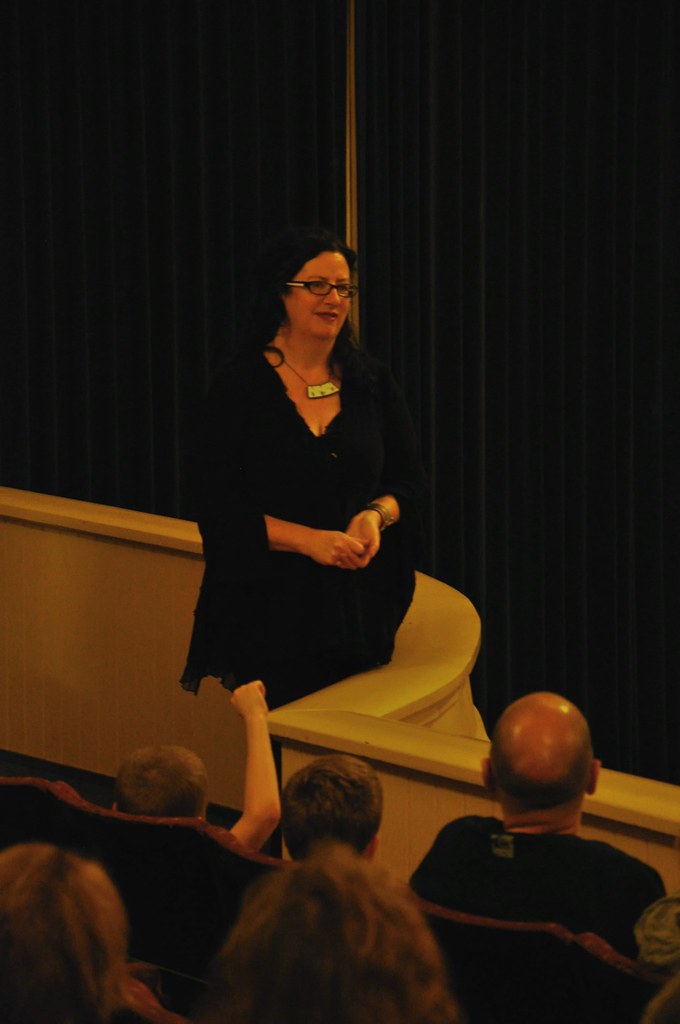
I'm actually standing on the balcony at the Camperdown cinema (Vic), a beautiful old heritage-listed building, where I was about to give a talk to introduce a screening of In the Shadow of the Moon. This was in 2008, I think. I had a fabulous time with the Corangamite Film Society and RiAus.


Saturday, October 03, 2015

Red, dead and dangerous to know: Ridley Scott's The Martian brings a planet to life


Apollo 13 / Ares 3

I once read a review of Ron Howard’s superb 1995 film, Apollo 13, which made an interesting point: everyone already knew how it ended – and yet you were absolutely on the edge of your seat throughout the recreation of the famous 'Houston, we have a problem' mission. This, as the reviewer highlighted, was a remarkable achievement.

When I attended the South Australian premiere of Ridley Scott’s The Martian, based on Andy Weir’s novel, I also knew the ending. Nevertheless, I was as tense as a coiled spring waiting for abandoned astronaut Mark Watney to extricate himself from each fresh disaster, and filled with relief and jubilation as the credits began to roll. 

There is more in common between the two films than you might think. Both feature astronauts who are at risk of being lost in space, who survive by going back to basic science, with a lot of help from dedicated NASA staff and with the world watching.

The Martian represents a space program perhaps at the same stage as Apollo 13, but on a different planet. It’s still an experimental, rather than a mature, technology. Apollo 13 and Ares 3 are both the third landing missions in their series when they experience these potentially fatal setbacks: a warning not to be complacent about space travel.

In fact this is an extraordinary thing: that there have, as yet, been so few human deaths while actually in space. (There have been some fatalities while in spacecraft; the closest to a death in space is the three Soyuz 11 cosmonauts who died during descent). President Nixon’s unused speech, prepared in the event of the death of the Apollo 11 astronauts, is now famous; but it’s surely only a matter of time before some head of state has to use a similar one for a death where the body cannot be brought home.

It’s interesting to contemplate what effect this might have on public perceptions of space travel, and indeed  of space itself, once a human body has lost its soul in the outer darkness. The first death in space will change everything.

Planetary archaeology

For my archaeological eye, there was much that appealed. Watney travels to the Pathfinder lander (launched 1997) so that he can use its comms equipment to contact Earth. There is an obvious echo of Apollo 12’s visit to the earlier Surveyor III robotic lander in 1969. Astronauts Alan Bean and Peter Conrad landed their lunar descent module about 155 metres away from Surveyor III and removed the camera and a couple of bits to take back to Earth, a vital study in how human materials are affected by lunar conditions.

In emergencies, future space travellers may well have to cannibalise previous missions for spare parts and other resources.

What happens back on Earth is also illustrative: Ares Mission Director Vincent Kapoor has to locate people who worked on the Pathfinder program and boot up old software and hardware so that they can talk to Mark Watney. Knowing about space heritage has its uses after all.

The rendezvous with Pathfinder is a vivid cross-cultural encounter with an earlier phase of Martian technology. An analogy might be someone’s chainsaw breaking, forcing them to resort to a ground stone axe to cut wood.

Apollo 11 toss zone (hashed area), where unnecessary fittings 
and objects were thrown out of the ascent module in order to 
make it light  enough to take off.      Image courtesy of 
Beth Laura O'Leary http://antiquity.ac.uk/projgall/oleary/
In order to leave, Watney has to jettison almost everything from his escape vehicle, the MAV 4. It’s a scene reminiscent of the Apollo ascents, where they similarly had to chuck any excess weight overboard. In both cases, astronauts just threw things outside from the hatches, the haste and chaos of it very at odds with the meticulous planning of other mission activities. Where the stuff landed is a sort of toss zone (as theorised by Lewis Binford and applied to the Moon by Beth Laura O'Leary), and may well be an archaeological signature of such human ascent sites – on the Moon, and now, mythically, on Mars.

Adapting The Martian

The film is very true to the book; what it leaves out you can live with, as it makes for more seamless viewing. It's expertly paced and never dull for a moment.

One thing that is very deftly done is some of the explanations of orbital mechanics. Experts explain to dunderheads in the film (and us in the audience) how something will work, using props. Such visual didactics could easily have missed the mark, coming across as forced and clunky, but they work both to explain things to a lay audience and add a little humour.

Thankfully, Ridley Scott eschews some of the book’s more laddish, hypermasculine moments, and does not interpose unnecessary romance into story. He also beefs up the role of Commander Lewis in a way that works well for her as a character and adds a bit more substance to a lead female role.

However, Kristen Wiig, as the plain-speaking Public Relations Manager Annie Montrose, is not given much to get her teeth into; the role is reduced and wooden compared to the book, and the same goes for satellite engineer Mindy Park. Replacing the Ares Mission director Venkat Kapoor, a practicing Hindu, with the more African-American half-Hindu half-Baptist Vincent Kapoor (played by English actor Chiwetel Ejiofor) is frankly odd. Andy Weir’s efforts at being inclusive were slightly thwarted here. Most of the diversity has to be crammed into one character doing the work of two through bifurcating his name, his religion and his background. Unsatisfying, although those who have not read the book will notice nothing amiss.

Image courtesy of 20th Century Fox

And of course the Martian vistas are all that you could want. The romance of red planet is writ large across the screen (all the better in 3D). I’ll commit heresy here by admitting that Mars is not my favourite planet. Nevertheless, the beauty and the terror of this alien landscape made me yearn for something greater than life on earth.


(And just quietly what a relief after the monumental cock-up that was Prometheus)


Updated 5 October 2015 to include Soyuz 11; thanks to @dsfportree for an interesting discussion.


Friday, August 21, 2015

Cold War material culture: the script of Ice Station Zebra

A random thought today sent me in search of the screenplay of the 1968 classic film Ice Station Zebra. Years ago it did not exist on the internet, and I couldn't find it now either, not even on the American Film Scripts Online database - but I did come across this image of the actual script on a bookseller's website.


Image courtesy of Royal Books
http://www.royalbooks.com/


The script is described thus:

Revised draft script for the 1968 film. Copy belonging to an uncredited crew member, with notations in holograph pencil on the versos of pages throughout, mostly numeric notations, with a few pages noting on-the-set supplies, and some personal notations. 
Goldenrod studio wrappers, rubber-stamped copy No. 170, dated June 14, 1967, with credits for director Sturges, producer Martin Ransohoff, and writer Douglas Heyes. 189 leaves, with last leaf of text numbered 203. Mimeograph, dated variously between 4/28//67 and 6/30/67, with blue and gray revision pages throughout, dated variously between 6/27/67 and 7/3/67. Pages Very Good plus, wrapper Near Fine, bound with two gold brads.

Just incidentally, the script will set you back $1750.00 USD.  I was momentarily tempted, I have to confess.


Sunday, December 07, 2014

In the mind's eye: the topology of Interstellar

So, I finally saw Christopher Nolan's film Interstellar (2014), after carefully avoiding all possible spoilers for weeks.

Wow. Just wow.

So much to say and think. I haven't looked up any reviews or commentaries yet, wanting to write about what really struck me without clouding my thoughts.

The first thing, soon said, is ROBOTS! Coolest. Robots. Ever. I hope they were based on real proposals for robot architecture because I want those robots.

The second thing is the representation of multidimensional space. The moment I realised the behind-the-bookcase space was five dimensions was revelatory. Amazing how they did that, how they made a 2D representation of 5D. Really fuckin' impressed, excuse my French.

As I was starting to understand how they put it together, two books I have been profoundly influenced by sprang to mind, followed by a third.

One was Greg Egan's wonderful novel Diaspora (1997), which is all about different kinds of non-Euclidean space. Egan has an extraordinary ability, through words alone, to make you almost see and feel higher dimensional spaces. My copy is hiding in the bookcases somewhere or I would at this point be quoting large chunks to demonstrate the sheer brilliance of it.

Much later, I was writing a paper about how gravity structures the archaeological record in Earth and space and the necessity of coming to grips with non-Euclidean space (The Gravity of Archaeology, which you can find here). I had to read a lot of topology, and in my quest for understanding I came across another extraordinary book: J.R. Weeks' The Shape of Space: How to visualise surfaces and three-dimensional manifolds (1985). Unlike Egan, he could legitimately use lots of diagrams (I have a feeling that diagrams might be a bit of a mood-killer in a novel), but again he was trying to show you how to visualise higher dimensional and non-Euclidean spaces in two or three dimensions. 

It's a freaky feeling when you realise you have just visualised something in seven dimensions.

Five dimensional hypercube, courtesy of Virtual Flower
http://robertinventor.com/software/virtualflower/virtualflower/tesseract.htm

Our brains, however, are not really made for such stuff. For me, at least, the experience of reading Egan and Weeks is feeling these dimensions just on the edges of vision; you can almost see them, and your brain can almost comprehend them, before a sort of vertigo sets in and the glimpse is lost. It's really hard to hold onto the moments of clarity when your flesher body lets go of its verticality and physical extension to split itself across a manifold.

Of course no discussion of other-dimensional realities would be complete without a nod to Flatland: A Romance in Many Dimensions (Edwin Abbott, 1884) - topology PLUS social satire!

Oh and the final one: Madeleine l'Engle's A Wrinkle in Time - remember the tesseract?

I'm giddy now with all this brainwork and must go and lie down for a while.


Thursday, January 12, 2012

Star Voyager: Exploring Space on Screen at ACMI. Review by guest blogger Dan North

The Australian Centre for the Moving Image’s exhibition Star Voyager: Exploring Space On Screen is a celebration of the historical and future relationship of space exploration and the moving image. Compiling a vast collection of film and archives from the late 1800s until present day, the otherworldly exhibition tells the tale of art informing science and in turn, science informing art.


Descending the stairs into darkness, one arrives amid the moving pictures and parlour tricks of the early 20th century. It is a world of fantasy and magic where voyagers to Georges Méliès' moon bring their top hats and umbrellas to be shot from a canon into space. Mars is host to an array of space operas, involving benevolent giants, and is home to the elaborate constructivist metropolis of the mysterious and beautiful Queen Aelita


Alongside these fantastic voyages and tricks of the eye are the writings of rocket pioneers Tsiolkovsky and Goddard, documenting the early beginnings of real space travel.

With the first occurrence of a countdown to zero before launch, the startlingly accurate 1929 film Frau im Mond by Fritz Lang is considered the first serious portrayal of space exploration. Lang employed rocket pioneer Hermann Oberth as technical advisor to provide an authentic as possible illustration of multi-stage rocket travel. A scene depicting the crew staring back at earth evokes a similar reaction the Apollo 8 astronauts would have had almost 40 years later as they saw their first earthrise. Despite scientific inaccuracies (such as the moon having a perfectly breathable atmosphere) the film was considered so accurate that the Nazi government confiscated Lang’s research and model rockets. A young Wernher von Braun was to be so inspired by Frau im Mond that he painted the film’s logo on early V-2s.


Moving on through other films and artifacts, a Russian film from the 1950s depicts what life on a soviet space station would be like. It’s a strange mash-up of antiquated phone exchange and a submarine - however space is not without it’s creature comforts -  everyone has an apartment with a view of the earth. Even your pet-comrade cat sits oddly purring at the window as the stars drift past. The film is presented as a sober documentary - this was to be the future for the USSR. This fictional Russian space station with its rotating wheel design was to be influential on Stanley Kubrick when thinking of his space hotel seen in 2001: A Space Odyssey.

The exhibition design by Minifie van Schaik Architects makes strong reference to the visual vocabulary of real spacecraft. In orbit around walls of gold mylar you’ll find satellite-like pods displaying rare footage of cosmonauts and astronauts, John F Kennedy’s ‘We choose to the go the moon!’ speech at Rice University, unedited footage of Neil Armstrong climbing tentatively down the ladder of the Lunar Excursion Module (you’ve likely seen it a thousand times before, but unedited and without soundtrack or sentimental narrative, the raw video of that boot planting on the lunar soil is still quite awe-inspiring). There’s newsreel footage of astronaut poster-boy John Glenn and various depictions of the space race in film - Apollo 13, The Right Stuff and Space Cowboys

The space race was also the era of the vinyl record. Curators Emma McRae and Sarah Tutton appear to have collected every space related album cover imaginable from Public Enemy’s Fear Of A Black Planet to the soundtrack of Plan Nine From Outer Space.


Unique to the exhibition is the short film On Mars 3D. It is too short. You want to see more. The Martian valleys and mountains look incredible and a little unbelievable. Is this really what the surface of Mars looks like? It makes Tatooine look boring. Planetary astronomy was never so cool.

Down a corridor reminiscent of the Discovery set from Kubrick’s 2001: A Space Odyssey (there’s a suspended model of the Discovery in there) you’ll find costumes, props and models from Forbidden Planet, Star Trek, Total Recall and Moon amongst others. Contrasting with their real-life, used-in-actual-space counterparts, you get a sense of how science has influenced film and vice versa. It’s definitely a reciprocal relationship.

Amongst all the relatively familiar imagery, one exhibit is particularly fascinating for it’s unusual visceral qualities; presenting the smell and the sound of our own star, the sun. Eerie and absolutely alien, artists Joyce Hinterding and David Haines have simulated what we could never possibly experience- a solar scratch and sniff.

The overall effect is a montage of original artifacts, props, film, and photographs- an artistic and scientific orgy of everything that is great about imagining or actually going into outer space. Highly recommended.

Star Voyager is on at ACMI, Federation Square, Melbourne, until January 29.


Dan North is a Sydney-based architect. He is also an amateur astronomer with a life long interest in the history of space exploration and set and prop design for science fiction films.


Sunday, July 17, 2011

The psychological effects of Skylab: divine retribution

It is 1979 in Punjab, India. The U.S. space station - SKYLAB - hurtles toward the Indian sub-continent. A young Punjabi boy, six-year-old Puneet, just stomped on a frog during play. Now, as he listens to a radio broadcast about the imminent crash, he fills with dread that SKYLAB will strike his home and kill him and his family. This charming story, inspired by true events, draws us into Puneet's exotic world and with his struggle as a boy growing up.
Written & Co-Directed by - Arshdeep S Jawandha
Directed by - Pat Pecorella


This short film was made in 2006. I find it interesting for the way it depicts a particular response to Skylab - the idea that an event in the heavens is caused by an action on Earth (The pre-enlightenment view that heaven and earth are interconnected - as above, so below......).  In the little boy's eyes, the disparity in scale does not seem odd at all: he is convinced that the fall of Skylab is caused by his naughtiness in squashing a live frog. Skylab is used as a way to illuminate the boy's understanding of how the world works.

He's terrified that the small world we see in the film - the house, the kitchen where his mother prepares meals, the garden, his father reading the newspaper in the sitting room - will be destroyed when the space station falls on it. Skylab is a metaphor for his awareness of the instability of all that seems solid around him. He's like the frog, for whom the violence of his stomp comes without warning and from above.

The director, Pat Pecorella, commented that:
Scientists attempted to guide it [Skylab] into the Indian Ocean, but its crashing somewhere in India was a possibility. Indian people remember this event and how frightened they were as children.  

Arshdeep  S. Jawandha, who wrote it and also co-directed (I guess he was basing it on his own experiences as a boy), seems to be a psychiatrist who specialises in children, if my internet sleuthing is correct. (On the other hand, they could be two completely different people).

The film starts, as you will see, with the text:
NASA launched the Skylab space station in 1973.  It sustained severe damage during liftoff. It was expected to fall somewhere in the Indian subcontinent, where exactly was unknown.

It's true, of course, that the space station was damaged during launch.  But this text implies that the damage was the cause of its de-orbit, which is not the case.  All the same it's a quick and simple way to explain to a general audience how a spacecraft falls out of the sky. Perhaps Jawandha was conscious of not making people believe that this sort of thing could happen at any old time (which it can, and does) - he has to make a plausible, predictable reason to prevent the same panic shown by little Puneet.

Puneet is concerned about some sorts of scale. He asks his mother,  "Can it [Skylab] be bigger than our house?";  "Is space bigger than Earth?"  The next morning, he finds the body of the frog and buries it.  Then he hears on the radio that Skylab fell into the Indian Ocean, as if his penitence has averted the disaster.

So, in my reading, it's all about causality and scale in the mind of a child.

References


Wednesday, July 06, 2011

Skylab in the cinema, and in French too!

I'm not the only person obsessed with Skylab at the moment ........ French actress and director Julie Delpy is making a loosely autobiographical comedy set in 1979, in which an extended family gathers for a birthday party in Brittany on the weekend of the re-entry.

Julie Delpy herself was 10 in 1979, and the film will be presented from the perspective of the ten-year old Albertine (Delpy plays Albertine's mother). In mid-July that year, the world speculated about where Skylab would re-enter, and what the consequences would be (many thought the impact may make the Earth explode). In the USA, people sold hard hats as 'Skylab Survival Kits', and a restaurant invented the Skylab cocktail:  "Two of these and you won't know what hit you". In more war-torn parts of the world, people thought of taking refuge in air-raid shelters; and there was a level of anxiety created by the earlier re-entry of a USSR satellite over Canada which released nuclear fuel.

Thanks to the bloggers at Julie Delpy: A tribute to her talent, I can tell you what the plot is:

Scripted by Delpy, the film is structured like a long flashback experienced by Albertine and triggered by a train journey with her husband and two children. During the trip, she remembers another journey she made when she was ten years old.
We are transported from 2018 to 1979. Albertine is with her parents and maternal grandmother on her way to the house of Aunt Suzette, her father’s elder sister, to spend the summer holidays there.
It’s her paternal grandmother’s birthday and the whole family is gathered together, including uncles, aunts and cousins. Endless meals, heated discussions about politics, racism, sexuality and education: the parents pass on their anxiety to the children who hear everything.
Skylab, the US satellite launched by NASA, thus becomes a huge fantasised monster, when it is just an obsession of Anna, Albertine’s mother, a woman who is as charming as she is neurotic, and is convinced it will crash into the west coast of France.
Here's a shot of Albertine with the family at St Malo, courtesy of Karius de Parius:


Fittingly, the film is being shot as we speak, at the same time of year as the re-entry. The film is due for release in September, apparently, and you may guess that I will be at the cinema as fast as I can, since it combines two of my favourite things, space and French language.

And as I'm writing this, I realise that in my marking-and-thesis-draft addled brain, it has escaped my notice that the anniversary of the re-entry is coming up on July 13th! The day before Bastille Day .... perhaps I should combine my traditional Bastille Day brekky with a Skylab celebration!


Wednesday, April 13, 2011

First Orbit: a review of the Yuri's Night 50th anniversary film by Christopher Riley

Last night I was a guest panellist at a screening of the new film, First Orbit, created by Christopher Riley to commemorate Yuri Gagarin's historic spaceflight in 1961.

In answering questions afterwards, I came to the defence of Valentina Tereshkova and named normally unmentionable things in a room full of physicists and space geeks. But that's another story, and for the moment I just want to consider my first impressions of the film.

The music was wonderful, and it seems a shame that Yuri didn't have a nice ipod so he could have listened to it on his journey.  What sounds would he have heard?  I don't know if his attitude was continually being adjusted, so perhaps the sounds of thrusters were audible .... or perhaps it was silent except for his blood and heart, and the small mechanical tinklings of his instrumentation, until the rude voice of Korolev burst in on his solitude .... (It was very interesting to hear Korolev, whose identity was so long a secret).

As usual, despite the conceit of letting the images speak for themselves, the choices made in the film have a subtle effect.  I think the intent was to allow every person, every viewer, the sense that this could be them:  that this was a universal body, an accessible experience.  It could have been us, floating serenely along in the spacecraft.  His perspective is ours, as shaped by the camera view.

I didn't have a problem with that, but ohers among my companions last night found this more disconcerting, as if Yuri had been de-Russianised, de-personalised, by being subsumed or subverted into allowing his unique, intimate experience to be cannibalised by us.

And of course it was long.  Many people walked out of the theatre, perhaps to other engagements, perhaps just a bit bored.  For me that was part of the point, too.  Did he tire of the view?  After a while did he have a bit of a snooze, just waiting for something to happen?  Was he conscious, for every minute, that he was completing a circumnavigation of creation, dreaming this round Earth into being?  It was a mental exercise, a sort of discipline, to remain focused, and I felt that to be important:  I was not there just to be entertained, it was a sort of reenactment or perhaps just an enactment.

After his reentry, the film ended abruptly. There was no footage of Yuri back on Earth, a terrestrial being like before.  He lands, and it's all over, as if he didn't really return.  As if the person he had been was obliterated in the blackout of the descent, and the story continues in the body of another person, the one who takes a world tour and is celebrated and feted.  Dissatisfying at one level, but I didn't mind that either.  It's we who come back to Earth, in the dimness of the lecture theatre, those who stayed the distance.

Monday, April 11, 2011

Celebrate the 50th anniversary of human spaceflight with Dr Space Junk!


 Yuri's Night
 Notice of a Free Special Screening
presented by   
the Australian Institute of Physics (SA Branch)
http://www.physics.adelaide.edu.au/aip-sa       aip-sa@physics.adelaide.edu.au
Ph: (08) 8201 2093 or (08) 8234 6112 (a.h.) or Mob: 0427 711 815  Fax:  (08) 8201 2905
Post:  AIP-SA secretary, c/o CaPS, Flinders University, GPO Box 2100, Adelaide SA 5001

and

the American Institute of Aeronautics and Astronautics (Adelaide Section)

at 7.00 pm on Tuesday 12th April 2011
in the Kerr Grant Lecture Theatre, Physics Building, University of Adelaide

On the 12th April 2011 it will be 50 years to the day since Yuri Gagarin climbed into his spaceship and was launched into space. It took him just 108 minutes to orbit the Earth, and he returned as the World's very first space man. To mark his historic flight, film maker Chris Riley of In the Shadow of the Moon fame has teamed up with the European Space Agency and the Expedition 26/27 crew of the International Space Station, to create a new film of what Gagarin first witnessed fifty years ago.  By matching the orbital path of the Space Station, as closely as possible to that of Gagarin's Vostok 1 spaceship, and filming the same vistas of Earth through the new giant cupola window, astronaut Paolo Nespoli, and documentary film maker Christopher Riley, have captured a new digital high definition view of the Earth below, half a century after Gagarin first witnessed it.  Weaving these views together with historic recordings of Gagarin from the time (subtitled in English) and an original score by composer Philip Sheppard, they have created a spellbinding film to share with people aroundf the world on this historic anniversary.

The Australian Institute of Physics and the Adelaide Section of the American Institute of Aeronautics and Astronautics invite you to a special screening of this historic movie - celebrating 50 years of manned space flight!

Following the screening Dr Ian Tuohy (Space Systems Manager), Professor Roger Clay (Astrophysicist), Dr Alice Gorman (Lecturer in Space Archaeology) and Dr Olivia Samardzic (Co-director Centre of Australian Space Education) will be present to answer your burning space science questions.

Contact: Scott Foster         T: 7389 5979  Email: scott.foster@defence.gov.au


Wednesday, March 30, 2011

On being a space archaeologist: between science and the postmodern?

My colleague Mick Morrison has posed an interesting question, as part of his hosting of the long-running blog carnival Four Stone Hearth this week. He asks:  "What are the marginal issues or stories in anthropology that you think deserve more attention?"

I suspect my primary answer to this would surprise no-one at all.  (But just to be clear about this, it would be the material culture and heritage of space industry and exploration).

Easy enough. But he also made me think about how I understand my position in the world of archaeology (or anthropology, in the North American sense, encompassing socio-cultural, bio-physical and linguistic anthropology as well as archaeology), as a researcher who is already on the margins, working in an area which many, quite frankly, consider to be mad.  (Not that anyone has ever said that directly to me, of course!). In fact I am marginal in more than one discipline, as I also lurk in the corners of space science and policy.

This raises a problem about what to call myself. I usually use "space archaeologist", but this can be confusing for those not accustomed to seeing the two words together, or who think it's all about remote sensing. But I'm not strictly a space scientist either, and although "space historian" is more easily understood, and captures part of what I do, I'm not entirely comfortable with this. Recent discussions with Brett Holman of Airminded highlighted for me the distinctions between archaeology and history. As he characterised it, historians tend to work alone, and are very text-focused, rarely interested in the actual places or things which they may discuss. Archaeologists use documents and archives too, but we are more focused on places, landscapes and material culture, and we are used to working collaboratively, often as part of large multidisciplinary teams, or with stakeholders such as Traditional Owners. So "historian" could be misleading too, given that I have an intense interest in the stuff. Another recent suggestion has been "space heritage adviser", which I kind of like, as it has a relationship to policy. None of these seem to fit all that well, however, and each seem to constrain me in some way that I'd rather not be.

So, thinking about this, I am led to the conclusion that some kinds of multi-, trans- or inter- disciplinary studies are more marginal than others.

This is perhaps best illustrated by an experience I had in the early 1990s, when I was involved in convening an interdisciplinary seminar series at the University of Sydney.  Naively, I assumed that my own contribution, an exploration of some obscure (at the time) mathematical models and their application to interpreting human behaviour in the archaeological record, counted as interdisciplinary, in the sense that the methods of two separate disciplines were involved. Not so.  Interdisciplinarity, as evident in the topics presented in this series, actually meant postmodern, with a heavy emphasis on Lacan, Kristeva, Derrida, Spivak, etc. I couldn't actually see how this worked.  (OK, Lacan does use topology, but as Alain Sokal has pointed out, very very badly indeed!  See The gravity of archaeology for my own, no doubt inadequate, application of topology to archaeology).  (And please, no-one tell Sokal). The others were clearly flummoxed by me putting equations up on the screen, and I understood that I wasn't playing the game correctly, not having mentioned Bataille or Deleuze even once; and clearly believing that I could find something out about the world ..... 

In some contexts, one of the most damning things a colleague can say about one's work is "That's not archaeology ......".  Flirting with pure mathematics can be seen as taking the interdisciplinary enterprise just a step too far. Fortunately, the field of contemporary archaeology, where we use archaeological theory and method to turn a lens on our own behaviour and interaction with material culture (see Schofield and Harrison 2010), is gaining support, and I find myself quite at home in this area. Schofield and Harrison even like my excursion into topology! (Thanks, guys).

So, if I am in some sense marginal by being inter- or trans-disciplinary, what is the status of the questions I want to ask about the material culture and places associated with space exploration and industry? Actually, they are pretty straight-down-the-line archaeology and heritage. I want to know what we can learn from the places and objects of space; I want to know what is significant to contemporary communities and what are the most practical yet philosophically sound ways of preserving space places and objects for future generations; I want to know how this unique technology interacts with human behaviour and ideology. So, despite my occasional use of literature, poetry, film and mathematics, perhaps I am just a regular common-or-garden archaeologist after all.

I don't have a problem with that.


References
Gorman, A.C.  2009  The gravity of archaeology.  Archaeologies:  the Journal of the World Archaeological Congress. 5(2):344-359

Schofield, John and Rodney Harrison 2010  After modernity:  archaeological approaches to the contemporary past.  Oxford University Press

Sokal, Alain and Jean Bricmont  1998  Fashionable nonsense: postmodern intellectuals' abuse of science.  Picador:  New York