Showing posts with label Contemporary archaeology. Show all posts

Sunday, August 11, 2019

An archaeological perspective on orbital stratigraphy

One of the things I've been thinking about for a while is the the structure of the archaeological record of Earth orbit - all the spacecraft that have been launched over the last 60 years, and their decay products, fragments and molecules of Earth-manufactured materials. Something people ask me occasionally is how you can do archaeology when there is no stratigraphy. In terrestrial archaeology, everything eventually falls to the ground and becomes buried as winds, water and human activities erode higher places and move the sediment to lower places. Generally, the deeper you dig, the older the remains that you find.

This isn't how it works in Earth orbit. Everything's falling, for sure - but a large proportion of stuff never reaches the ground. It's all up there, the new mixed up with the old, the functioning with the defunct, the living with the dead. It's not a mirror of stratigraphy on Earth. The lower something is says nothing about how recent it is.

With one exception - everything in geostationary orbit is younger than 1963, when Syncom 3 became the first satellite to successfully reach this critical orbit, the importance of which for telecommunications had been predicted since the early 20th century. This is just seven years after the first satellite though - not very long. And there's only about 40 satellites left in orbit which date from this period.

Multigravity environments

It's more useful not to think of Earth as the standard, but as a special case in a solar system comprising many different levels of gravity and many different ways of experiencing it. For example, when we talk of microgravity in Earth orbit, it's not really that there is no gravity. The Earth is still there, pulling everything towards it as usual. It's the acceleration of falling towards it that creates the sensation of microgravity. You can experience the same thing in a droptower ride at an amusement part or the zero-gravity 'Vomit Comet'. You don't even have to leave Earth to have different gravity experiences!

The nature of the archaeological record varies according to the gravity you're in. In full Earth gravity, a powerful attractor, things fall. In Earth orbit, things float but can get pulled back to Earth by atmospheric drag. On the Moon, things fall, but more slowly, and less energy is needed to throw them up into orbit. At the five Lagrange points in the Earth-Moon-Sun system, things bounce around. (Indeed, just recently, they have been shown to be massive dust traps).

Lagrange points in the Earth-Moon-Sun system. Image credit: NASA


I prefer to conceptualise the way artefacts respond to variable gravity environments as a dynamical system. This is a visual, mathematical way of representing how objects move over time when certain boundary conditions are set. Objects are the recipients of energy through various sources, and gravity determines how much energy the objects need to move. The dynamical system is a map of places where objects end up as they lose energy - the process of entropy. Effectively, such a map is also an archaeological plan of a site or the surface of an excavation unit. (Now I wonder if we should be regarding our plans as frozen moments in a dynamical system, just one that is generally moving a lot more slowly than orbit. So the critical difference between the two regimes is not speed, but time).

These places are points of stable or unstable equilibrium. When an object falls to the ground, it's in a stable equilibrium place of low energy. To get off the ground, energy has to be added. The energy might come from someone kicking it, or a stream of water which moves it on. The Lagrange points include both stable (L4 and L5) and unstable equilibria (L1, L2 and L3). Unstable equilibrium is like balancing an egg on its pointy end: you can do it, but it's going to fall over pretty quickly. (Also, it helps if the egg is hard-boiled). Using this as a framework, Earth and Earth orbit are not completely different places with different rules, but places within the same system with different amounts of energy.

It also helps to visualise this as an Einsteinian gravity well. The bottoms of the wells are points of low energy and stable equilibrium.
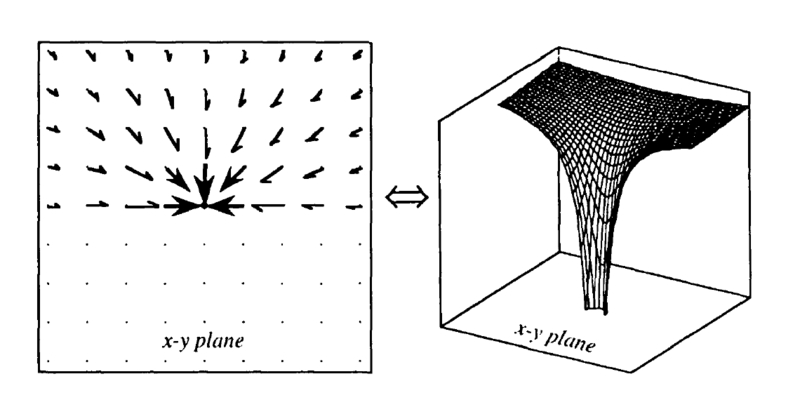
A 2-D slice of a gravitational force vector field (left) is interchangeable with a 3-D gravity well (right), with the z-axis showing energy (potential). Image courtesy of Invent2HelpAll

How junk disperses, or a taphonomy of orbit

In fact, the stratigraphy of space junk does include a terrestrial component. The lowest point of energy in the orbital dynamical system is the surface of Earth: an orbit of zero apogee and perigee. The atmosphere is a barrier or boundary between different gravity regimes, as space objects can bounce off its upper surface, and those that get pulled into it tend to incinerate. However, some spacecraft parts are made of materials like stainless steel and titanium alloys, which have high melting temperatures. Other parts may have carbon-carbon insulation which provides some protection from temperature extremes. Sometimes these components scream at high speed into the atmosphere, with their flesh burning, and fall with a smoking thud to the surface. The so-called 'space balls', titanium pressure vessels, are one of the most common spacecraft parts to survive re-entry. These spheres are the best gravity travellers; they get to come back.

Of course little of the spacecraft is likely to remain in orbit after the main body has re-entered - perhaps some molecules or broken-off bits. When we find the space balls or other Earthbound space junk, it's most likely that this is all that remains of the spacecraft. They've fallen to the point of lowest energy. This includes the spacecraft graveyard at the bottom of the ocean. Earth orbit is bookended by graveyards, if you take into account the graveyard orbit a few hundred kilometres above the geostationary ring. This is where old GEO satellites go to rest in their undead way, as they can still drift down and across the orbits of living satellites.

In general the the structure of space junk is not vertical layers as we're accustomed to in archaeology. Instead, spacecraft decay fragments have an elliptical or cloud geometry. When a spacecraft is whole, all its components are on the one orbital trajectory. Now imagine a solar panel detaching from the main body. Initially, its speed and orbit will be pretty much the same as the main body. But as time passes, the orbits will diverge. If the panel is tracked by one of the Earth-based telescopes, then we will have all the data about it's orbit into the past and will be able to trace it back to the original spacecraft - as long as we keep tracking it.

If a spacecraft explodes, the debris initially forms a cloud around it. The cloud travels together for a little while and then the individual pieces, all with their own weight, size, shape and velocities, start to disperse. If you look at the orbital tracks of Fengyun 1C, the Chinese satellite which was the target of a test missile shot in 2007, the debris rapidly moves apart and starts to spread out as you see here:
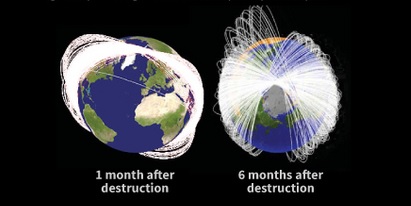
Image result for fengyun 1c
Fengyun 1C debris evolution. Image by Karl Tate @space.com

Position in orbit is described using a set of six equations devised by Johannes Kepler. Usually what people use, however, is Two-Line Elements - a bit like Eastings and Northings. The position is simplified into two strings of numbers. But because of the non-linear unpredictability of orbits, the reliability of the TLEs diminishes pretty fast. After 30 days you can't be sure that the TLE will accurately predict where something is. What this means in practice is that objects have to be continually watched or tracked to know where they are. This is called persistent observation and it's not generally something archaeologists worry about on Earth. However, artefacts on the surface do move around, although very slowly. You can record a concentration of stone artefacts on the surface, but if you revisit the same site a year later, half of them might be missing. Some have worked their way underground; some are covered by vegetation; others have moved under the influence of wind, water, animal movement or land use and industrial activities. Ten years into the future, there may be nothing to see. So perhaps I should apply the principle of persistent observation to terrestrial archaeology after all...

Objects in space are, of course, moving at incredibly high speeds - an average of 7-8 km per second. It's not that objects within archaeological deposits don't move; soils can act as liquids over a long time period, with a gravity-driven convection that gradually makes artefacts rise higher in the profile. Sometimes objects rise to the surface like a fish and get stranded there. Others, like stone tools with narrow sharp edges, slip back in for re-circulation. This is something archaeologists are very interested in as it says something about the integrity of the site and the relationship between objects. We're looking to that relationship to try and work out the human behavioural correlates, so we need to understand how the relationships decay over time due to natural or cultural factors, such as water movement or scavenger activity.

It's the relationship that matters

Both inside Earth and in orbit, the way the relationships between objects within a space evolves over time is critical to working out the human behavioural component. Looking at how the space debris environment evolves, it seems that after a certain amount of time it would be impossible to reconstruct the orbital path and work out what spacecraft a piece of junk came from, if you did not already have tracking records. Let's imagine the scenario of a future human archaeologist after the records have vanished (we can't assume they will survive in their current form) or even an alien archaeologist looking at space debris to get a handle on Earth culture. They will initially use materials and style to identify which space objects belong in the same time frame or to the same culture. They'll also have to work out what differences are due to style, and which to function.

Effectively, orbital archaeologists of the future will be 'recapitulating' a period of terrestrial archaeology before there was absolute dating, when similarities in style were used to posit chronological and social relationships. This period of investigation is known as culture history, and it worked on a number of premises. The first was the definition of culture, which as V. Gordon Childe phrased it, was a consistently occurring suite of artefact types, features and structures that you could attribute to an ethnic group. The second was the assumption that things change over time, coming in and out of fashion. Graphs of the frequency of occurrence of different artefacts types or styles resembled battleship curves, as they were known. Something starts out at a low frequency, then its numbers increase as it becomes popular. Soon the next big thing starts to supersede it and the frequency declines until no-one makes or uses the object any more. This is pretty much what happens in the fashion industry. Using changing frequencies to date an object is called seriation.

Because atmospheric drag pulls objects out of Low Earth Orbit all the time, things that survive there will be those with the greatest numbers, eg rocket bodies. This makes it a matter of sampling. Future archaeologists may not find the rare satellites as easily as the common ones. It's like the famous section in Kent G. Flannery's The Early Mesoamerican Village, a classic of the 1960s-1970s movement known as the New Archeology. A Real Mesoamerican Archaeologist laughs about another's failure to find the city of Teotihuacan using a particular sampling strategy. The Skeptical Graduate Student explains that this is not the purpose of a sampling strategy - and that the sample should produce results in proportion to what exists in the entire population of artefacts.

In another post I'll consider whether we can apply absolute dating techniques to space junk in orbit.


Topological stratigraphy

Terrestrial stratigraphy is locally linear and Euclidean, but orbits are non-linear and non-Euclidean. At larger scales, space is better described as the topological object called a manifold. Stratigraphy might simply be the wrong concept to describe the structure of orbiting objects. What kind of word would we use instead? Perhaps gravigraphy - written in gravity? Or orbitography, which is 'the determination and positioning of satellite orbits by a form of geodesy'?

Visualisations of space junk show Earth surrounded by white dots, like a cloud of silent bees. If you took Earth out of the middle, you would have a donut shape or torus where geostationary satellites are concentrated, and perhaps a series of intersecting tori for low to medium Earth orbit satellites. This is in stark contrast to terrestrial stratigraphy, which is conceptualised in a box-shape (even though Earth is spherical). Objects in this gravitationally-constrained tori move on elliptical paths inside the shape.

Let's put Earth back in. If we sliced a wedge vertically through through this cloud or swam, and froze the objects within it, what would we see? At the outer edge, the graveyard orbit, there'd be a thin smattering of defunct satellites. They are all dead. Below it, in the GEO range, there is thick ring of living and dead satellites. The 'type fossil' of this layer is the winged bird.

Then there is a sparse background scatter of satellites and junk until we hit the navigation satellites in the Medium Earth Orbit range. The US GPS network orbit at around 20, 000 km.

In LEO, we get the highest density of rocket bodies as well as satellites. There is a more diverse size range, from ENVISAT, the International Space Station, to cubesats and nanosats. There is the sparsest smattering of organic material.

There's a dead zone from LEO to the height of the tallest building or structure on Earth. Birds and aeroplanes fly at different altitudes, but they don't stay there or live there. There are gases, clouds, dusts.

On the surface of Earth, the ancient is mixed up with the modern. I suppose it is more like orbit than we might think, the living and the dead jostling side by side. Organic material is dense. Movement is slow. The deeper you go under the surface, the older things become. In this subterranean sphere, everything human is dead.

In all of these layers, the past and the present are mixed up to different degrees. The closer to the present you get, the higher and deeper human culture goes. Mines and building foundations cut into the dead deep past and overlay it with modern material. This is the variable borderland between the Pleistocene, Holocene and Anthropocene, a diachronous boundary that archaeologist Matt Edgeworth and his co-authors (2015) have discussed in an insightful paper (see below).

What is a place in orbit?

I'm relatedly curious about the concepts of setting or site in the orbital environment. Here, a 'place' is really a set of equations that defines the way an object moves - not just now but in the past and into the future. Place is a prediction, effectively. Place is movement, not stasis.

Could an orbital pathway, in and of itself, have heritage significance? Could it be 'preserved', and what would be the relationship between a culturally significant trajectory and the equations that define it? Could those equations, in and of themselves, also be considered culturally or archaeologically significant?

Perhaps in the future, there will be markers along the orbits of significant spacecraft that are not longer there, alerting anyone/thing who approaches that they are at a heritage orbit. Perhaps certain orbits - like Vanguard 1's - could be registered as significant so that nobody can launch something into the same orbit. An orbit has economic significance - so why not heritage significance too?

I think I have a lot further to go in this line of thinking. But it's a start anyway.


References

Matt Edgeworth, Dan deB Richter, Colin Waters, Peter Haff, Cath Neal, and Simon James Price 2015 Diachronous beginnings of the Anthropocene: the lower bounding surface of anthropogenic deposits.  The Anthropocene Review 2(1):33-58

Flannery, Kent G. (ed) 1976 The Early Mesoamerican Village. Academic Press


Friday, May 17, 2019

Key works in lunar cultural heritage: the essential reading list for Apollo 11's 50th anniversary

If you are interested in the issues around managing the cultural heritage values of archaeological sites located on the Moon, these are the key works that you need to read. A bibliography of the broader field of space archaeology and heritage can be found here.


Capelotti, P.J. 2010 The human archaeology of space: lunar, planetary and interstellar relics of exploration. Jefferson NC: McFarland and Company Inc

Capelotti, P.J. 2009 The culture of Apollo: a catalogue of manned exploration of the moon. In Ann Darrin and Beth O'Leary (eds) The Handbook of Space Engineering, Archaeology and Heritage pp 421-441 Boca Raton: CRC Press

Darrin, Ann and Beth O'Leary (eds) 2009 The Handbook of Space Engineering, Archaeology and Heritage. Boca Raton: CRC Press

Donaldson, Milford Wayne 2015 The preservation of California's military Cold War and space exploration era resources. In B.L. O'Leary and P.J. Capelotti (eds), Archaeology and Heritage of the Human Movement into Space, pp. 91-110. Heidelberg: Springer.

Fewer, Greg 2002 Towards an LSMR and MSMR (Lunar and Martian Sites and Monuments Records): Recording the planetary spacecraft landing sites as archaeological monuments of the future. In Miles Russell (ed) Digging Holes in Popular Culture. Archaeology and Science Fiction, pp 112-172 Oxford: Oxbow Books

Gibson, R. 2001 Lunar archaeology: the application of federal historic preservation law to the site where humans first set foot upon the Moon. Unpublished Masters thesis, Department of Anthropology, New Mexico State University, Las Cruces

Gold, R. 2009 Spacecraft and objects left on planetary surfaces. In Ann Darrin and Beth O'Leary (eds) The Handbook of Space Engineering, Archaeology and Heritage, pp 399-419 Boca Raton: CRC Press

Gorman, A.C. and Beth Laura O'Leary 2013 The archaeology of space exploration. In Paul Graves-Brown, Rodney Harrison and Angela Piccini (eds) The Oxford Handbook of the Archaeology of the Contemporary World, pp 409-424. Oxford: Oxford University Press

Gorman, A.C 2019 Dr Space Junk vs the Universe: Archaeology and the Future. Sydney: New South Books

Gorman, A.C. 2016 Culture on the Moon: bodies in time and space. Archaeologies, 12(1) pp. 110-128.

Gorman, A. 2014 The Anthropocene in the Solar System. Journal of Contemporary Archaeology, 1(1) pp. 89-93.

Gorman, A.C. 2013 Look, but don’t touch: US law and the protection of lunar heritage. The Conversation, https://theconversation.com/look-but-dont-touch-us-law-and-the-protection-of-lunar-heritage-20758

Hertzfeld, Henry R. and Scott N. Pace 2013 International Cooperation on Human Lunar Heritage. Science, 29 November, 342(6162): 1049-1050

Lunar Legacy Project, New Mexico State University. http://spacegrant.nmsu.edu/lunarlegacies

NASA 2011 NASA’s Recommendations to Space-Faring Entities: How to Protect and Preserve the Historic and Scientific Value of US Government Artefacts. Human Exploration and Operations Mission Directorate, Strategic Analysis and Integration Division, NASA https://www.nasa.gov/directorates/heo/library/reports/lunar-artifacts.html

O'Leary, B.L. and P.J. Capelotti (eds) 2015 Archaeology and Heritage of the Human Movement into Space. Heidelberg: Springer.

O’Leary, B.L., Bliss, S., Debry, R., Gibson, R., Punke, M., Sam, D., Slocum, R., Vela, J., Versluis, J. and Westwood, L. 2010 The artifacts and structures at Tranquility Base nomination to New Mexico state register of cultural properties. Accepted by unanimous vote by the New Mexico Cultural Properties Review Committee on 10 April 2010

O'Leary, Beth Laura 2015 'To boldly go where no man [sic] has gone before': approaches in space archaeology and heritage. In B.L. O'Leary and P.J. Capelotti (eds) Archaeology and Heritage of the Human Movement into Space, pp 1-12 Heidelberg: Springer.

O'Leary, B.L. 2009 One giant leap: preserving cultural resources on the moon. In Ann Darrin and Beth O'Leary (eds) The Handbook of Space Engineering, Archaeology and Heritage pp 757-780.Boca Raton: CRC Press

O'Leary, B.L. 2009 Evolution of space archaeology and heritage. In Ann Darrin and Beth O'Leary (eds) The Handbook of Space Engineering, Archaeology and Heritage pp 29-47 Boca Raton: CRC Press

O'Leary, B.L. 2009 Historic preservation at the edge: archaeology on the moon, in space and on other celestial bodies. Historic Environment 22(1): 13-18

Reynolds, Joseph 2015 Legal Implications of protecting historic sites in space. In B.L. O'Leary and P.J. Capelotti (eds), Archaeology and Heritage of the Human Movement into Space, pp. 111-129. Heidelberg: Springer.

Rogers, T.F. 2004 Safeguarding Tranquillity Base: why the Earth's Moon base should become a World Heritage Site. Space Policy 20(1): 5-6

Spennemann, Dirk HR and Guy Murphy 2011 [2020] Returning to the Moon Heritage issues raised by the Google Lunar X Prize. Institute for Land, Water and Society Report nº 137. Albury, NSW: Institute for Land, Water and Society, Charles Sturt University.

Spennemann, Dirk H.R. 2006 Out of this world: issues of managing tourism and humanity's heritage on the Moon. International Journal of Heritage Studies 12(4):356-371

Spennemann, D.H.R. 2007 Extreme cultural tourism from Antarctica to the Moon. Annals of Tourism Research 34(4):898-918

Spennemann, D.H. R. 2004 The ethics of treading on Neil Armstrong's footsteps. Space Policy 20(4): 279-290

Walsh, J. 2012 Protection of humanity's cultural and historic heritage in space. Space Policy 28(4):234-243 

Westwood, Lisa D 2015 Historic preservation on the fringe: a human lunar exploration heritage cultural landscape. In B.L. O'Leary and P.J. Capelotti (eds), Archaeology and Heritage of the Human Movement into Space, pp. 131-155. Heidelberg: Springer.

Westwood, L. and B. O'Leary 2012 The archaeology of Tranquility Base. Space Times Magazine 4(51)

Westwood, L., Beth Laura O'Leary and Milford Wayne Donaldson  2017 The Final Mission: Preserving NASA's Apollo Sites. Gainesville: University Press of Florida

Westwood, L., G. Gibson, B. O’Leary, and J. Versluis 2010 Nomination of the Objects associated with Tranquility Base to the California State Historical Resources Commission. Accepted by unanimous vote to the California State Register of Historical Resources on 30 January 2010


Saturday, March 17, 2018

Flaked glass bibliography: a resource for lithics studies

I put this together for my PhD years ago, and sent it to the lithic email discussion list. Until recently it was still available online but the site seems to have disappeared now. Fortunately I kept a copy. Here it is for anyone interested in flaked bottle glass.


Some people are astonished to find that my PhD was nothing to do with space. Just shows you it's never too late to change!


~~~~~~~~~~~~~~~~~~~~~~~~~~~~~~~~~~~~~~~~~~~~~~~~~~~~~~~~~~~~~~~~~~~
Date:    Mon, 29 Jun 1998 12:15:21 +1000
From:    Alice Gorman 
Subject: flaked glass bibliography

Hi.  Here is the glass bibliography.  It's not exhaustive, and focuses on
Australian material, but I hope it will be of some use to those who
requested it.  As I said to John Dockall, it seems that the two principle
uses of glass flakes are woodworking, and surgery/body modification.  If
anyone has any references that I don't have, please let me know!

Alice

~~~~~~~~~~~~~~~~~~~~~~~~~~~~~~~~~~~~~~~~~~~~~~~~~~~~~~~~~~~~~~~~~~~
Allen, J. and Jones, R.  1980  Oyster Cove:  Archaeological traces of the last Tasmanians and notes on the criteria for the authentication of flaked glass artefacts.  Papers and Proceedings of the Royal Society of Tasmania 114:225-233

Casamiquela, R.M.  1978  Tema Patagonicos de Interes Arqueologico:  III. La tecnica de la talla del vidrio.  Relaciones de la Sociedad Argentina de Antrpologia 12:213-223 (Buenos Aires)  (Contact between occidentals and ethnic groups of continental Patagonia and Tierra del Fuego - glass knapping)

Clark, Jeffrey T.  1981  Glass scrapers from Historic North America. Newsletter of Lithic Technology 10:31-34
Cooper, Zarine and S. Bowdler 1998 Flaked glass tools from the Andaman Islands and Australia. Asian Perspectives 37(1): 74-83

Deal, M. and Hayden, B.  1987  The persistence of pre-Columbian lithic technology in the form of glass working.  In B.Hayden (ed)  Lithic Studies among the Contemporary Highland Maya.  235-331.  University of Arizona Press  (About glass scrapers at Dinamarquero)

Gallagher, J.P.  1977  Contemporary stone tools in Ethiopia:  Implications for archaeology.  Journal of Field Archaeology 3(4):407-414   (glass reference p 408)

Gojak, D.  1981  Flaked glass from Wybalenna, Flinders Island.  Unpublished manuscript

Hayden, B. and Nelson, M.  1981  The use of chipped lithic material in the contemporary Maya highlands. American Antiquity 46(4):885-898  (Replacement of obsidian with bottle glass)

Holmes, W.H.  1919  The Lithic Industries.  Handbook of Aboriginal American Antiquities Part I  Bureau of American Ethnology, Bulletin 60, Washington

Jackson, D.  1991  Raspadores de vidrio en Dinamarquera:  reflejo de una encrucijada cultural.  Anales del Instito de la Patagonia 20:57-67.  Serie Ciencias Sociales, Universidad de Magallanes, Punta Arenas.

Jackson, D.  1991  Los instrumentos de vidrio de Cuarta Chorillo, Coasta de Bahia Santiago, Estrecho de Magallanes.  Anales del Instito de la Patagonia 20:69-74.  Serie Ciencias Sociales, Universidad de Magallanes, Punta Arenas.

Knudson, R.  1979  Inference and imposition in lithic analysis.  In Brian Hayden (ed)  Lithic Use-Wear Analysis  Academic Press, New York pp 269-281 (Spurious glass artefacts from the Homestead site)

McCary, B.C.  1962  Artifacts of glass made by the Virginia Indians. Bulletin, the Archaeological Society of Virginia 16(4):59-61

Man, E.H.  1932  On the Aboriginal Inhabitants of the Andaman Islands. Second Edition.  Royal Anthropological Society of Great Britain and Ireland, London

Martinic, M. y Prieto. A  1986  Dinamarquero, Encrucijada de Rutas Indigenas.  Anales del Instito de la Patagonia 16:53-83.  Serie Ciencias Sociales, Punta Arenas.  (Ethnographic description of glass scraper knapping.)

Mitchell, S.R.  1949  Stone-Age craftsmen:  Stone tools and camping places of the Australian Aborigines.  Tait Book Co Pty Ltd, Melbourne  (Kimberley points)

Mulvaney, D.J.  1969  The prehistory of Australia.  Thames and Hudson, London

Neil, Wilfrid T.  1977  Knapping in Florida during the historic period. Florida Anthropologist 30(1):14-17

Plomley, N.J.B.  1966  Friendly Mission:  The Tasmanian journals and papers of George Augustus Robinson 1829-1834.  Tasmanian Historical Research Association, Hobart  (Use of glass flakes for surgery; other uses and use by women)

Poplin, Eric C.  1986  Expedient technology in European North America: Implications from an Alternative Use of Glass by Historic Period Populations.  Unpublished PhD Thesis, Unversity of Calgary, Alberta

Runnels, C.  1975  A note on glass implements from Greece.  Newsletter of Lithic Technology IV(3):29-30

Runnels, C.  1976  More on glass implements from Greece.  Newsletter of Lithic Technology IV(3):27-31

Spencer, Sir Baldwin  1928  Wanderings in Wild Australia.  Macmillan and Co Ltd, London (Flaked glass & porcelain on the Overland Telegraph)

Tindale, N.  1941  A Tasmanian stone implement made from bottle glass. Papers and Proceedings of the Royal Society of Tasmania pp 1-3

Tindale, N.  1937  Tasmanian Aborigines on Kangaroo Island, South Australia.  Records of the South Australian Museum 6:29-37 (Glass artefacts)

Akerman, Kim  1978  Notes on the Kimberley stone-tipped spear focusing on the point hafting mechanism.  Mankind 11(4):486-489 
Allen, J.  1969  Archaeology and the History of Port Essington (Northern Territory)  Unpublished PhD Thesis, RSPaS, ANU, Canberra

Allen, J.  1973  The archaeology of nineteenth century British imperialism: An Australian case study.  World Archaeology 5:44-59

Anderson, June  1981  Survey for Aboriginal Sites in the North Dandalup and Little Dandalup Dam Project Areas, Western Australia  Report to the Metropolitan Water Supply Sewerage and Drainage Board, Perth

Anderson, June  1984  Between Plateau and Plain.  Flexible Responses to Varied Environments in Southwestern Australia  Occasional Papers in Prehistory 4  Department of Prehistory, Research School of Pacific Studies, ANU, Canberra

Backhouse, J.  1843  A Narrative of a Visit to the Australian Colonies London p 103, p 433

Balfour, H.  1903  On the method employed by the natives of N.W. Australia in the manufacture of glass spearheads.  Man 3(35):65

Berndt, R.M.  and C.H.  1954  Arnhem Land  Melbourne

Birmingham, J.  1976  The archaeological contribution to nineteenth century history:  Some Australian case studies.  World Archaeology 7:314

Edge-Partington, J.  1915  Obituary, Norman H. Hardy, d. January 10. 1914. Man: 9-10

Elkin, A. P.  1948  Pressure Flaking in the Northern Kimberley, Australia. Man 130 (Kimberley points)

Flood, J.M.  1970  A point assemblage from the Northern Territory Archaeology and Physical Anthropology in Oceania V(1):27-52

Gould, Richard A.  1969  Yiwara:  Foragers of the Australian Desert. Collins, London and Sydney

Gould, Richard A.  1971  The lithic assemblages of the Western Desert Aborigines of Australia.  American Antiquity 36:149-169

Harrison, Rodney  1996  It's the way it shatters that matters.  An analysis of the technology and variability of Aboriginal glass artefacts in the Shark Bay and Swan regions of Western Australia.  Unpublished B.A, Hons Thesis, University of Western Australia.

Hayden, Brian  1979  Palaeolithic Reflections.  Lithic Technology and Ethnographic Excavation Among the Australian Aborigines  Australian Institute of Aboriginal Studies (Canberra) and Humanities Press Inc (New Jersey)

Jones, R.  1971  Rocky Cape and the problem of Tasmanians.  Unpublished PhD Thesis, University of Sydney.  (Summary of uses of glass)

Knowles, Sir Francis H.S. Bart  1953  Stone-Worker's Progress:  A study of stone implements in the Pitt Rivers Museum  Occasional Paper on Technology 6  T.K. Penniman and B.M. Blackwood (eds)  Oxford University Press, Oxford


Lewis, Shelagh  1977  Australian Aboriginal Material in Manchester Museum Manchester Museum Publication No NS 5. 77  Manchester

Love, J. R. B.  1936  Stone Age Bushmen of Today  London

Macknight, C.C.  1970  The Macassans - study of the early trepang industry along the Northern Territory coast.  PhD, RSPaS, ANU

Macknight, C.C.  1972  Macassans and Aborigines.  Oceania 42:283-321

McBryde, Isabel  1982  Coast and Estuary.  Archaeological Investigations on the North Coast of New South Wales at Wombah and Schnapper Point  with contributions by V.M Campbell, K.H. Lane, K. McQueen and N.A. Wakefield. Australian Institute of Aboriginal Studies Canberra  (possible glass scrapers)

McCarthy, F.D.  and Davidson, F.A.  1943  The Elouera industry at Singleton, Hunter Valley, NSW.  Records of the Australian Museum (2):226-227

McCarthy, F.D. and F.M. Setsler  1960  The archaeology of Arnhem Land Records of the American-Australian Scientific Expedition to Arnhem Land Volume 2,  Melbourne pp220-223  (Macassans)

McCourt, Tom  1975  Aboriginal Artefacts.  Rigby, Adelaide

Mulvaney, D.J.  1966  Beche-de-mer, Aborigines and Australian history. Crosbie Memorial Lecture.  Proceedings of the Royal Society of Victoria 79(2):449-457

Searcey, A.  1907  In Australian Tropics  London

Simpson, Colin  1951  Adam in Ochre  Angus and Robertson, Sydney

Spencer, Sir Baldwin  1928  Wanderings in Wild Australia.  Macmillan and Co Ltd, London (Flaked glass & porcelain on the Overland Telegraph)

Tindale, N.  1925-8  Natives of Groote Eylandt and the West Coast of the Gulf of Carpentaria.  Records of the South Australian Museum III:61-134

Westlake, E.  n.d  Tasmanian field fournals of E. Westlake  Unpublished manuscript in the Pitt Rivers Museum, Oxford.  (Copy in AIAS Library, Canberra)  Comments by Mrs Hughes
~~~~~~~~~~~~~~~~~~~~~~~~~~~~~~~~~~~~~~~~~~~~~~~~~~~~~~~~~~~~~~~~~~~ Alice C. Gorman Department of Archaeology and Palaeoanthropology (02) 67 73 2306 e-mail: agorman@metz.une.edu.au
~~~~~~~~~~~~~~~~~~~~~~~~~~~~~~~~~~~~~~~~~~~~~~~~~~~~~~~~~~~~~~~~~~~


Additions to the bibliography:

Ulm, Sean, Kim Vernon, Gail Robertson and Sue Nugent 2009 Historical continuities in Aboriginal land-use at Bustard Bay, Queensland: results of use-wear and residue analysis of Aboriginal glass artefacts. Australasian Historical Archaeology 27: 111-119


Tuesday, February 13, 2018

Historic images of the Earth from space - how the view from the Tesla Roadster compares.

On February 6th 2018, Elon Musk launched his own personal midnight cherry Tesla Roadster into space on a test Falcon Heavy rocket. The car went sailing away from Earth with a mannequin in a spacesuit, a copy of Isaac Asimov's Foundation series on a disc, a Hitchhiker's Guide the the Galaxy Don't Panic sign, and a plaque engraved with 6000 names of SpaceX employees. There may have been some other things, but finding a reliable source is harder than you'd think.

Now that the dust is starting to settle, I want to think about something else - some of the iconic, world-changing images of the Earth from outside, and the addition of this new one seen from the front seat of a car.

Here they are:

Apollo 8, 1968

Image credit: NASA


Apollo 17, 1972

Image credit: NASA

International Space Station, 2011


The Cupola on the ISS, 2014

Image credit: NASA

Tesla Roadster, 2018

Image credit: SpaceX

This is something that I'll have to think a lot more about, but here are a few initial impressions. 

Early conceptualisations of what the Earth looked like from outside tended to be greyscale: it was assumed that the blue sky would only appear so from the surface of the Earth (due to Rayleigh scattering). The blueness of the Earth was a surprise that came with the first human spaceflight missions. It was translated into the blue marble, and the pale blue dot, in a colour scheme including white, black, and muted tones. 

Another factor is the presence or absence of the photographer. In the Apollo 8 and 17 images, there's no hint of them. Their absence accentuates a separation of the natural and cultural, setting the human observers apart from the world they're capturing on film. In the case of the whole ISS, the image is taken by a service vessel approaching or departing. We still don't see the photographer.

So many images of the ISS show the space station in relation to the partially curved Earth. Space is closer to us, with people living just a few hundred kilometres above our heads. Then we get the astronaut's eye view, as if we are telepresencing from inside their bodies. These shots are often taken from the Cupola, and often there are people in them. It's a more intimate relationship to the Earth, but it's always looking down. We have a more integrated view of the interconnectedness of Earth and space.

So what about the Tesla Roadster? The addition of the red colour against the blue and white is striking. The effect is almost cartoon-like. 

The other big contrast is how dominant the human presence is - and it's not even human! The Earth is only a backdrop: we're meant to focus on the car in the foreground. I don't know where the camera filming was (this is a still from the video), but we have both a hidden observer and a portrait of the Starman. (We can't see the rocket body which is apparently still attached).

While the other images are related to sensibilities of the Earth's fragility, environmental awareness, the erasure of national borders and the insignificance of Earthly conflicts and struggles (aspects of the Overview Effect), I don't think this is what is going on here.

The faceless driver is not even looking at the Earth. They're focused on leaving. 

I think this is a radical paradigm shift. I don't fully understand what it means yet, but I'm pretty sure others are going to start analysing this as we get further away from the event. 


Monday, December 04, 2017

The right stuff: how archaeologists come to be.

Am I an archaeologist because I'm interested in the stuff? Or am I interested in the stuff because I'm an archaeologist? Which came first?

Some time ago, I was talking with the erudite Dr Duncan Wright about how common it was for archaeologists to have been collectors as children. I collected fairly ordinary things - shells, stamps, feathers, and tram tickets, and had hoards of apricot stones stashed in hollows of trees. Nothing more exotic than that. Today, I have a possibly unhealthy interest in lids, pencil cases, tiny spoons, and the fairies-on-sticks that you buy at agricultural and horticultural shows. (There's a whole cabinet at the Pitt Rivers Museum full of tiny tiny spoons for removing ear wax! Oh the splendour! And there is nothing more satisfying than a well-fitting lid, not a screw-top like on a jar, but a tea pot lid, for example). Healthier collecting interests are space things (obviously), icons, fans, gloves and hats, 1960s tea cups and other ceramics, and stone tools. (This feels a bit confessional. Don't judge me).

The tactile and aesthetic qualities of things are important. I think I like tiny spoons because of the scale; perhaps this a child's interest in the miniature. Gaston Bachelard has a whole chapter on the miniature in The Poetics of Space.

With the 1960s tea cups, it's the asymmetric ones that appeal; they seem subversive and space age-y.  And they are lovely to drink from too.

Fans and gloves are elegant (Dr Space Junk is all about elegance) and old-fashioned; but they are also bloody useful things to own in hot or cold weather, so I love that they can be both beautiful and functional. The mark of a perfect fan is how silent it is when you use it. 

Pencil cases partake of that too, and they are of course receptacles for treasured pencil stubs and beautiful pens that are a pleasure to write with. These days I store assorted USB sticks in my pencil case as well.

So perhaps I was interested in the stuff first.  Perhaps that's why I'm an archaeologist, apart from, as Heather Burke says, being nosy.

I guess what I'm getting at here is partially the difference between history and archaeology.  Would I be content to just read about places and things? I remember the experience of being at the Centre Spatial Guyanais at Kourou, and my delight and satisfaction at placing my palm flat on the surface of an Ariane 5 rocket booster, leaving an invisible hand print of bacteria and oils. The physicality of things, the materiality, does matter to me. I want to touch them. (The continual temptation of art galleries and museums).

In historical archaeology, one of the underlying principles is that the artefacts and places can tell the stories of people who get left out of histories, often the oppressed and poor. So it has a political dimension of giving forgotten people a voice through the material traces they leave behind. It's not just stuff any more; it's stuff that speaks.


Monday, October 16, 2017

A gallery of shadow astronauts Part 1

For the last few years, I have been playing with the idea of shadows as part of a site's fabric. It's not just about the hard materials. It's about the soft, the fleeting, the ephemeral, and the symbolic: about the interplay of darkness and light, presence and absence, loneliness and companionship.

Apollo 11. Shadow: Neil Armstrong. NASA

Apollo 12. Shadow unknown. NASA

Apollo 12. Shadow: Pete Conrad. NASA

Apollo 14. Body + shadow: Alan Shepard. Shadow: Edgar Mitchell. NASA

Apollo 14. Astronaut shadow unknown. NASA

Apollo 15. Shadows: Dave Scott and Jim Irwin. NASA
In these images, I'm interested in the astronaut who is not in the picture, whose presence is revealed by their shadow. It's also about the insubstantial shadow in relation to the hard and solid objects. In the image immediately above, it looks like the shadow of Jim Irwin is attempting to capture the solid stick-insect shape of the tripod with a shadow net. 

There's a pattern of elongated legs. The bodies are distorted, and also cyborg: in the shadow, flesh and camera meld into one amorphous shape.

The photos are silent, although we do have a beepy staticky soundtrack to them in our heads, implanted by the Apollo 11 television footage. Somehow the shadows accentuate the silence.

I particularly like Pete Conrad's shadow cast in the crater as he stands on the edge looking down. The angle of his body makes the shadow appear as if in profile, creeping silently along a shadow ridge to what end we cannot know. It has a dream-like quality.

We could say that of all the shadows, perhaps. Were they not caught in the photograph like a fly in amber, they would have vanished without trace in seconds, as evanescent as the dream on waking.


Saturday, June 03, 2017

Cable ties in literature: from the boudoir to the post-apocalyptic

It's no secret that I have an obsession with cable ties. The nice thing is that when I explain their fascinating history to people, they often catch the bug as well, coming to appreciate the stunningly simple design of this monumentally successful piece of technology. If you want to know the full story, you can read my paper on cable ties here.

Anastasia Steel and Christian Grey in the cable tie section of the
hardware store. I mean seriously. What a depauperate population
of the popular plastic fastening device.
Sadly, cable ties have not yet set the world of literature alight, unless you count their famous appearance in Fifty Shades of Grey. I would say that E.L James paid insufficient attention to cable ties as critical material infrastructure in her novel; and the range of cable ties available in the hardware shop in the film version is frankly disappointing.


Hugh Howey's Wool is a different proposition. I was lent this book by a friend and was astonished that I hadn't heard of it before. It was immediately enthralling, and there really is nothing nicer than finding a new author whose work just makes you want to read more.

So you can perhaps imagine my breathless excitement when I started Chapter 21 of Wool to find a description of CABLE TIES OF THE FUTURE.

Oh yes.

So here, for your delectation, is the passage in question. I don't think there are any spoilers in it if you haven't read the book.

The next morning Juliette arrived early at her desk having stolen little more than four hours of sleep. Beside her computer, she saw a package waiting for her: a small bundle wrapped in recycled pulp paper and encircled with white electrical ties. She smiled at this last touch and reached into her overalls for her multi-tool. Pulling out the smallest pick from the tool, she stuck it into the clasp of one of the electrical ties and slowly pulled the ratcheting device apart, keeping it intact for future use. She remembered the trouble she'd gotten into as a mechanic's shadow the day she'd been caught cutting a plastic tie from an electrical board. Walker, already an old crank those decades ago, had yelled at her for the waste and then shown her how to tease the little clasp loose to preserve the tie for later use. 
Years had passed, and when she was much older, she had found herself passing this lesson on to another shadow named Scottie. He had been a young lad at the time, but she had had a go at him when he had made the same careless mistake she once had. ... 
She loosened the other tie crossing the package and knew the bundle was from him. Several years ago, Scottie had been recruited by IT and had moved up to the thirties. He had become 'too smart for Mechanical', as Knox had put it. Juliette set the two electrical straps aside and pictured the young man preparing this package for her. The request she'd wired down to Mechanical the night before must've bounced back up to him, and he had spent the night dutifully doing her this favour. 
She pried the paper apart carefully. Both it and the plastic ties would need to be returned; they were both too dear for her to keep and light enough to porter on the cheap. As the package came apart, she noticed that Scottie had crimped the edges and had folded these tabs under each other, a trick children learned so they could wrap notes without the expense of glue or tape.

Scottie leaves her a note: Keep the ties - I got plenty. 

Where do I start? There is so much going on here, and although I believe there are some technical unlikelihoods, on the whole Howey has paid the cable tie much greater respect as an artefact than E.L James.

At this point I must digress. I searched for a link to Wool to include and discovered something that astonished me. Another reviewer HAS ALREADY COMPARED WOOL TO FIFTY SHADES OF GREY.

What.

Science fiction's answer to Fifty Shades of Grey, the review in the Guardian says. Perhaps I missed the BDSM scenes in Wool. I'm pretty sure I did. And I may be wrong, but I'm also pretty sure that few reviewers take the cable tie approach to literature. Well there's nothing for it but to read this other review.

Ah, now I read that the comparison is made on the basis that both works were initially self-published. There is no mention of cable ties. So I shall continue.

Juliette's cable ties are described as 'white electrical'. This is the industrial context in which cable ties were first invented, when Maurus C. Logan visited the Boeing factory in 1956 and watched the workers tying up the electrical wiring in an aircraft. He was employed by US electrical outfitters Thomas and Betts. Since their first manufacture, cable ties migrated into everyday life and a myriad of uses securing every kind of thing. Here, in the isolated culture of the silo, sealed off against the toxic world outside, cable ties have retreated to their original use.


Colour is significant in cable tie manufacture. Black cable ties are generally intended for outdoor use; their carbon content makes them UV resistant. In the silo, the cable ties are white. They will never be used outside, as no-one can survive outside in the poisoned atmosphere. They're like little pale fishes trapped in an underground pool.

There are two types of cable ties, those which have to be cut off and can't be re-used, and re-usable ones, which need to be undone with a special tool. It's not entirely clear from Howey's account which is intended here. If you loosen the ratchet head, will it really be useable again as it won't engage with the ridged tail? Juliette doesn't seem to be using a specialised tool, just the smallest one from her panoply.

This is a minor point against the real implications of the passage however: that in the closed world of the silo, an artefact that was once mass-produced and discarded without thought is now precious and valuable.

The cable ties are symbolic here as well: Scottie is using them as a material allusion to the history that he and Juliette share, knowing that they will make her recall the past. They symbolise the passing on of knowledge: the creation of new bonds - as well as their dissolution. They are used to secure the parcel, but they are part of the gift as well.

Fastening is an art when materials to secure objects are in short supply. The parcel is a contradiction of meanings. Scottie has used the valuable cable ties to hold it all together, but in the first layer he has employed the technique learned from childhood to fold the paper together. Here we see a discipline of alternatives in an alternative world.

I particularly appreciate the thought that has gone into this passage, projecting a social and technological context for an artefact of the present into the future. It's what science fiction does best.

So my Cable Ties in Literature Award today goes to Hugh Howey for Wool. It is perhaps not quite on the level of other literary awards, given the small pool of nominees. Nevertheless, I regard it as an achievement. Congratulations, Hugh.


Sunday, February 12, 2017

Surveyor 3 - the only multi-occupation site on the Moon

I've been looking at the amazing pictures of astronaut Alan Bean visiting the Surveyor 3 robotic lunar landing craft to remove a camera for return to Earth, in 1969. Something so obvious suddenly struck me and I wondered why I had not seen it before.

Surveyor 3 was part of a series of landing missions that left seven craft on the surface of the Moon. In November 1969, Apollo 12 landed on the edge of a crater, just 180 m from Surveyor 3, launched two years before. The two astronauts, Pete Conrad and Alan Bean, walked over the Surveyor 3 and removed a camera and a couple of other pieces for analysis. (This analysis showed evidence of 'scouring' on the Surveyor surfaces, a result of dust stirred up by the Apollo 12 landing).

Image courtesy of NASA
All of the Apollo sites are of a particular type: there's a landing module, numerous places where samples were taken, cameras and flags set up, the 'toss zone' of discarded objects, the odd rover, and countless astronaut bootprints. 

Surveyor 3 is the only lunar site with astronaut footprints that was not a human landing mission. So you have an interesting mismatch of archaeological traces - a spacecraft which is not capable of containing human bodies, nor of moving, yet surrounded with the evidence of human movement.

You could argue that Surveyor 3 and Apollo are now part of the same site as they preserve evidence of interaction between the two locations. They're close in both time and space.

It's like a rockshelter with archaeological deposit, with only sparse evidence of occupation - some stone tools and a hearth - at 18 000 years before present (bp), followed 10 000 years later by a denser layer of stone tools, bones, and hearths. Imagine this time frame telescoped with the acceleration of modern technology and spread flat across the landscape instead of stratified.

In archaeology, it's not unusual to find evidence of people incorporating artefact and places from the past into their lives. Stone tools from older campsites are re-used and sharpened, sometimes thousands of years later; masonry is scavenged from old buildings to be incorporated into newer ones. This is a practice known as spolia

This isn't exactly re-use; it's more in the nature of a scientific sample. Still, it illustrates something about how artefacts often move between space and Earth and end up out of context.

So, unlike all other lunar landing sites at the present time, the Surveyor 3 site is the only one which is the result of multiple visits. It's a rare human-robot encounter on a far world, receding further into the past with each passing year.

And incidentally, 2017 is Surveyor 3's 50th anniversary. 


Friday, November 25, 2016

A map of all the space junk that has re-entered over Australia

Today someone wrote to me to ask for help in identifying a piece of space junk which had been found in Queensland some years ago. Dr Space Junk is always happy to help, so I sent off a brief explanation.

This made me think, though, of how interesting it would be to map the location of all known re-entry events. There'd be a whole bunch of Skylab in Western Australia, some material from the Europa launches from Woomera in the 1960s in the Northern Territory and Queensland, and many pressure vessels used in rocket fuel systems - globally, these are the most common component to survive re-entry as they're usually made from titanium, stainless steel and/or carbon-carbon. Because of Australia's location, many rocket bodies fall back to Earth over our landmass. We're well situated for observing and tracking the LEOP (Launch and Early Orbit) phase of launch so it makes sense that the second and third stages are likely to re-enter in our vicinity.

You could compare the distribution of this junk with the meteorite entries being mapped by the Western Australian Fireballs in the Sky project, which asks citizen observers to send in data whenever they see some flaming object heading towards Earth. And of course there's also the tektite strewn fields.

I might just expand it to include anything that falls from the sky, as it's likely there's stuff that my Friday-arvo brain has forgotten about at the moment. The more I think about it, the more I think this could be an extremely interesting map to create and I wonder why I've not thought of it before. Such a deliciously simple idea that could lead to - well I don't really know just yet, but it's sure to be something!


Sunday, November 06, 2016

Do objects and people cast shadows inside the International Space Station?

Do astronauts cast shadows in space?

Astronaut Mike Hopkins casts a spoon shadow. Image courtesy of NASA.

I've been thinking about shadows a lot, and also space stations. This has involved reading about habitability studies, an area I started to investigate when I was writing about Skylab a few years ago. The point of this line of enquiry is whether shadows are considered when the interiors of space stations are designed. Perhaps they contribute to creating a feeling of homeliness. Perhaps a lack of shadows is something characterising a laboratory environment, or a solitary confinement cell, or a padded cell, and hence to be avoided. Astronauts are, after all, under constant surveillance. You can hide things in shadows. Things can hide themselves in shadows.

It's worth observing that a shadowless environment can occur when you have no light, or when you have too much light.

Part of the answer to this is how, when, where and with what the ISS is illuminated. It appears that the lighting at present is a combination of fluorescent and LED.  

A perusal of images of the interior shows that there are certainly shaded areas, and more highly illuminated areas. The restricted interior space, and the curvature will also have an impact on the appearance of shadows. Have a look at this one:

Image courtesy of NASA
Of course, when we see images of the inside, they are generally illuminated. But the space station is also darkened at 'night'.  Recently astronaut Alexander Gerst took a series of rather spooky pictures with the lights turned off. Clock this and tell me it doesn't send chills down your spine:

Image courtesy of NASA
Do you see that the helmets are hooded? Is this from fear of what you might see if you looked through the visor?

Perhaps illumination inside the ISS is designed to avoid the ever-present uncanny, always just out of sight, in another module, or outside the window....


Wednesday, August 24, 2016

From aerospace to everyday life: the trajectory of cable ties.

This is our poster for the World Archaeological Congress in Kyoto in a few days time! My co-author is the wonderful Aylza Donald, who has caught the cable tie love.


Sunday, May 22, 2016

Artefacts are the skeletons of people's minds

The words above popped into my mind recently as I was thinking about the archaeological stuff I wanted to teach the first years. I wrote them on a piece of paper and drew a box around them, to distinguish it from other fragments of thoughts, scribbled in passing on the same piece of paper, which go something like this:


I will figure out what I was thinking about them another time. For now, I'll just try to excavate my thoughts around the bony artefacts. I was thinking about them as physical skeletons, fleshed out by wishes, dreams, meanings, social interactions, the accumulation of touches, the passing of time, the clothing of use.

The brain, of course, already has a bone in the form of the skull. When I'm thinking about the skeletons of mind, I mean the artefacts are the hard bits of the soft brain tissue. They just happen to be outside the cranium and sometimes vastly larger than it.

While living, in its systemic context, the artefact can be visible or invisible depending on where or when it is interacted with. It can be in the foreground or the background. It might appear in dreams as something half-registered, barely impinging on the dream-consciousness. It might be perceived only from its shadow. 

(And indeed this begs the question of virtual worlds and how humans interact with objects which cross different registers of existence).

The artefact moves in and out of our perception in a pattern much like a dynamical system. Then people for whom the artefact was meaningful pass on, or discard it. Eventually, it ends up at the point of lowest energy - it's archaeological context.

Dynamical system. Image courtesy of Henry Harrison
http://www.mathworks.com/matlabcentral/fileexchange/40812-dynamical-system-viewer

The layers of organs, muscles, skin, slowly decay as it falls out of memory. The forces of taphonomy start to strip it down and pare it back from corpse to skeleton.

Let's take the metaphor further and think about the mineralisation of the once dynamic and malleable artefact. It takes on the character of stone and sinks like one to the bottom of the pool where only the rare worm tunnels through the silt to touch its surface in a polychaete kiss.

And then we dig it up.......and hope to apprehend its place within the brain as a calcreted thought.


Saturday, November 21, 2015

Bus stop taphonomy: an experiment in contemporary archaeology

Most mornings I wait at a certain bus stop to catch the 300 up to Flinders University. There's a large tree, and a strip of scraggly grass on clayey soil. When it's really wet, I have to watch my steps as it gets quite slippery. Along the streets are houses and one business, a mower shop cheerfully painted in bright yellow and green - very useful as in the dark as a landmark.

Often when I'm standing there waiting, I notice small items of rubbish. Sometimes I even collect them, thinking of my Modern Material Culture class. One time it was a small pink plastic flower with a flat back, that looked like it had fallen off a toy. Once it was a battered piece of orange plastic bunting, still attached to a section of rope, and a crushed texta lid. A couple of mornings ago, there was a broken glass bottle in the street, and I collected a fragment which, in a different context, might be mistaken for deliberately flaked glass. This one was for my Archaeology of Australian Stone Artefacts class.

It's best to collect objects quickly, as they often don't last long. Since Monday, the broken glass pile has diminished. There's none of it still to be seen on the grass verge where I'm standing, only on the asphalt where it was smashed. I don't know where the stuff goes. Blown or washed away, or does a council employee come along at night and pick the grass clean? Perhaps the movement of humans, dogs, birds and bicycles shuffles the artefacts along until they're just out of my sight.

With a pocketful of snap-lock bags and a will, I could make this into an interesting experiment. I could, each day, collect whatever I could see in my 5 m radius. Some days it might be nothing at all. I'd have to take note of weather, visibility, any local events that might be relevant. For example, I'm pretty sure the orange bunting derives from the installation of the controversial NBN cables in the street. 

How long have these objects been in the street before they pass my bus stop? I assume they're recent, but perhaps they have been circulating for a while. I could tag one and see how far it travels. Perhaps the crushed texta lid originated out Salisbury way, and has traveled through the streets and gutters of Adelaide town to my bus stop, only to be captured and objectified.

What is their life span? How long does it take before UV exposure, and chemical and mechanical weathering cause these objects to disintegrate? What is their size range? Do they fly under the radar because they are generally small, less then 10 cm or so? What makes them so invisible?

What would I find out if I collected them for a year?


Sunday, October 11, 2015

Satellites are little knots of materiality in an invisible electromagnetic tapestry

Satellites go beyond the limits of human bodies to be our senses in the void. They are conduits of information in the form of signals in different wavelengths, mediated and managed by the hardware of transponders, antennas, modulators, processors, and data storage facilities. Without communication, they have no function, whether this is gathering data from the solar system or deep space to send back to earth, or transmitting terrestrial telephone and television around the planet. These signals are the real purpose of the hardware. Satellites are little knots of materiality in an invisible electromagnetic tapestry.

In the nearly 60 years since launch of Sputnik 1, the rara avis has become a veritable flock. There are over 23 000 tracked objects over 10 cm, and over 100 million particles less than a centimetre in size currently located between Low Earth Orbit and the so-called ‘graveyard orbit’, approximately 36 000 km above the surface of the Earth. A mere 6% of these objects are operational spacecraft. Their chronological range is from 1958 (Vanguard 1, the oldest surviving spacecraft, with its upper launch stage and a loose clamp) until the present time. In weight, the accumulated debris is estimated to be 6000 tons. But I argue that this ‘space junk’ represents far more than just a risk or hazard to operating spacecraft and satellites, as it is regarded by space industry, or an all-too-familiar pollution problem: it is the repository of human ideologies and values – capitalist, communist, mercantile, colonial, gendered, scientific, environmental and cosmological.  As junk, it is the proper study of archaeologists, who excavate through what is discarded in the garbage heaps of history, to find the significance in what people consider to be without value.


(This is a passage I removed from a recently submitted paper, but I quite like it despite that)