Showing posts with label Dr Space Junk. Show all posts

Saturday, March 10, 2018

An anatomy of street harassment

This is something that happened to me a couple of years ago, and it's absolutely text book. I'm writing about it as men sometimes ask how women tell the difference between someone who's interested in them, and someone who's harassing them. So I'm going to tell this story to elucidate some of the finer points. I'd be very surprised if every female reader didn't immediately recognise this experience.....

It starts in the early evening on a university campus, where I've been attending a conference. I'm waiting at the bus stop, by myself, in order to go into the city for the conference dinner. I've got a book to help pass the time. But it's starting to get dark, and I'm a little unsure about how to get to my destination. 

A man walks into the bus shelter.

WATCHPOINT
Do I acknowledge his presence? Do I keep my head in my book and pretend he's not there?

DECISION
Acknowledge. It's not that dark, he's most likely a university student, there's no reason not to be friendly.

ACTION
'Good evening!' he says. 'Hello!' I say, and return to my book. I've been polite to a fellow traveler, and the interaction could end here.

But he keeps talking. Asks me if I'm a student here too, what I'm studying. I'm at a conference, I tell him, and explain a bit about it. He tells me about his thesis. All very pleasant and light-hearted. I would actually be rather reading my book, this is a little intrusive into personal time and space, but hey, why not? Sometimes you meet nice people in random places, and it's no big deal after all. Ten minutes of my time to learn about someone else's life. He also advises me not to catch the bus the online journey planner recommended; his local knowledge is useful here. Catch the next bus, he says, it's a more direct route to the city.

The bus arrives.

WATCHPOINT
This is also the bus he is catching. Do we sit together to continue the conversation or not? Does he expect me to? Do I owe him more conversation for telling me about the bus?

DECISION
No. We have had a pleasant conversation already. I have been in too many of these situations before, and feel that this is the logical disengagement point. I will sit in a different part of the bus, if I can.

ACTION
He boards the bus, sits halfway down. I sit near the front and continue to read my book. Someone boards and sits beside me. Excellent, no spare seat.

So we travel on. It's dark by now. As we draw closer to the city, the person sitting next to me gets off. I'm aware that he has seen this and I'm now exposed again. Sure enough, he comes up and says, 'Do you mind if I sit with you?'

WATCHPOINT
OK. This is where I really know where this is going. I'm 50 years old. I can say no. But it seems ungrateful. After all, he did help give me advice about which bus to catch. On the other hand, I know this script all too well.

DECISION
It's another ten minutes of conversation. He's pleasant enough. It would feel mean to say no. I'll make leaving the bus the definitive cut-off.

ACTION
'Sure', I say to him.

So we chat away, and finally we're in the city. We both get off the bus. 'Well', I say, 'it was lovely to meet you, good luck with your thesis, and have a great evening'. 'Oh', he says, 'are you sure you know how to get to your conference dinner? I could walk you'. 'No, really, it's fine. I have my phone and I'm perfectly fine by myself. Thank you though, it's very kind of you to offer'. But he doesn't give up. We go over this point a number of times, he's got plenty of time, he's very happy to walk with me, no I'm fine, how kind, but no, I don't need him to walk me, I'm sure he's keen to get home, no really he has heaps of time, he doesn't mind, it's on his way home anyway.

WATCHPOINT
Short of being even blunter, there is no way out of this impasse.

DECISION
I don't really want to be brutal, even though I know what the consequences are likely to be. But perhaps I'm wrong. He may just be a kind person. And what if I do get lost in the dark streets?

ACTION
'OK', I say, 'if you're sure it's not out of your way'.

WARNING WARNING WARNING

It's not that I feel in any physical danger from this person, although one can never rule it out. I'd also feel differently if I was on my way home, and he would find out where I lived. I'm just going to a function centre. But I'm a few too many steps down the decision tree now. All I've done is postpone the moment where I have to shut it down. I've been soft and cowardly in order to avoid the horrible experience of feeling you've been mean to someone. The one thing you can't do, which you've been trained not to do since girlhood, is hurt their feelings. It's really hard to overcome, especially if you're a young woman.

So we walk and chat. He tries on a few compliments. 'I'm sure you're a great teacher'. Things like that. I respond non-committally, trying to give him no encouragement. What else can I do? Soon we're in the street where the function centre is, and I can see where I need to go. 'OK', I say, 'there it is over there. Thank you so much, it was lovely to meet you, I don't want to hold you up any more'.  'No problems', he says. 'What are you doing tomorrow? Would you have time to meet for a coffee?'. 

WATCHPOINT
This is a polite request, and there's no harm in meeting someone for a coffee, is there? But will he interpret it as a green light to press for more? Of course he will - he hasn't paid attention to a single 'no' I have given him so far.

DECISION
I don't want to have coffee with him, and moreover, I simply don't have time to skive off from a professional conference to meet with a stranger. If I had this time to spare, I'd rather spend it with my Canberra friends.

ACTION
'I'm afraid not', I tell him, 'the conference starts at 8.30 am, and I'm flying out directly after. I simply won't have time'. 

But he won't leave this one. He asks again. I say no. He asks again. This is getting tedious. I'm really starting to be annoyed.

WARNING WARNING WARNING

And here I make the biggest mistake of all. Even as I did it, my brain was screaming WHAT ARE YOU DOING. I think I wanted to make clear that I was a professional, that we were simply two people in the academic world talking about academic things, and to make an obvious break that will allow me to walk away.

I give him my card. I say 'If you're ever in Adelaide, look me up'. Then I realise, holy shit, my mobile phone number is on the card.

By now a few other conference delegates I recognise are on the street, converging on the door. One of them, Andy, looks at me quizzically; very perceptively, he has sensed the vibe that I'm not comfortable (this, believe me, is rare). I use the look to escape, and join Andy thankfully at the door of the venue. I wave goodbye to my new 'friend', and finally, at last, he walks away. It's hard not to think that this is because I am now with another man and so no longer fair game.

So, you might think, nothing happened here. The man was not offensive, I did not feel in actual danger at any point. It was just annoying. What's the big deal?

What the big deal is, is that he forced me to manage the situation. At every point along the way, I had to judge his intentions and decide when to pull the pin. And yet at no time did he do anything overt enough for me to call it out. Taken individually, each single watchpoint was insignificant. But at every point where I did not shut him down, he took it as tacit permission to continue. 

I had to be responsible for his actions. I had to assess them and make decisions about what to do. And you know what, it's fucking exhausting. It's exhausting playing cat and mouse, it's exhausting managing someone else's shit. Instead of a straightforward bus trip into town, I spent 45 minutes dealing with this bloke. I made rookie mistakes, all with the desire of not hurting his feelings. And the consequences were exactly what I knew they would be.

That night, after the conference dinner, he rang my mobile.

I received many phone calls and texts over the next weeks. Mostly I didn't respond. Once I did answer and told him I was very busy. A second time I was just fed up with it. I told him that it had been nice to meet him, that I was grateful for his assistance in my journey, but that I didn't want to talk to him. Nothing personal, perhaps I'd get in touch if I was in that city again.

More calls. I didn't respond.

They've stopped now, thank heavens.

He didn't respect me reading my book at the bus stop, sitting by myself on the bus, refusing his offer to walk me, telling him I didn't want to talk. Oh, he's done this before, and probably wondered why women won't talk to him because he's a 'nice guy'.


Monday, December 04, 2017

The right stuff: how archaeologists come to be.

Am I an archaeologist because I'm interested in the stuff? Or am I interested in the stuff because I'm an archaeologist? Which came first?

Some time ago, I was talking with the erudite Dr Duncan Wright about how common it was for archaeologists to have been collectors as children. I collected fairly ordinary things - shells, stamps, feathers, and tram tickets, and had hoards of apricot stones stashed in hollows of trees. Nothing more exotic than that. Today, I have a possibly unhealthy interest in lids, pencil cases, tiny spoons, and the fairies-on-sticks that you buy at agricultural and horticultural shows. (There's a whole cabinet at the Pitt Rivers Museum full of tiny tiny spoons for removing ear wax! Oh the splendour! And there is nothing more satisfying than a well-fitting lid, not a screw-top like on a jar, but a tea pot lid, for example). Healthier collecting interests are space things (obviously), icons, fans, gloves and hats, 1960s tea cups and other ceramics, and stone tools. (This feels a bit confessional. Don't judge me).

The tactile and aesthetic qualities of things are important. I think I like tiny spoons because of the scale; perhaps this a child's interest in the miniature. Gaston Bachelard has a whole chapter on the miniature in The Poetics of Space.

With the 1960s tea cups, it's the asymmetric ones that appeal; they seem subversive and space age-y.  And they are lovely to drink from too.

Fans and gloves are elegant (Dr Space Junk is all about elegance) and old-fashioned; but they are also bloody useful things to own in hot or cold weather, so I love that they can be both beautiful and functional. The mark of a perfect fan is how silent it is when you use it. 

Pencil cases partake of that too, and they are of course receptacles for treasured pencil stubs and beautiful pens that are a pleasure to write with. These days I store assorted USB sticks in my pencil case as well.

So perhaps I was interested in the stuff first.  Perhaps that's why I'm an archaeologist, apart from, as Heather Burke says, being nosy.

I guess what I'm getting at here is partially the difference between history and archaeology.  Would I be content to just read about places and things? I remember the experience of being at the Centre Spatial Guyanais at Kourou, and my delight and satisfaction at placing my palm flat on the surface of an Ariane 5 rocket booster, leaving an invisible hand print of bacteria and oils. The physicality of things, the materiality, does matter to me. I want to touch them. (The continual temptation of art galleries and museums).

In historical archaeology, one of the underlying principles is that the artefacts and places can tell the stories of people who get left out of histories, often the oppressed and poor. So it has a political dimension of giving forgotten people a voice through the material traces they leave behind. It's not just stuff any more; it's stuff that speaks.


Friday, July 07, 2017

Autobiographical reminiscence: the phases of Venus

As a child, I loved stargazing, and this was a pretty easy thing to do growing up on a farm. We had constellation charts that were stored in the bottom shelf of the glass-fronted bookcase in the sitting room, and I learned to locate and name them. I think the charts may have come from Weekly Times special offers, which was how we acquired a Readers Digest atlas. (The Weekly Times was a newspaper devoted to rural issues).

The constellation of Andromeda
Of course the names were often figures from Greek and Roman mythology: Orion, Andromeda, Gemini, Perseus, etc. Among the books in the glass-fronted bookcase were volumes of classical mythology retold for popular consumption, which I devoured; and it only now occurs to me that the constellations united the stars and ancient civilisations in my mind. Perhaps it was not so illogical to love both astronomy and archaeology.

Venus was always my favourite planet. Not only was it the brightest thing in the firmament after the Moon, but Aphrodite seemed like a much more interesting goddess than any of the others - even Athene. I might have been a bookworm, but I wasn't giving up the allure of the flesh on that account. And of course, Venus is the only female planet to identify with.

My friend Ged remembers me pointing out Venus in the dawn sky when I was staying over on her parent's property, in primary school days. Something puzzled me, though. I had read of how the ancient Babylonian astronomers charted the phases of Venus (this may have been in one of my archaeology kid's books, or an encyclopedia). For the life of me, I couldn't see how this could be done. They didn't have telescopes, and I couldn't see any bloody phases. I never asked anyone about this; well, country NSW wasn't exactly crawling with astronomers, and there was no internet then.

In 6th grade, at the age of 10, it came to my mother's attention that I was short-sighted, and probably had been the whole time. I'd just developed strategies to make up for the fact that I couldn't read the blackboard at school, and it never occurred to me that everyone didn't experience the world like this. So I was duly taken away to get glasses. Suddenly, my father's hitherto mysterious ability to identify the species of a flying bird was revealed. I had thought him terribly clever because he clearly could distinguish between flying styles. Now I realised he could actually see them.

Ah, I thought. So this was how the Babylonian astronomers did it. They could see the phases of Venus without the benefit of modern telescopes.

It was now much easier to tell the difference between the stars and planets as the telltale twinkling was more obvious, and I could at last see the rabbit on the Moon.

However, this new sight was both a blessing and a curse. Glasses cemented a certain reputation captured by Dorothy Parker's famous aphorism: Men seldom make passes at girls who wear glasses. Being seen as smart was antithetical to being seen as desirable, the pinnacle of a woman's achievement. Athene was taking ascendency over Aphrodite as the contradictions and constraints of being a teenage girl were ushered in with high school life.

Another phase of Venus was about to begin.


Saturday, July 30, 2016

A funny thing happened on the way to the spaceport

Back in 2005, I was lucky enough to visit the Centre Spatial Guyanais in French Guyana. This is where the Ariane rockets are launched. It was amazing. I spent a couple of days in the archives, and drank a lot of ti-punch. Later, I incorporated some of my research into an article.

There were a few other people on the official part of the visit, and we took a group shot at the end. An acquaintance thought it might be amusing to re-imagine the Kourou spaceport as a landing rather than a launching site.....


Tuesday, February 09, 2016

Dr Space Junk wears the Orbiting Solar Observatory


In this picture I'm wearing one of my favourite pieces of jewellery, a pendant made from a NASA Goddard commemorative plate with spacecraft around the circumference. One of them is an Orbiting Solar Observatory, a satellite series I am quite interested in as it was tracked by Orroral Valley.

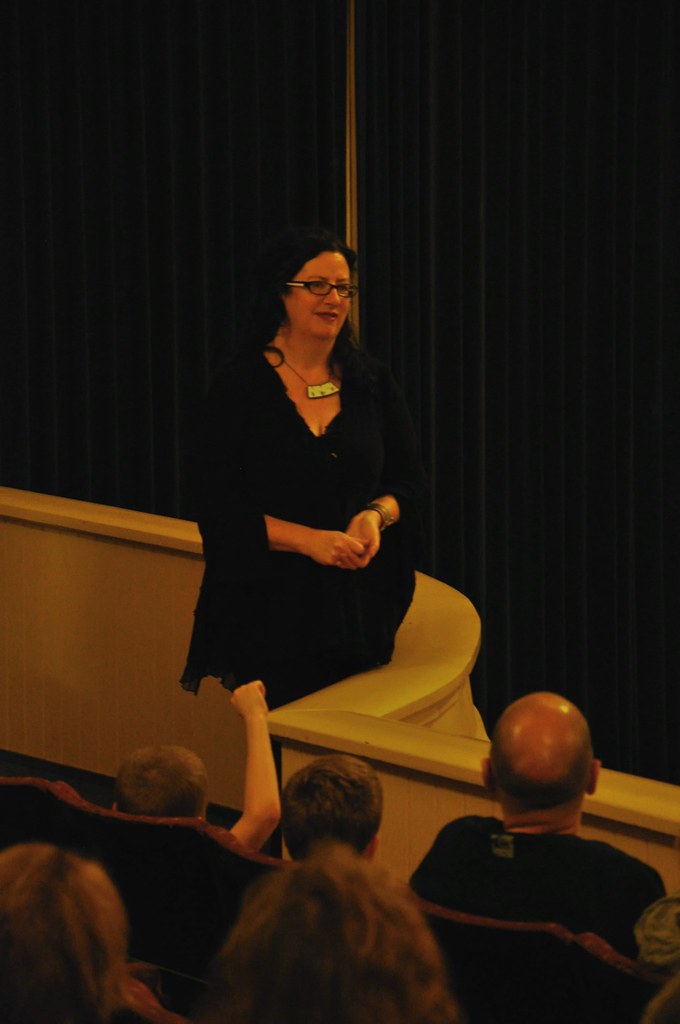
I'm actually standing on the balcony at the Camperdown cinema (Vic), a beautiful old heritage-listed building, where I was about to give a talk to introduce a screening of In the Shadow of the Moon. This was in 2008, I think. I had a fabulous time with the Corangamite Film Society and RiAus.


Saturday, January 02, 2016

Space Age Archaeology: A Retro-blog-spective

Just because it's the New Year, I've decided to make a list of my most-read posts from each year since 2004, when I started this blog.

2004: Flying Saucers at Woomera 

 In September, I was researching Australian space history at the National Archives office in Adelaide. This was in the days when you sat there for hours furiously scribbling notes in pencil until your fingers bled. One of the files I looked at was the (formerly) secret UFO file from Woomera. What I discovered in this file gave me pause for thought....

2005:  The Little Lemon

Racehorses and space. You wouldn't think there was a connection, would you? However....this is what happened when my father tried to name a racehorse after Laika the dog during the Cold War.

2006:  Space biscuits and recognition for space archaeology

Once upon a time in the dim past of internet history there was a lovely man called Nicey who ran a website devoted to tea, biscuits, and sit downs. It was called, appropriately, Nice Cup of Tea and A Sit Down. It was charming and funny and full of biscuits (proper Commonwealth biscuits, not the American version of the scone), and they loved space archaeology! I wonder what happened to him?

2007: Nostalgia for Infinity: exploring the archaeology of the final frontier

This was the abstract for a session on space archaeology at the World Archaeological Congress in Dublin, which I was convening with Beth Laura O'Leary.  The title incorporated the name of a spaceship that will be familiar to anyone who has read the works of Alistair Reynolds.

2008: A rocket cake to be proud of!

No-one doesn't love a rocket cake, and for some reason anything I post about space-related food and drink goes down a treat. Kudos to my friend Kaylene Manderson, who made this masterpiece!

2009: Quirky, yet methodologically sound: a review of Space Travel and Culture: from Apollo to Space Tourism.

Michael Allen wrote a review of this book, in which I had a chapter, and more-or-less called my contribution "quirky, yet methodologically sound".  I was enchanted.

2010: Space food: recreating an authentic space experience on Earth. A review of The Astronaut's Cookbook. 

I wasn't joking about the food-and-drink bit. Another book review, but this time by me, and I have a little digression into the history of Australia's monopoly on the manufacture of Space Food Sticks. Snap them up if you find them gathering dust on a supermarket shelf, because they went out of production last year. But whatever you do, do not attempt to actually eat one. They're not very nice.

2011: Consuming the Space Age: The Cuisine of Sputnik

Nicola Twilley of Good Magazine ran a week-long distributed online conversation about food-writing. I decided to write something about space food, and this was the result.  A little bit of history, a little bit of politics, a cocktail recipe, and the Sputnik Burger!

2012: Space-craft: rockets, jetpacks, and other DIY space paraphernalia

They don't love me for my unique insights into space history or brain-splintering forays into theory. What the readers of my blog really want is recipes and spacey things for kids. I'm cool with that, though. Here's some excellent things you can make, collected together from all over the internet, and yes, there is another cake.

2013: The Anthropocene in the Solar System

I didn't post much in 2013. I had left the university for a break to return to my first profession, heritage consulting. In April, I went to the Society for American Archaeology conference in Hawai'i, and managed to injure myself rather badly, necessitating a long 18 month rehabilitation. In May, I gave a TEDxSydney talk, and shortly afterwards, life took an even more unexpected turn which I'll tell you about one day over a beer. BUT there were other good things. The lovely brain-the-size-of-planet Matt Edgeworth invited me to give a paper at the Chicago Theoretical Archaeology Group conference on the Anthropocene (so sometimes someone does actually want me for my theories), and this was later published in the Journal of Contemporary Archaeology. You can read the abstract in this blog post, and the article here.

2014: How to avoid sexist language in space - Dr Space Junk wields the red pen

They asked for it, and I delivered. Not cakes this time, but what I hope is a practical guide to eliminating locutions like "manned mission" that reinforce the idea that women like/are like fluffy kittens and aren't really suited to the man's business of space. Which, incidentally, was exactly what a Russian cosmonaut trainer said in a public talk in Adelaide last year, so don't even try to tell me it's not an issue.

2015: How would lunar mining affect the cultural significance of the Moon?

Terrestrial mining is something I know a fair bit about. In my former career as a heritage consultant, I spent a LOT of time on mining sites, and in remote areas where mining exploration was taking place. My job was the make mining companies comply with legislation that was supposed to protect Aboriginal heritage places. In this excerpt from a forthcoming paper, I consider how these principles might play out in space.


I raise a glass of dry Australian sherry to you, dear readers! I feel that 2016 is going to be an exciting year in space.....


Friday, November 13, 2015

Women in the kitchen of science: on being excluded from the life of the mind.

When I was in my late teens at university, one of my favourite books was Herman Hesse's The Glass Bead Game (1943). In the 25th century, in the European province of Castalia, there was an isolated, university-like community devoted to the life of the mind. The pinnacle of intellectual activity was the Glass Bead Game, an esoteric exploration of the deep connections between ideas. The scholars took little part in secular life, but politicians and wealthy people would attend the Glass Bead tournaments. This was the only point at which the chaotic, everyday politics of the rest of the population intersected with the great minds of Castalia.

The book follows the life of Joseph Knecht, the greatest Magister Ludi, or master of the Glass Bead Game. Over the course of the book, he begins to question the value of the isolated 'ivory tower' life and eventually abandons Castalia.

There were so many things about The Glass Bead Game that appealed to me at that stage of my life. I had, perhaps, grandiose ambitions of making great intellectual discoveries. Arcane knowledge about the nature of the universe seemed like the most exciting thing to me, and a community of like minds, all devoted to higher thought, was a dream to be achieved. The book held out a vision of the pursuit of knowledge as the highest human calling, and in my naivety I yearned for this world.

There was one teeny, tiny problem though. The world of Castalia was a purely male one. All of the Magisters and scholars were men. Only in the outside world did men marry and have families. Women are mentioned only in this capacity in the book: as wives and mothers who have nothing to do with study or knowledge.

As a young woman, this didn't bother me too much. I was adept at reading myself into male roles in fiction, imagining myself as Biggles, as Mowgli and Bilbo. I read the book many, many times, pondering the never-quite-revealed mysteries of the Glass Bead Game, as elusive as the Rites of Eleusis.

But after a while, I felt more and more the effort of including myself where I was excluded, and it started to annoy me more and more. A period of many years followed where I didn't re-read it. By this time I was a professional archaeologist and thinking about the research that later became my PhD.

I think it was while packing books for a house move that I found my copy again and decided it was what I felt like reading at that moment. I was by now in my late 20s. But this time it was different. I could no longer kid myself that women could be any part of this world. In Hesse's vision, mind belonged to men and the corporeal world belonged to women. The further I progressed through the chapters, the less I could stomach it. I abandoned the book unfinished and have never read it since. It made me sad to be so disillusioned by what had been a beloved novel.

Now let's leap forward to another part of my life. In the mid-1990s, I was living in the UK and collecting data for my PhD. A conference about stone tools was being held in Ireland. I wanted desperately to go, not just because of the lithics, but because it would be my first visit to the land of my ancestors, who fled the ravages of the Great Famine in the 1850s for a new life in Australia.

When the plane touched down in Cork airport, I was very emotional. I can still remember the moment vividly. The Irish soil was already something familiar, a landscape thrumming through my blood. Even though I had never seen it, never breathed the air, I was aware of a knowledge deep below the surface of my mind, passed on from my Irish great-great-great grandmothers in some fashion, that made this home.

Over the next week, from Cork to Dublin, I had an experience that was completely novel to me. Almost all the street names, the town names, the shop names, were Irish. I didn't have to spell my surname. Hell, I even looked Irish: eyes passed over me in the street, while the Englishness of my conference companions was noted. For the first time, my ethnic identity was indistinguishable from everyone else's. I was deeply part of this culture despite the generational time gap. I belonged: it was only when I spoke and my Australian accent marked me as a foreigner that I stood out in any way. From multicultural Australia, where even the fairly homogenous, white rural community of my childhood contained people of Irish, Welsh, Scottish, English descent, from Catholic, Anglican, Uniting, Methodist, Presbyterian beliefs, I was experiencing the monoculture of Irish Catholicism. Suddenly, a whole raft of negotiations about who I was were removed from the table. There were some things that were so accepted that they needed no explanation. I have to say it was very liberating.  I've often reflected on it over the years, and I'm sure you can see how this experience is relevant to understanding a raft of similar inclusions/exclusions.

Now, I have a very particular reason for telling you about these two seemingly disparate experiences, and it is this.

No male person reading The Glass Bead Game has to confront their exclusion from the highest intellectual life constructed as normal or natural. Every male person experiences the world of science and the intellect without their identity being up for constant negotiation. They are the default setting, just as I was in Ireland.

Let's think about that.


Monday, September 01, 2014

Dr Space Junk in da stratosphere: excavating my desktop


This is one of the results of me mucking around with graphics a few years ago. I found it while attempting to file all the stuff lying around on my computer desktop. At the time I made it, I was obsessed with vintage Russian space designs. (Well, still am, really).


Since I'm looking at random stuff, which I'm going to call an assemblage in fact, in Spit 1 of my computer, I might put a couple more artefacts up here. (Spits, for the non-archaeologists, are arbitrary excavation units. They might be 5 or 10 cm depending on the kind of deposit you're digging through. Typically Spit 1 is where all the grass roots, worms, sticks, and discarded rubbish is).

Here's a fabulous paper by Mark Edmonds about the archaeology and heritage of the Jodrell Bank telescope in the UK:


Full reference is

This is a picture of a cloud chamber. Cloud chambers are very exciting places where you can see the traces of sub-atomic particles like electrons. I think I was vaguely thinking of an archaeology of cloud chambers with some Schrodinger's cats thrown in for good measure.


Here's the first few slides of a lecture on cultural landscapes I used to give to the ARCH2108 Cultural Heritage Management class at Flinders University. The lecture is joint effort between me and my esteemed colleague Dr Lynley Wallis. The beginning is about the origins of the cultural landscape approach in geography (although there is another strand deriving from landscape painting) - later on the lecture covers cultural landscapes in archaeology and heritage management, including space, of course.


The final artefact from my desktop is an aerial image of the sewage works at the abandoned Orroral Valley NASA Tracking Station, from when we were doing a geophysical survey in 2010. Space sites can be more mundane than you might think. It was a rather peaceful place, slightly down slope and out of view from the main antenna and operations buildings. I thought that if anyone adaptively reused the site the tanks would make lovely water gardens.


Tuesday, May 27, 2014

How I became a space archaeologist Part II


For long-time readers, I'm going to take up the story where I left it in How I became a space archaeologist. As you recall, I was working in Queensland when the idea of investigating the archaeology and heritage of orbital debris came to me one night while on my verandah looking up at the stars. Later that year (2002), I finished the contract I was working on and took up a position as Senior Conservation Officer in the Heritage Branch of the Environmental Protection Agency in the Central Queensland town of Rockhampton. After work and on weekends, I'd sit at my tiny desk with a dial-up connection and surf the web to learn about space. I made tables of spacecraft and launch dates; I read histories of space programs and trawled through sites like Encyclopedia Astronautica. And I became aware, for the first time, that Australia had a rich and diverse space history of its own. I was astonished by how little I knew of events that took place during my childhood.

In these early days, despite my lack of knowledge, themes that have since become dominant in my work started to emerge. Vanguard 1 and the Woomera launch site in South Australia quickly became part of my research pantheon. As my background was Aboriginal archaeology, it was hard not to also look at how Woomera had impacted on the lives of Aboriginal people. I thought about what it was that an archaeological approach could bring to the study of space exploration, and I thought about how you would apply Burra Charter principles to stuff in space, answering the question I had first posed myself back on the verandah of my Queenslander.

December approached: the month in which the big annual Australian Archaeological Association conference took place. I think it was in Townsville that year, and I had funding from the EPA to attend. The conference was a turning point. One of my cousins, Anna Morgan, was there. She made an important introduction. She had studied archaeology at James Cook University with Professor John Campbell. In his classes, she said, he had talked about doing archaeology in space.

What an amazing coincidence! But more was to come. When I sat down with John and talked about what I wanted to do, he informed me that there was a third person who was interested in space archaeology: Beth Laura O'Leary from New Mexico State University. Suddenly I had colleagues! And John was involved in organising a session at the 5th World Archaeological Congress in Washington DC the following year. Would I like to present a paper in it? he asked me.

It seemed the timing was right. I had about five months to prepare: to make my thoughts and ideas coalesce into something concrete enough to present, and to get enough money together for an overseas trip.

And so I continued to spend my weekends at the tiny desk, reading and thinking, and also learning how to use powerpoint. I don't think I had ever used it before this; the pictures I used for my PhD presentations were on overheads and slides. Soon it seemed that one paper wasn't going to be enough to contain all that I wanted to talk about, and I sent two abstracts in. One was about general themes for space archaeology; and the other - I think, I will have to try and find it, was about orbital debris. Both abstracts were accepted.

Now a more serious issue raised its head. Already, I was struggling to access the information I needed with the current incarnation of the World Wide Web, and in the library of Central Queensland University. I was doing this in my spare time, and it wasn't easy to negotiate leave to attend conferences that weren't strictly work-related. I would be taking leave to attend the World Archaeological Congress in April 2003. When I returned, everything would be the same. Was I serious about this research? I searched my soul and decided that I had never been more serious about anything in my life. So if this was the case, I had to accept that living in Central Queensland and working at an unrelated job was not going to further my research. I was going to have to leave.

This was a tough realisation, because I loved my life at that point. Working at the EPA was great; I had excellent colleagues, and I enjoyed the pace of the public service. I loved living in the beautiful coastal town of Yeppoon. I was presenting a world music show on the local community radio station, Radio NAG, and my radio friends were a delight and joy. Every now and then I would escape to Brisbane for a touch of city life. It was all pretty excellent.

But to make my vision of space archaeology happen, I would have to quit my job, leave Yeppoon, and take a leap into the unknown.

So I did. I submitted my resignation, effective from the end of March 2003. I packed up my house and put everything into storage, keeping only one suitcase, my laptop, and some books and papers. I booked my flights to Washington. I registered for the World Archaeological Congress. I worked on the two presentations. I thought about the future endlessly, and I tried not to think about the future.

For some reason, I don't really remember why now, I had decided some media around my papers would be a good idea. One of the journalists at the University of New England (where I was an adjunct) helped me put together a media release. It seemed to strike a chord. With only a few days before I left, the phone ran hot. I think I did around seven radio interviews on my mobile in just one day while I was running around like a headless chook trying to tie up all the loose ends.

Finally all was done. Almost everything I owned was in storage, and it would be seven years before I was able to retrieve it. The house had been cleaned and inspected. I'd had my last day at work, and a farewell party in Rockhampton at my friend Marianne's house. It was time to go.


Monday, April 07, 2014

Nerding it up at the cool end of town - Dr Space Junk at Nerd Nite Sydney


Last week I flipped over to our nation's sunny capital for a space policy workshop, then on to Sydney to talk at the Nerd Nite.

This was heaps of fun. I met new people, caught up with old friends, and got to have a warm and sympathetic audience for my ideas. No space junk this time - more astronomy and antennas. They had a lucky escape, though - I didn't get started on cable ties ......

No, I said nerding it up, not nuding it up. Shut up down the back there.


Sunday, March 30, 2014

Space Age Archaeology and the future: do I know where I'm going?


Not so long ago, I mused about my last ten years writing Space Age Archaeology. Today, in response to a question posed by Doug Rocks-Macqueen, I'm thinking about the future. What's my vision for the blog?

To be honest, I don't have a plan, and I've never really had one beyond each post. The future consists of the nebulous ideas and lists in my head of things I want to write about. Sometimes I think I should get some professional advice about design and marketing, and then I think it's all too much effort. I don't want to take over the world. It seems enough to have a place where I can write about my ideas with some sense of occasionally reaching other people who are interested, and where I am answerable to no-one but myself.

But maybe there will be outside constraints in the future. As we know, the academic world is now starting to take an interest in social media as a measure of impact. Once upon a time, blogging was a distraction from the main game, a frivolous pastime, and really rather suspect, almost indicative of a personal failing. These views always surprised me when I heard them reported - thankfully no-one has ever expressed them to my face! Now, there's lots of talk about academics being required to engage with the public/community through these avenues, and even more sinister hints of it becoming enforced and monitored.

Now I'm all for communication, obviously, but I don't know how I'd feel about having to meet someone else's expectations, or about the university scrutinising my fluid and organic meanderings around the online world. I think I would NOT LIKE IT AT ALL. I'm not doing this to jump through someone else's hoops.

On the other hand, it's nice to think that an activity I do mainly for pleasure may count in the mad scramble to punt something through the ever-changing goalposts of the academic world.

A couple of years ago, when I was reading around the area of archaeological blogging to prepare a paper for the first ever Digital Humanities Australasia conference, I found that no-one had really studied or written about individual archaeology bloggers. (This may have changed since). Almost all of the papers I came across dealt with institutional blogs based around a university department, a museum, or a project. To date I've seen nothing concrete about how the higher-ups in university administration and policy imagine academic engagement with social media, and I'd be surprised if a great many of them were actively engaged in the Versosphere themselves (I just made that word up - TwitterVERSE + blogOSPHERE. Naturally, it includes everything else). So it's important, I think, to have some data not just about the group blogs but also the individuals.

I also learnt recently, thanks to Noel Hidalgo Tan over at the South East Asian Archaeology Newsblog, that mine is a 'personality-based blog'. I'm not promoting a particular research project, or an organisation, or serving an identified community, so there are no mission statements or policies or performance indicators to consider. (Oh! The freedom!). Perhaps this makes it harder to have a clear vision of where the blog is going. And perhaps it means I don't really need one, either.

One thing is startlingly clear to me, though: we're not in it for the money.

*pours another cup of quince tea*


Tuesday, January 21, 2014

Happy 10th anniversary Dr Space Junk!


Ten years ago, when my sister was attempting to explain to a friend what the hell it was I was doing, he came up with the name Dr Space Junk. I liked it and have kept it ever since. Thanks, (the dishy) Andrew!

Dr Space Junk is sort of me and sort of not-me, to use a Zoolanderism. She doesn't have to bow to academic pressures and has some serious hardware at her disposal. She moves somewhat fluidly between the real world and the fictional realm at times. She always stops for afternoon tea.
 

After all this time, I can't really imagine not having this alter ego who plays a primary role in my online life. In a conference paper a couple of years ago, I mused about the advantages of communicating with an avatar. In December last year, I talked about my experiences in the world of social media at the Australian Archaeological Association Annual Conference.

I found it surprisingly hard to write about this from an academic perspective as it's all so personal. I had no idea what I was doing really when I started blogging in 2004, and I don't really remember what motivated me to start. I do remember very clearly the day I began the blog. I was in Adelaide for the International Space University Summer Space Programme, at which I was giving a guest lecture, and spending much of my free time in the Woomera archives at the Defence Science and Technology Organisation.

 On this afternoon, I was in Dr Heather Burke's house, alone in the middle of the day while she was at work. It was warm inside the bluestone terrace, and in the small sitting room, I was surrounded by bookcases and beautiful objects ..... bird's nests, bark paintings, carriage lamps ..... I had my feet on the coffee table, an old traveling case, while I slouched on the sofa with my laptop.

 I decided to bite the bullet and just begin. All sorts of decisions had to be made - name, format, design, introductory text, profile. The design templates were fairly limited, and I chose a simple black one to mirror the night sky. (This remains unchanged - every time I play around with new templates I chicken out when it gets to crunch time). At the time I was a bit obsessed with quince tea, and with some research I had been doing around the origins of anthropology and its relationship to theosophy. Thus Dr Space Junk's starship came into being, influenced perhaps also by Gully Foyle .....


I didn't really have much to say in early days. It was the beginning of my space research. I was starting to come to grips with the literature, and a few themes that were very much influenced by my previous work and professional career as a heritage consultant were swirling around in a mass of information. Blogging was also quite new, so the established networks and connections didn't really exist. It felt like it was just me and my brain.

Every now and then someone would stumble across my blog and make a comment. This was very exciting stuff! Then Dr Mick "Cheekbones" Morrison, another early Australian archaeology blogger, recommended that I put a tracker on. Suddenly, I could see that people were actually reading. I was very happy, but it gave me a sort of squirly feeling as well - I felt very exposed, and I realised that previously I had been mainly writing for myself. It took a little mental adjustment to not to censor myself and to regain my voice after this revelation. 

Over time, my posts became longer and longer as my research grew and I had more to say. A few years ago, after reading some of the scholarly and beautiful posts written by various friends and colleagues on their blogs, I had a crisis of confidence. Should I be putting more effort into what I wrote? I asked the advice of (by then) Associate Professor Heather Burke, a notorious avoider of social media and a committed cynic. What she said was very wise. 'Think about it', she said to me. 'When do you write and what do you write about?' 

'Well', I said, not having really considered this before, 'I suppose it's when inspiration hits me. It might be a few sentences or a few paragraphs. I don't spend hours crafting a post, and I don't really have any sort of plan about it - it just happens when it happens'. 

'If you had to sit down and work on a post for hours, and approached it like it was an academic paper, do you think you would post very much?' she said. I thought about this some more. It was true. I probably wouldn't. That might work for some people, but the more spontaneous approach was better for me, and the kind of tangents I was sometimes prone to follow. Heather made me feel comfortable with what I was doing, and for that I thank her.

Having said that, the last six months have been a big hiatus as I've grappled with various tedious technical problems (only just resolved) and numerous changes in the shape of my life. But I feel reinvigorated about the power of the blog after having a post selected in the Science Online Open Lab 2013 anthology. It's not just me who feels the cable tie love!

Now Dr Space Junk is on Twitter (@drspacejunk) and even on Soundcloud as DJ Space Junk. There's a T-shirt design (yet to be realised) and a cocktail concept (ever evolving). For ten years Dr Space Junk has accompanied me on my journey through outer space and the increasingly complex layers of social online space. She's not retiring any time soon.


Friday, April 06, 2012

Sunday, April 01, 2012

Dr Space Junk: the logo

This is it, my new logo, launched at the Digital Humanities Australasia conference in Canberra last week.

Translation: Dr Space Junk says "Save our space heritage".


Saturday, December 10, 2011

Happy Christmas from Dr Space Junk

I'm organised this year!  This collage is from my Facebook status updates, those (mostly) with a space theme, of course.


If the text is too small to read click on the picture to get a larger version.  That's if you really want to know my innermost thoughts.


Tuesday, July 19, 2011

What should Dr Space Junk do on the Day of Archaeology?

Help, everyone.  Next Friday, I will be writing about my day as a space archaeologist for the Day of Archaeology.


Have you ever wondered what archaeologists really get up to? Is it all just digging or is there a lot more to it? The Day of Archaeology 2011 aims to give a window into the daily lives of archaeologists. Written by them, it will chronicle what they do on one day, July 29th 2011, from those in the field through to specialists working in laboratories and behind computers. This date coincides with the Festival of British Archaeology, which runs from 16th – 31st July 2011.

So what shall I do on that day?  In the way these things work, I actually have many interesting things to do in the week before, and even the day before (of that more later); but unless I want to sit at my computer and write, I haven't got anything particularly riveting apart from farewell drinks for our former Dean of Humanities later in the afternoon on Friday 29th July. OK, so maybe they want an ordinary day, but believe me, no-one wants to read about me visiting the finance officer to see about our budget for the field school or going through the class lists to chase down outstanding assessment, or reading my way through PhD students' chapters. That might characterise an academic's life, but not necessarily an archaeologist's.

Here's my preliminary ideas: I could:

1. Visit the Aviation Museum in Port Adelaide to have a serious look at their collections
2. Go out to the University of South Australia at Mawson Lakes and have a look at their FedSat materials (actually I'm liking this option!)
3. Do one of my favourite activities, op-shopping in the hope of locating rare Woomera or other space souvenirs, and vintage items from the 1950s-1970s related to space (I'm liking this one even more!)
4. Make a second version of DrSpaceJunkSat (my cardboard satellite) as a sort of experiment in performance art. (This might be especially appropriate as the day before I am giving a joint seminar on Theatre/Archaeology with a drama person).
5.  Write something.  Well they do say "behind a computer" is acceptable.  Perhaps documenting my thought processes would be interesting enough.

So these are the options I've thought of so far, but perhaps I am completely forgetting some marvellous space thing in Adelaide that I should really pursue, or perhaps there is some lead that I should follow up.

Please, if you have any outstanding ideas for my day, do share them.


Thursday, June 30, 2011

How I became a space archaeologist

It's getting on for 2 am and I have no business being awake. At least, if I had any business being awake, it should be finishing my end-of-semester marking, commenting on thesis drafts, and working on my talk for Friday night ....

So all of that is obviously not happening. Instead, I have been reflecting on how I became a space archaeologist. Previously, I had specialised in Aboriginal archaeology, particularly flaked stone tools, contact-era flaked bottle glass, and usewear and residue analysis. (I still do some of those things).  I was also a professional cultural heritage manager, working outside the university sector as a consultant.

Space archaeology came about in a particular moment, back in 2002. This was the setting:  my lovely old Queenslander house in the central Queensland town of Gladstone, where I was employed as the project archaeologist on the raising of the Awoonga Dam. The house had the characteristic broad verandahs of that architectural style and a back garden with guavas, mangos, poincianas, and other marvellous semi-tropical trees. It also had an excellent bath, fabulous for soaking off the dirt after a hard day in the field.

I was frequently in the field with my team, all of them young women from the three Native Title claim groups in the area. Surveying, monitoring earthworks, excavating, a whole bunch of stuff.  In the height of summer it could be very hot and sweaty work indeed. On one such day I came home, exhausted, clumped up the stairs in my steel-capped, acid-resistant boots, flung off my fluoro vest and hard hat as I entered the door, and went straight to the fridge for a delicious cold beer.

Now I have to confess I am slightly on the old-fashioned side in adhering to the principle of changing for dinner, whether one is by oneself at home, or in the field with only a flimsy dress suffering from the effects of being rolled into a ball and squeezed into some corner of the suitcase not occupied by explorer socks. But sometimes it is just all too much of an effort, and this was one of those days. I think I may have paused briefly to pull my heavy boots off, but the next stop after the fridge was the verandah where I collapsed into a chair with my beer and sat, thinking of nothing much, looking up at the stars.

Now Queensland, you recollect, doesn't have daylight saving, so it gets dark far more quickly on summer evenings that the rest of us are used to.  So the stars were already out, even though I wasn't long home. I was contemplating them idly, perhaps thinking about my childhood ambition to be an astrophysicist, the little telescope my parents gave me for Christmas one year, the circular constellation charts that were stored in the bottom shelf of the glass-fronted cabinet in the sitting room. I thought to myself:  I think I'm looking at the stars, but actually, the sky is full of satellites and space junk too.

It was the second part of the thought that was critical, very much related to my then-task of managing the heritage values of the more than 300 recorded Aboriginal and European sites within the inundation area of the Awoonga Dam. If there is human material culture in space, does it have heritage value?  Does the Burra Charter apply to things that aren't even on the Earth?

I thought about this for a while.  And then I decided I was going to find out.


References
The Burra Charter: The Australia ICOMOS Charter for Places of Cultural Significance (1999)


Wednesday, June 22, 2011

Dr Space Junk talks to Radio SETI

Earlier in the month I did an interview with the charming Dr Seth Shostak from Radio SETI, on his programme Are We Alone. (I'm going to admit that I have a teeny tiny crush on him now). The theme of this episode was space archaeology, as described below:

Indiana Jones meets Star Trek in the field of space archaeology. Satellites scan ancient ruins so that scientists can map them without disturbing one grain of sand. Discover how some archaeologists forsake their spades and brushes in favor of examining historic sites from hundreds of miles high.

Also, if you were to hunt for alien artifacts – what would you look for? Why ET might choose to send snail mail rather than a radio signal.

Plus, the culture of the hardware we send into space, and roaming the Earth, the moon, and Mars the Google way.


If you'd like to listen, you can find it here:

Sunday, May 29, 2011

You know you're a complete space nerd when .....

Someone starts talking about the ATM and you assume they mean the Apollo Telescope Mount rather than Automatic Teller Machine.


Tuesday, April 19, 2011

The all-new Space Age Archaeology

Well, I've been thinking about changing the format of Space Age Archaeology for some time now .... the blog is eight years old, and the template is so ancient that I can't play around with it - it basically can't be changed.  But I'm so used to the font and the colours that anything else looks odd to me.  And I'm pretty sure that once I abandon this template I can't go back to it.

So I guess I'm going to just take the plunge and see what emerges.  Anyone who feels strongly enough to comment is absolutely welcome to do so.  About anything - font, background, gadgets, whatever.  I may be brave enough to apply my new design tonight, I may not.  Hard to tell.