Showing posts with label orbital debris. Show all posts

Sunday, August 11, 2019

An archaeological perspective on orbital stratigraphy

One of the things I've been thinking about for a while is the the structure of the archaeological record of Earth orbit - all the spacecraft that have been launched over the last 60 years, and their decay products, fragments and molecules of Earth-manufactured materials. Something people ask me occasionally is how you can do archaeology when there is no stratigraphy. In terrestrial archaeology, everything eventually falls to the ground and becomes buried as winds, water and human activities erode higher places and move the sediment to lower places. Generally, the deeper you dig, the older the remains that you find.

This isn't how it works in Earth orbit. Everything's falling, for sure - but a large proportion of stuff never reaches the ground. It's all up there, the new mixed up with the old, the functioning with the defunct, the living with the dead. It's not a mirror of stratigraphy on Earth. The lower something is says nothing about how recent it is.

With one exception - everything in geostationary orbit is younger than 1963, when Syncom 3 became the first satellite to successfully reach this critical orbit, the importance of which for telecommunications had been predicted since the early 20th century. This is just seven years after the first satellite though - not very long. And there's only about 40 satellites left in orbit which date from this period.

Multigravity environments

It's more useful not to think of Earth as the standard, but as a special case in a solar system comprising many different levels of gravity and many different ways of experiencing it. For example, when we talk of microgravity in Earth orbit, it's not really that there is no gravity. The Earth is still there, pulling everything towards it as usual. It's the acceleration of falling towards it that creates the sensation of microgravity. You can experience the same thing in a droptower ride at an amusement part or the zero-gravity 'Vomit Comet'. You don't even have to leave Earth to have different gravity experiences!

The nature of the archaeological record varies according to the gravity you're in. In full Earth gravity, a powerful attractor, things fall. In Earth orbit, things float but can get pulled back to Earth by atmospheric drag. On the Moon, things fall, but more slowly, and less energy is needed to throw them up into orbit. At the five Lagrange points in the Earth-Moon-Sun system, things bounce around. (Indeed, just recently, they have been shown to be massive dust traps).

Lagrange points in the Earth-Moon-Sun system. Image credit: NASA


I prefer to conceptualise the way artefacts respond to variable gravity environments as a dynamical system. This is a visual, mathematical way of representing how objects move over time when certain boundary conditions are set. Objects are the recipients of energy through various sources, and gravity determines how much energy the objects need to move. The dynamical system is a map of places where objects end up as they lose energy - the process of entropy. Effectively, such a map is also an archaeological plan of a site or the surface of an excavation unit. (Now I wonder if we should be regarding our plans as frozen moments in a dynamical system, just one that is generally moving a lot more slowly than orbit. So the critical difference between the two regimes is not speed, but time).

These places are points of stable or unstable equilibrium. When an object falls to the ground, it's in a stable equilibrium place of low energy. To get off the ground, energy has to be added. The energy might come from someone kicking it, or a stream of water which moves it on. The Lagrange points include both stable (L4 and L5) and unstable equilibria (L1, L2 and L3). Unstable equilibrium is like balancing an egg on its pointy end: you can do it, but it's going to fall over pretty quickly. (Also, it helps if the egg is hard-boiled). Using this as a framework, Earth and Earth orbit are not completely different places with different rules, but places within the same system with different amounts of energy.

It also helps to visualise this as an Einsteinian gravity well. The bottoms of the wells are points of low energy and stable equilibrium.
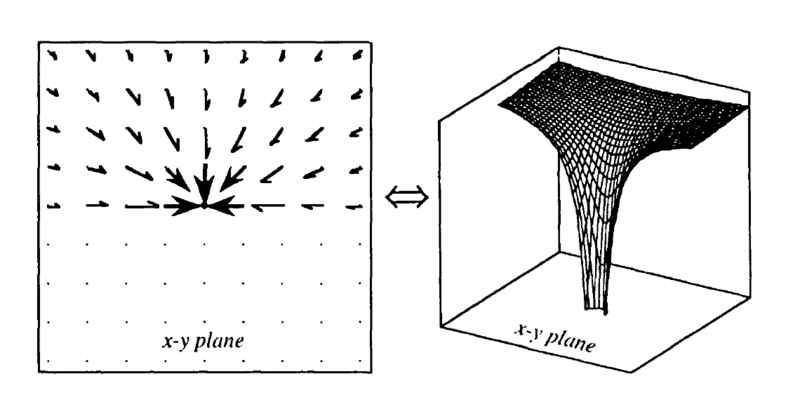
A 2-D slice of a gravitational force vector field (left) is interchangeable with a 3-D gravity well (right), with the z-axis showing energy (potential). Image courtesy of Invent2HelpAll

How junk disperses, or a taphonomy of orbit

In fact, the stratigraphy of space junk does include a terrestrial component. The lowest point of energy in the orbital dynamical system is the surface of Earth: an orbit of zero apogee and perigee. The atmosphere is a barrier or boundary between different gravity regimes, as space objects can bounce off its upper surface, and those that get pulled into it tend to incinerate. However, some spacecraft parts are made of materials like stainless steel and titanium alloys, which have high melting temperatures. Other parts may have carbon-carbon insulation which provides some protection from temperature extremes. Sometimes these components scream at high speed into the atmosphere, with their flesh burning, and fall with a smoking thud to the surface. The so-called 'space balls', titanium pressure vessels, are one of the most common spacecraft parts to survive re-entry. These spheres are the best gravity travellers; they get to come back.

Of course little of the spacecraft is likely to remain in orbit after the main body has re-entered - perhaps some molecules or broken-off bits. When we find the space balls or other Earthbound space junk, it's most likely that this is all that remains of the spacecraft. They've fallen to the point of lowest energy. This includes the spacecraft graveyard at the bottom of the ocean. Earth orbit is bookended by graveyards, if you take into account the graveyard orbit a few hundred kilometres above the geostationary ring. This is where old GEO satellites go to rest in their undead way, as they can still drift down and across the orbits of living satellites.

In general the the structure of space junk is not vertical layers as we're accustomed to in archaeology. Instead, spacecraft decay fragments have an elliptical or cloud geometry. When a spacecraft is whole, all its components are on the one orbital trajectory. Now imagine a solar panel detaching from the main body. Initially, its speed and orbit will be pretty much the same as the main body. But as time passes, the orbits will diverge. If the panel is tracked by one of the Earth-based telescopes, then we will have all the data about it's orbit into the past and will be able to trace it back to the original spacecraft - as long as we keep tracking it.

If a spacecraft explodes, the debris initially forms a cloud around it. The cloud travels together for a little while and then the individual pieces, all with their own weight, size, shape and velocities, start to disperse. If you look at the orbital tracks of Fengyun 1C, the Chinese satellite which was the target of a test missile shot in 2007, the debris rapidly moves apart and starts to spread out as you see here:
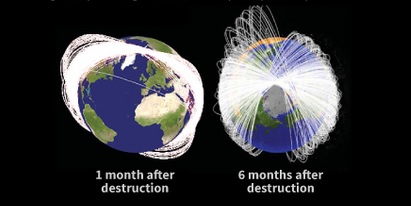
Image result for fengyun 1c
Fengyun 1C debris evolution. Image by Karl Tate @space.com

Position in orbit is described using a set of six equations devised by Johannes Kepler. Usually what people use, however, is Two-Line Elements - a bit like Eastings and Northings. The position is simplified into two strings of numbers. But because of the non-linear unpredictability of orbits, the reliability of the TLEs diminishes pretty fast. After 30 days you can't be sure that the TLE will accurately predict where something is. What this means in practice is that objects have to be continually watched or tracked to know where they are. This is called persistent observation and it's not generally something archaeologists worry about on Earth. However, artefacts on the surface do move around, although very slowly. You can record a concentration of stone artefacts on the surface, but if you revisit the same site a year later, half of them might be missing. Some have worked their way underground; some are covered by vegetation; others have moved under the influence of wind, water, animal movement or land use and industrial activities. Ten years into the future, there may be nothing to see. So perhaps I should apply the principle of persistent observation to terrestrial archaeology after all...

Objects in space are, of course, moving at incredibly high speeds - an average of 7-8 km per second. It's not that objects within archaeological deposits don't move; soils can act as liquids over a long time period, with a gravity-driven convection that gradually makes artefacts rise higher in the profile. Sometimes objects rise to the surface like a fish and get stranded there. Others, like stone tools with narrow sharp edges, slip back in for re-circulation. This is something archaeologists are very interested in as it says something about the integrity of the site and the relationship between objects. We're looking to that relationship to try and work out the human behavioural correlates, so we need to understand how the relationships decay over time due to natural or cultural factors, such as water movement or scavenger activity.

It's the relationship that matters

Both inside Earth and in orbit, the way the relationships between objects within a space evolves over time is critical to working out the human behavioural component. Looking at how the space debris environment evolves, it seems that after a certain amount of time it would be impossible to reconstruct the orbital path and work out what spacecraft a piece of junk came from, if you did not already have tracking records. Let's imagine the scenario of a future human archaeologist after the records have vanished (we can't assume they will survive in their current form) or even an alien archaeologist looking at space debris to get a handle on Earth culture. They will initially use materials and style to identify which space objects belong in the same time frame or to the same culture. They'll also have to work out what differences are due to style, and which to function.

Effectively, orbital archaeologists of the future will be 'recapitulating' a period of terrestrial archaeology before there was absolute dating, when similarities in style were used to posit chronological and social relationships. This period of investigation is known as culture history, and it worked on a number of premises. The first was the definition of culture, which as V. Gordon Childe phrased it, was a consistently occurring suite of artefact types, features and structures that you could attribute to an ethnic group. The second was the assumption that things change over time, coming in and out of fashion. Graphs of the frequency of occurrence of different artefacts types or styles resembled battleship curves, as they were known. Something starts out at a low frequency, then its numbers increase as it becomes popular. Soon the next big thing starts to supersede it and the frequency declines until no-one makes or uses the object any more. This is pretty much what happens in the fashion industry. Using changing frequencies to date an object is called seriation.

Because atmospheric drag pulls objects out of Low Earth Orbit all the time, things that survive there will be those with the greatest numbers, eg rocket bodies. This makes it a matter of sampling. Future archaeologists may not find the rare satellites as easily as the common ones. It's like the famous section in Kent G. Flannery's The Early Mesoamerican Village, a classic of the 1960s-1970s movement known as the New Archeology. A Real Mesoamerican Archaeologist laughs about another's failure to find the city of Teotihuacan using a particular sampling strategy. The Skeptical Graduate Student explains that this is not the purpose of a sampling strategy - and that the sample should produce results in proportion to what exists in the entire population of artefacts.

In another post I'll consider whether we can apply absolute dating techniques to space junk in orbit.


Topological stratigraphy

Terrestrial stratigraphy is locally linear and Euclidean, but orbits are non-linear and non-Euclidean. At larger scales, space is better described as the topological object called a manifold. Stratigraphy might simply be the wrong concept to describe the structure of orbiting objects. What kind of word would we use instead? Perhaps gravigraphy - written in gravity? Or orbitography, which is 'the determination and positioning of satellite orbits by a form of geodesy'?

Visualisations of space junk show Earth surrounded by white dots, like a cloud of silent bees. If you took Earth out of the middle, you would have a donut shape or torus where geostationary satellites are concentrated, and perhaps a series of intersecting tori for low to medium Earth orbit satellites. This is in stark contrast to terrestrial stratigraphy, which is conceptualised in a box-shape (even though Earth is spherical). Objects in this gravitationally-constrained tori move on elliptical paths inside the shape.

Let's put Earth back in. If we sliced a wedge vertically through through this cloud or swam, and froze the objects within it, what would we see? At the outer edge, the graveyard orbit, there'd be a thin smattering of defunct satellites. They are all dead. Below it, in the GEO range, there is thick ring of living and dead satellites. The 'type fossil' of this layer is the winged bird.

Then there is a sparse background scatter of satellites and junk until we hit the navigation satellites in the Medium Earth Orbit range. The US GPS network orbit at around 20, 000 km.

In LEO, we get the highest density of rocket bodies as well as satellites. There is a more diverse size range, from ENVISAT, the International Space Station, to cubesats and nanosats. There is the sparsest smattering of organic material.

There's a dead zone from LEO to the height of the tallest building or structure on Earth. Birds and aeroplanes fly at different altitudes, but they don't stay there or live there. There are gases, clouds, dusts.

On the surface of Earth, the ancient is mixed up with the modern. I suppose it is more like orbit than we might think, the living and the dead jostling side by side. Organic material is dense. Movement is slow. The deeper you go under the surface, the older things become. In this subterranean sphere, everything human is dead.

In all of these layers, the past and the present are mixed up to different degrees. The closer to the present you get, the higher and deeper human culture goes. Mines and building foundations cut into the dead deep past and overlay it with modern material. This is the variable borderland between the Pleistocene, Holocene and Anthropocene, a diachronous boundary that archaeologist Matt Edgeworth and his co-authors (2015) have discussed in an insightful paper (see below).

What is a place in orbit?

I'm relatedly curious about the concepts of setting or site in the orbital environment. Here, a 'place' is really a set of equations that defines the way an object moves - not just now but in the past and into the future. Place is a prediction, effectively. Place is movement, not stasis.

Could an orbital pathway, in and of itself, have heritage significance? Could it be 'preserved', and what would be the relationship between a culturally significant trajectory and the equations that define it? Could those equations, in and of themselves, also be considered culturally or archaeologically significant?

Perhaps in the future, there will be markers along the orbits of significant spacecraft that are not longer there, alerting anyone/thing who approaches that they are at a heritage orbit. Perhaps certain orbits - like Vanguard 1's - could be registered as significant so that nobody can launch something into the same orbit. An orbit has economic significance - so why not heritage significance too?

I think I have a lot further to go in this line of thinking. But it's a start anyway.


References

Matt Edgeworth, Dan deB Richter, Colin Waters, Peter Haff, Cath Neal, and Simon James Price 2015 Diachronous beginnings of the Anthropocene: the lower bounding surface of anthropogenic deposits.  The Anthropocene Review 2(1):33-58

Flannery, Kent G. (ed) 1976 The Early Mesoamerican Village. Academic Press


Monday, April 22, 2019

The end of the Space Age

At the moment, we feel kind of connected to many places off-Earth. We have active experiments, orbiters and rovers on the Moon and Mars. Japan's Akatsuki is in orbit around Venus. New Horizons has whizzed past Pluto and into the Kuiper Belt.

But just imagine if we couldn't send anything more into space. This situation might arise if the density of space junk becomes too great and the exponential cascade of collisions causes the Kessler Syndrome. Objects launched from Earth would not escape fatal damage from these hypervelocity collisions.


Gradually, one by one, orbiters would crash onto planetary surfaces as their fuel ran out. Batteries would fail, materials would decay. One by one, the little spacecraft voices that come to the antennas of Earth would fall silent.

The great antennas set to listen to the human sounds of space would cease their turning like sunflowers to catch the signal; they in their turn would become useless monuments to the Space Age.


Sunday, April 01, 2018

I'm all burned out about space junk

My Twitter colleague @misosusanowa alerted me to this Devo song from Q. Are we not men? A. We are Devo. It was written in 1976, and released in 1978, the same year that a USSR Kosmos satellite re-entered over the forests of northern Canada, spewing nuclear fuel as it broke up. One year later, of course, the re-entry of Skylab caused a global sensation.


Well, she was walking all alone
Down the street in the alley
Her name was Sally
I never touched her, she never saw it

When she was hit by space junk
When she was smashed by space junk
When she was killed by space junk

'In New York, Miami beach
Heavy metal fell in Cuba
Angola, Saudi Arabia
On Christmas eve', said NORAD

A Soviet Sputnik hit Africa
India, Venezuela, in Texas, Kansas
It's falling fast, Peru too
It keeps coming, it keeps coming, it keeps coming

And now I'm mad about - space junk
I'm all burned out about - space junk
Walk and talk about - space junk
It smashed my baby's head - space junk
And now my Sally's dead - space junk


It's not a happy song, it has to be said. However, space junk hardly ever hits people or property, so poor Sally was extremely unlucky. Or perhaps she was unlucky in her choice of boyfriend, as there is a subtle undertone of domestic violence. The Cold War on the home front. 


Friday, January 27, 2017

Technological rites of passage in the liminal space of Earth orbit.

In February 2016, a  cosmonaut on the International Space Station lobbed a USB stick out of the hatch to become an orbital object for perhaps a few weeks, before a fiery death in the Earth's atmosphere. To give it enough mass to leave, it was attached to an empty film cannister stuffed with paper towels. Presumably these objects were due for disposal as waste in any case.

Cosmonaut Sergey Volkov about to release the package.
Image credit: NASA TV
The USB stick contained messages and videos from the 2015 celebration of Victory Day, May 9, which commemorates German surrender to the USSR at the end of World War II. It was the 70th anniversary of this day.

It's not entirely clear from the media accounts whether the flash drive was material from the cosmonauts themselves, or of Russian people and celebrations back on Earth. I think it is most likely the latter, as otherwise, surely, cosmonauts could have thrown their own USB out for the actual 70th anniversary in 2015, rather than a year later in 2016.  (Although I suppose they may have had to wait for an EVA).

It's worth musing a little further on this hybrid orbital object, though. It was composed partly of junk, and yet it was not itself junk. The usual definition of space junk is something in orbit that does not serve a useful purpose now or in the foreseeable future. Mostly, we think of space junk as all the many thousands of defunct satellites, rocket bodies and fragments of spacecraft.

The purpose of this object was (1) to BE in orbit and (2) to vanish from orbit. Its brief passage of time in space between launch and de-orbit was all it was about. Clearly, though, the materiality and physicality of both the object and the sequence of events is important - the fact that it happened even though no evidence survives and no-one can access those messages and images.

It's hybrid nature is also evident in the combination of tangible objects and intangible data. The videos and messages were not actually playing as they left the ISS. They were passive and silent. You'd have to plug the USB stick into a computer to see what they were. In this ceremonial act, seeing the videos and listening to the messages was not important.

You could argue that the data was not intangible as it was physically stored in the device as 0s and 1s. What's intangible, though, is the interpretation and meaning given to a certain de-coding of those numbers, as perceived by a body with a certain range of senses.

The old archaeology joke is that if you can't tell what the hell an artefact was used for, then it was ceremonial or ritual. Sometimes this is actually true! Rituals can be classified in a number of ways. The celebration of Victory Day is a commemorative rite, marking the end of a war. On Earth there are probably millions of war memorials from grand triumphal monuments to plaques and honour boards. They have a static component and an active component when people gather on significant days to carry out ritual actions and speak ritual words. The USB release is also commemorative as it marks the 70th anniversary of a ritual.

But it's also a sort of technological rite of passage. Van Gennep's classic Les Rites de Passage uses the metaphor of passing from one room of the house to the next. The nature of the commemoration was to allow the USB to pass from one state, space, to another, the Earth. In van Gennep's terms, the stages of the ritual are separation, liminality and incorporation. Orbit becomes the liminal space, neither one state nor the other, suspended, falling, as ambiguous as the junk-notjunk. Incorporation comes when the object disintegrates in the atmosphere, returning to Earth with the new identity of spaceflown object. For this ritual, to have lived and died in space is more important than never having existed in the first place.


Note: I wrote about this because I found some notes scribbled on a piece of paper from a talk preparation, so this is to help me remember the ideas - I've recycled the paper already!


Friday, November 25, 2016

A map of all the space junk that has re-entered over Australia

Today someone wrote to me to ask for help in identifying a piece of space junk which had been found in Queensland some years ago. Dr Space Junk is always happy to help, so I sent off a brief explanation.

This made me think, though, of how interesting it would be to map the location of all known re-entry events. There'd be a whole bunch of Skylab in Western Australia, some material from the Europa launches from Woomera in the 1960s in the Northern Territory and Queensland, and many pressure vessels used in rocket fuel systems - globally, these are the most common component to survive re-entry as they're usually made from titanium, stainless steel and/or carbon-carbon. Because of Australia's location, many rocket bodies fall back to Earth over our landmass. We're well situated for observing and tracking the LEOP (Launch and Early Orbit) phase of launch so it makes sense that the second and third stages are likely to re-enter in our vicinity.

You could compare the distribution of this junk with the meteorite entries being mapped by the Western Australian Fireballs in the Sky project, which asks citizen observers to send in data whenever they see some flaming object heading towards Earth. And of course there's also the tektite strewn fields.

I might just expand it to include anything that falls from the sky, as it's likely there's stuff that my Friday-arvo brain has forgotten about at the moment. The more I think about it, the more I think this could be an extremely interesting map to create and I wonder why I've not thought of it before. Such a deliciously simple idea that could lead to - well I don't really know just yet, but it's sure to be something!


Sunday, October 11, 2015

Satellites are little knots of materiality in an invisible electromagnetic tapestry

Satellites go beyond the limits of human bodies to be our senses in the void. They are conduits of information in the form of signals in different wavelengths, mediated and managed by the hardware of transponders, antennas, modulators, processors, and data storage facilities. Without communication, they have no function, whether this is gathering data from the solar system or deep space to send back to earth, or transmitting terrestrial telephone and television around the planet. These signals are the real purpose of the hardware. Satellites are little knots of materiality in an invisible electromagnetic tapestry.

In the nearly 60 years since launch of Sputnik 1, the rara avis has become a veritable flock. There are over 23 000 tracked objects over 10 cm, and over 100 million particles less than a centimetre in size currently located between Low Earth Orbit and the so-called ‘graveyard orbit’, approximately 36 000 km above the surface of the Earth. A mere 6% of these objects are operational spacecraft. Their chronological range is from 1958 (Vanguard 1, the oldest surviving spacecraft, with its upper launch stage and a loose clamp) until the present time. In weight, the accumulated debris is estimated to be 6000 tons. But I argue that this ‘space junk’ represents far more than just a risk or hazard to operating spacecraft and satellites, as it is regarded by space industry, or an all-too-familiar pollution problem: it is the repository of human ideologies and values – capitalist, communist, mercantile, colonial, gendered, scientific, environmental and cosmological.  As junk, it is the proper study of archaeologists, who excavate through what is discarded in the garbage heaps of history, to find the significance in what people consider to be without value.


(This is a passage I removed from a recently submitted paper, but I quite like it despite that)


Wednesday, June 18, 2014

Archaeology and Heritage of the Human Movement into Space

A new book on space archaeology is about to be released (August): Archaeology and Heritage of the Human Movement into Space, edited by Beth Laura O'Leary and P.J. Capelotti. It's based around papers from a session at the Society for American Archaeology last year.

My offering is about the kinds of data we can access about orbital objects and their cultural meanings. A key part of my argument is based around a brilliant photograph taken by Dr Marco Langbroek, a Palaeolithic archaeologist and astrographer, of a section of geostationary orbit. I look at what the spatial relationship between the satellites says about geopolitics, the spectrum landscape between Earth and space, and even go a bit of Deleuze and Guattari (this surprised me as much as I expect it surprises you).

Here's a taster:
Spectrum is both a driver of satellite telecommunications technology and an invisible ‘soup’ in which the spacecraft swim. This makes it very different from sensory landscapes of human interaction, composed of visible light wavelengths, sound, and the molecular interactions of smell and touch. It is truly non-human and robotic; our interaction with it can only be mediated by antennas and signal processors.
And there's much more where that came from.

There are many other fascinating chapters, and we're very excited about the book, which captures the state of the discipline 11 years after the 5th World Archaeological Congress in 2003.


Friday, June 06, 2014

Evolution, orbital debris, and Laika's ghost

Laika's Ghost is a short story by Canadian science fiction writer Karl Schroeder. Gardner Dozois (I love you, Gardner, best science fiction editor in the world ever) included it in his Mammoth Book of Best New SF 25 (2012). Dozois' introduction says the story 'takes us to a desolate future Russia haunted by ghosts of the Soviet past, where a game is being played for the highest stakes of all'.

Don't worry, there are no spoilers. The following passage, naturally, struck me. One of the characters, Ambrose, laments:
Then when I was twelve the Pakistan-Indian war happened and they blew up each other's satellites. All that debris from the explosions is going to be up there for centuries! You can't even get a manned [sic] spacecraft through that cloud, it's like shrapnel. Hell, they haven't even cleared low Earth orbit to restart the orbital tourist industry. I'll never get to really go there! None of us will. We're never getting off this sinkhole. 
In this scenario, human access to space has been closed off by a catastrophic space debris event, killing a vibrant space tourism industry, and with it dreams of Martian settlement. Earth governments or authorities - 'they' - appear helpless, unable or unwilling to initiate a clean-up operation.

The last image is compelling. Ambrose paints the Earth as a sinkhole, a low energy point of stable equilibrium in a dynamical system, that we're stranded at the bottom of. How will we scale the gravity walls to emerge into space now? Outside is the danger of shrapnel, as if it were a WWI trench.

To my archaeologist's mind, another vision comes: the famous sinkhole site in South Africa, Swartkrans, where it was first discovered that our ancestors the Australopithecines were not mighty hunters kick-starting the evolutionary process to modern humans by cooking a few chops, (while defending the female-types cowering back in the cave from leopards), but were rather prey to the carnivores instead.

What is the archaeological signature of a culture that made it into space and then retreated? In this future scenario, Earth becomes Swartkrans rather than Olduvai.

A leopard sinks its teeth into a hominid cranium


Sunday, June 30, 2013

Aloha avatar: space archaeology in Hawai'i

The last few months have brought many things, some anticipated, and some entirely unexpected.

In early April I went to the Society for American Archaeology conference in Honolulu, where my excellent colleagues Dr Beth Laura O'Leary and Lisa Westwood had organised a space archaeology session. Unfortunately, it was on at 8.30 am on the first day of the conference .... but we still had a reasonable turn-out, and a great array of papers, including one from the very dynamic Ann Garrison Darrin, co-editor of the Handbook of Space Engineering, Archaeology and Heritage. I was very pleased to meet new space colleagues Joe Reynolds and Justin Walsh. Space.com reporter Leonard David, always a big supporter of space archaeology, wrote about the session here.

My contribution was, no surprise, on orbital debris (see abstract below).


Gorman, Alice (Australian Cultural Heritage Management)

[13]

Robot Avatars: The Material Culture of Human Activity in Earth Orbit

Since the launch of Sputnik 1 in 1957, more than 7000 rocket launches have delivered payloads into space that now are a critical part of the infrastructure of modern life, particularly in telecommunications and navigation. This paper discusses the broad research questions that can be addressed by investigation of the thousands of satellites, rocket bodies, and pieces of junk currently in Earth orbit. Their materials and design reflect the nature of our social and political interactions with space and adaptations to a new environment, a robotic colonial frontier. Factors that contribute to the character of this material record include microgravity, extreme temperature and radiation conditions, national political and scientific agendas, and technological styles through time and across terrestrial cultures. In other words, what can space junk tell us about contemporary life on Earth? However, unlike terrestrial artifacts, satellites in orbit are barely visible to us and are not designed to interact with human bodies in any way. They may represent the beginnings of a technological trajectory that will transform how human cultures relate to time and space.

The slightly cryptic last sentence alludes to Dyson spheres/swarms and Matrioshka brains - not my usual territory, but it seemed to fit, so I went there.

I loved Honolulu. (Someone said to me before leaving, 'But it's just like the Gold Coast', as if that were a bad thing! I love the Gold Coast too. Tacky has its own aesthetic). Mai Tais and Pina Coladas were $4.00 - what's not to love about that?  In the spirit (ha ha) of this blog, I offer a Mai Tai recipe to drive away the winter blues. Fittingly, Mai Tai is said to be based on the expression 'Maita'i roa ae', which has been translated by some as 'out of this world'.

The ingredients are in imperial measurements 'cos that's how those kooky Americans do things.

1 oz light rum
1 oz dark rum
1/2 oz lime juice
1/2 oz orange curacao
1/2 oz orgeat syrup (I think you can use Amaretto or other almond liqueurs here)
Maraschino cherry for garnish

Put all the ingredients except the dark rum into a cocktail shaker with ice cubes and shake well. Strain into glass with lots of ice and top with the dark rum. Makes 1.

On the last day of the idyll, I went on a road trip around the island of Oa'hu with Jo Smith and Jordan Ralph, in a Mustang convertible. Does it get any better than that? And - joy oh joy - on the edge of the island, we came across a satellite tracking station.

Of course it was a military one, so I knew I'd never get inside, but I did want to take some photos. This was where things started to go awry. I went up to the guard house to ask permission, and upon leaving it, I missed a concrete step and tore my Achilles tendon at both ends. I didn't fall, as there were two bollards that I grabbed for support, but perhaps it would have been better if I had: more bruises and sprains no doubt, but my calf would not have taken the full brunt of it.

Here's the photo, taken by Jordan Ralph. I could barely walk but was determined not to give in.

It's only just occurred to me that I look a little like I'm attempting the hula here. It's more magician's assistant stance really - ta da! Or: here's one I made earlier!
And so began six weeks of crutches, ice, ultrasounds, physio, visits to the surgeon and lots of lying down. I may yet avoid surgery, but two and a bit months later I still can't walk properly and have a way to go yet.

And when I got back to Oz, in mid-April, I had only two weeks left to prepare for my next big adventure: TEDxSydney. Of that, more in another post.


Monday, April 15, 2013

The Anthropocene and the ethics of space exploration

Final frontiers

For many advocates of space exploration, the Solar System is the answer to human woes. As we exhaust our terrestrial resources, face overpopulation and stare down the barrel of rising sea levels, moving off-planet holds as many promises as it does challenges.

Already we have left our cultural footprint in the Solar System, from the teeming satellites in Earth orbit and landing sites on the Moon, Mars and Venus, to the Voyager spacecraft at the edge of the Solar System. And access to space is slowly moving out of the hands of national governments with the rise of commercial spaceflight development, and the growth of the space tourism market.

Why is space different?

In general, we don’t think of the space environment in the same way as Earth’s. There are several reasons for this. One is the common perception of space as a black, empty vacuum. Second, unlike Earth, space is practically infinite — beyond our sun there are billions of others just like it, even in our 'unfashionable end of the western spiral arm of the Galaxy'.

Then there is the absence of life, as far as we know — although there is always hope that this might change with further exploration. Until that happens, there is nothing living to suffer from any human activities in space. Effectively, there is no need to consider human impacts on the space environment seriously.

Historically, space has been seen as the very last frontier, ripe for colonial conquest. Just as on Earth, the motivations for colonisation are not just about curiosity, or an 'urge to explore', but about finding new resources to exploit for terrestrial markets. The unstated rationale behind this draws heavily on Western anthropocentric ideas of the mastery of creation — the assumption that the non-human world is there for our use. This instrumental view is still very prevalent in the way the space industry justifies its activities.

It’s also a matter of 'out of sight; out of mind'. When we look outwards from the surface of our planet at night the things that arrest our attention tend to be the stars of deep space. Unless you know what you’re looking for you might not even identify the other planets in our solar system, let alone the human-made satellites and space stations.

Of course it doesn’t help that so few people have actually experienced space itself. And for many of them, the revelation of space was actually one of Earth. The vision of the 'whole Earth' was first seen by the lunar-orbiting Apollo 8 mission in 1968. The image of the blue-and-white planet, a marble-sized splash of colour in the inky blackness, emphasised the fragility of life on Earth, and was responsible for the growth of a global ecological awareness.

In all of this, the intrinsic values of the space environment, in and of itself, have been frequently overlooked. While the need for an environmental ethics of space has long been recognised, there is little evidence that space industry has moved beyond a purely anthropocentric perspective.

The rights of rocks

On Earth, the concept of 'nature' having value in its own right, independent of human use, is no longer problematic. Australian philosopher Val Plumwood has been at the forefront of a movement to break down moral distinctions between humans and nature. Plumwood argues that nature has its own agency or autonomy, and should be reconceived as a co-participant in human endeavour rather than something on which we are dependent.


Whatever we do to nature is a reflection of ourselves – whether here or on other planets. watsonsinelgin/Flickr


In her view, we pay attention to the resources offered by the environment, and the limits they impose on our activities, 'only after disaster has occurred' and then only to “fix things up”. Dependency appears as a source of anxiety or threat, or as a further technological problem to be overcome'.

Never has this statement been more applicable than to the problem of orbital debris or space junk.

Our use of Earth orbit to place the satellites on which we now depend for telecommunications, weather, and navigation has created a seemingly irreversible environmental crisis — space so filled with junk that we are at risk of losing our access to it. Even so, the problem is still framed from an anthropocentric and geocentric perspective: in other words, how it will affect the Earth? The value of this apparently empty space is conceived entirely in terms of human use. Could we argue that it has intrinsic value — and as such is a place towards which we have a moral obligation?

The issue is perhaps clearer when we consider other planets. The view that inanimate celestial bodies have a right to exist undisturbed has been called 'cosmic preservationism'. One of the arguments is that the uniqueness of these planetary landscapes creates intrinsic value. There is no doubt — as human space exploration has repeatedly proven — that each object in space has its own story to tell.

And indeed, we really know so little of the solar system that it is hard to tell what is unique and what is common. However, critics of cosmic preservationism claim it leads to the absurd position of rocks on Mars having rights.

Citizens of the solar system

In order to continue as a space-faring species, and even perhaps to continue to live on Earth, we have to find sustainable ways to use the resources of space to survive. This means water, oxygen and minerals, all of which exist in various quantities spread across planets and asteroids. Already, the technologies and structures we may need to mine the moon and asteroids are being considered.

Our very presence on other celestial bodies, whether in human form or through robot avatars, changes them. They are altered physically, and also conceptually, becoming part of a human cultural landscape in a new way. We cannot land, sample, build colonies or mines and whisk away as if nothing happened — our chemical and mechanical traces are now part of the planet. At this stage of human space exploration such impacts are minimal, and no doubt acceptable. But this won’t always be the case.

Already, the international geological community is heralding the arrival of a new epoch – the Anthropocene. Human impacts on the Earth have reached the scale where they are defining a distinct geological layer. Will we have the same level of impact on the rest of the solar system too?

Perhaps the answer is to take up Plumwood’s challenge and abandon the opposition of nature and culture. This allows an acknowledgement of intrinsic value in the space environment that need not take priority over human interests, but can be managed by a critical assessment of competing interests. An ethic of respect for the wonders of the Solar System of which we are an integral part should not be that hard to achieve.

You can read the rest of the series here.

The Conversation
This article was originally published at The Conversation as part of the Final Frontiers series. Read the original article.


Sunday, March 31, 2013

Artefacts of the future: time travel and time-dependent states

As usual, some of the most prescient and perceptive treatments of the archaeology of the contemporary past are to be found in literature. In The Woman who Died A Lot (Jasper Fforde 2012), an asteroid impact on Earth is predicted for the year 2041. In the passage below, our heroine Thursday Next discusses the likelihood of this event actually occuring, and how archaeological evidence works in the context of time travel.
We were currently at 34 percent likelihood, and this figure was derived from many sources - astronomical observation, computer modelling, level of divine concern, guesswork and archaeology - future archaeology. Artefacts from the future had been found, but dating was contentious as it is difficult to say when something was to be invented or built. Of course, something with a date on it beyond 2041 would be conclusive, but the fossil record  - both forward and back - is sketchy at best and, so far, nothing like that has turned up.
Despite Fforde's confusion of archaeology and palaeontology (*sigh* ... this happens elsewhere in the book also), the difficulty of distinguishing the future from the present, or even the past, on the basis of artefacts, is a point well made.

The present could be seen as a thin ephemeral layer on the surface of the Earth, with probabilities multiplying exponentially both forwards and backwards.  The material remains of future and past, as Fforde notes, are equally fragmentary. Taphonomy works in both directions.

Of course I am thinking about this in the light of my current task, which is to write my presentation for the Society for American Archaeology conference in Honolulu next week. I'm thinking about what we can learn from investigating the totality of orbital debris, not just interesting individual items within it. I've often talked about the value of the cultural landscape of orbital space, and now I'm trying to figure out what it means.

My half-articulated thoughts are about the breakdown of relationships between objects which were once connected (ie part of the same spacecraft, or launched on the same flight) but now, through orbital evolution, appear unrelated. Their original states cannot be retrodicted from their current position, unless they are being actively tracked. So it's about taphonomy, entropy and dynamical systems.

When orbital debris falls to Earth, it's falling into its own future, and our present. The tricky bit is recognition.


References
Fforde, Jasper 2012 The Woman Who Died a Lot. London: Hodder & Stoughton Papaerback edition 2013, p 180


Friday, March 15, 2013

The Anthropocene in the Solar System

This is my abstract for an upcoming session on the Anthropocene at the Theoretical Archaeology Group conference in Chicago. No, alas, I'm not going to be there in person; I will be presenting in Skype mode. None of the conference registration and travel costs, but none of the conference partying either ......
A characteristic of what many are now calling the Anthropocene era is the redistribution of elements and minerals in patterns recognisable as the result of human interventions. Since 1957, the year Sputnik 1 was launched, approximately 6000 tons of human materials have been injected into Earth orbit, and more is thinly spread in various locations throughout the solar system. Mineral signatures rarely seen beyond the terrestrial sphere are now colonising interplanetary space. Their contribution to the estimated 40 000 tons of material from space that falls to Earth every year, including meteoroids and dust, is increasing. With the predicted acceleration of asteroid and lunar mining, the human impacts on space are likely to grow. However, the idea of the Anthropocene as constituted in an Earth/Space system has barely been explored. In this paper I draw on Nigel Clark’s concept of 'ex-orbitant globality' to situate the Anthropocene in a multi-gravity environment, moving away from the geocentrism that has dominated both archaeological and environmental approaches to understanding what space means.


References
Clark, Nigel 2002 Ex-orbitant globality. Theory, Culture and Society 22:165-185

Gorman, A.C. 2014 The Anthropocene in the Solar System. Journal of Contemporary Archaeology 1(1):87-91


Monday, January 16, 2012

Surviving space junk re-entry: a beginner's guide

Given how frequently space junk re-enters the atmosphere, it's surprising that there is not more information about what to do in this event. So I am putting together here a small guide just in case you happen to be in this situation.

1. Don't panic: it is highly unlikely to actually fall on YOU.
You'll have heard all the commentators saying this, but it really is true: the odds of it being YOU that is the site of impact really are extraordinarily low. In the entire history of human space exploration, there is only one recorded instance of someone being hit by space junk. According to the Centre for Orbital and Reentry Debris Studies (CORDS) this was Lottie Williams of Oklahoma, who was hit by a piece of a Delta II rocket as she was taking a walk one day in 1996. She was unharmed. When Skylab re-entered over Western Australia in 1979, there were no claims for property damage made and no-one was hurt. There's just so much ocean, desert and ice - and this is usually where stuff lands.  There has never been a recorded re-entry over a city or town.  

The problem is, of course, that it is very difficult to predict re-entry points as there are so many variables to take into account. So it's not easy to be prepared.

But let's just say you are likely to be in the debris footprint area. Here's what you can do.

2.  Secure your pets or animals
It's just like fireworks: animals don't like it very much. The fragments may be traveling at tens of thousands of kilometres per hour as they come screaming into the upper atmosphere (which then slows them down until they fall vertically). The pieces are compressing the air into pressure waves and the energy builds up until it creates an exploding sound or sonic boom. The sonic booms can be frightening for humans too. Take the same precautions for household pets that you might on New Year's Eve. Keep them inside if possible, and remain calm around them. Don't use a chain or slip collar to restrain them. Some recommend playing them classical music (or something else soothing) as a distraction. There are many websites where you can find out more about this.

3.  Do not touch fragments of re-entered spacecraft.
In its journey through the atmosphere, the spacecraft ,or the pieces of it, are subject to extreme heating caused the friction of the atmosphere, through which it may be travelling at hypervelocity. Depending on the materials, some may still be burning when they land. Even when cool, there may be jagged and sharp edges that easily cut you.

Moreover, there are many toxic or radioactive elements that may be part of the fuel, the structures, or the experiments flown on board the spacecraft. If you handle them without knowing what you are doing, they may poison you. These include the fuel hydrazine and the metal beryllium. Let the authorities deal with it.

You're probably pretty safe with a titanium or steel pressure spheres, the most common spacecraft part to survive re-entry. However, despite titanium's traditional reputation as an inert metal, there is some recent evidence that the corrosion products of titanium may be harmful.  Don't take unnecessary risks.

4.  Be ready for fire
If burning fragments are falling all around you, it's not impossible that one may land on your house or the building you're in and set it alight. And when you go outside, there may be more. Do what you would normally expect to do in such an emergency: call 000 (or the fire department in your country); make sure you know where everyone is; evacuate the building (it will be safer outside) and do not go back inside. If you have a fire plan, put it into effect. This may if course involve removing animals or releasing them.

5. Notify the relevant authorities
There's a few people who need to know. Your local, regional or state government may have to play a role in coordinating relief, or recovery of debris, so let them know. It's also a matter of international relations. The country it lands in will have to notify and communicate with the launching state about recovering fragments (these are used to analyse what happened) and perhaps to talk about compensation. If your country has a space agency, they also need to know.

Debris is often found months or years later; and when it's not a high profile re-entry like Skylab, UARS or Phobos Grunt, it may not be obvious which re-entry it came from or who owned it. It's up to the government to find out. (Dr Space Junk has provided this service on occasion).

6. Assist in the scientific analysis
Your experience can be very useful. The colour of fragments falling through the sky tells us something about their temperature and sometimes what they are made of; the number and timing of falls helps map the debris footprint; the size and nature of the fragments may indicate what part of the spacecraft they came from and how it broke apart. While you most certainly shouldn't touch recently fallen material, or move it, you can take photographs and GPS coordinates, and estimate the dimensions of the pieces. What you see and experience can have some value when put together with information gathered from other sources.

7.  Be aware of the legal situation
There are two international conventions that you should be aware of.  One is the Outer Space Treaty of 1967, which imposes liability for damage caused by space junk on the launching state, and the other is the Space Liability Treaty 1972, which requires that the launching state pay compensation for any damage caused.  I don't know, however, if that includes emotional damage - there is some latitude for interpretation. Keeping in mind safety considerations, if you or your property have been harmed by falling space debris, document it as you would for insurance purposes.

The other critical part of the Outer Space Treaty is that the re-entered material is still the property of the launching state, so you cannot sell it on eBay. In the ideal situation, the launching state will try to recover material for analysis. Be co-operative and don't try to pass fakes off as real space junk - they'll know the difference!

OK. This is very rough and ready, but it's a start. One of the sources for these recommendations is the experience of Western Australians when Skylab re-entered in 1979. It was inspired by my series of #Reentrytips on Twitter.


Wednesday, October 05, 2011

Skylab: fear and loathing on Saturday Night Live

A couple of weekends ago I was glued to the computer, waiting to hear when and where the UARS re-entered.  The blogosphere and the twitterverse were in a frenzy.  One of the gems that emerged, via @cosmos4u and @spacearcheology, was this video of John Belushi in a sketch from Saturday Night Live in 1979.  I'd not come across it in my search for the cultural footprint of Skylab.  (Actually that's quite a good concept, I think!).

There's a creepy World Trade Centre reference, and talk of probabilities - just the very stuff that psychologist Talma Kushnir identified as an issue feeding public fears.  In general the sketch betrays a lack of faith in official information: of course they're going to tell us there's nothing to worry about!  Skylab ends up not as passive technology, but a vicious world-destroying monster, paid for by John Belushi's hard-earned taxes.


Thursday, September 22, 2011

Shades of Skylab: the re-entry of the UARS satellite, and the psychological effects of orbital debris

This Friday, debris from NASA's Upper Atmosphere Research Satellite (UARS) is predicted to re-enter the Earth's atmosphere. Twenty six components are expected to survive, with a 1-in-3200 chance of hitting someone or something. Where it will re-enter is not precisely known. 

Artist's impression of UARS. Image courtesy of NASA

When Skylab was about to re-enter, there was a great deal of speculation and fear across the world. In the early days, NASA did not give much thought to managing public expectations, only establishing an information centre towards the end. Some thought that it was best not to give the public the impression that NASA was in control (only partially true) as it would reduce the blame if anything went wrong! People thought the world might blow up, or that the spacecraft would descend upon them in vengeance for their misdemeanours (see also my previous post here). Psychologist Talma Kushnir investigated how people in Israel perceived the risk.  This is how she summed up the situation:
The anticipation of the fall of Skylab was a worldwide event. Several features of that situation might have caused confusion and emotional arousal in at least part of the population. For example, catastrophes usually occur without prior notice, but in this case the whole world was alerted for weeks beforehand. While the fall was inevitable, its exact timing, location and consequences were unpredictable. For many people it represented a risk of unknown magnitude. The public was constantly bombarded by the mass media with bulletins of confusing information. Moreover, the information provided at the time was mainly probabilistic and varied from moment to moment, within and between available sources. On the whole, many individuals might have perceived the situation as stressful. (Kushnir 1982:85)
Among her conclusions were that 
1. The media played a role in exaggerating the risks; and presented statistics about the risk that were not very accessible;
2. Stress was higher among women, youth and uneducated people - the less education the person had, the more unrealistic their expectations;
3. Fear of science and technology may have contributed to higher levels of stress.

The gendered dimension is interesting here. Kushnir noted that:
in almost any sample, females are more likely to have less years of formal education and less knowledge of scientific and technological matters. These reasons may contribute to their stronger feelings of helplessness. (Kushnir 1982: 92) 
Moreover, they may also be more likely to express their anxiety than men (Kushnir 1981:112), thus skewing the results.

What was the ultimate result of Skylab's fall on public attitudes?  Back in the 1980s, Kushnir felt that Glass's gloomy prediction of 1970 had only been reinforced by Skylab. Glass argued that there would be:
more and more massive resistance to technological change. I predict in equal measure a growing hostility to science .... Hence the fifth .... limiting factor in the growth of science - the psychological resistance of and the restricted support by a population inadequately educated in the understanding of science and militantly opposed to it because of its identification with the technological annihilation of the human environment. (Glass 1970:75)
Sure, it's very Cold War, but one could argue that at least part of this prediction has been played out in subsequent decades. How will re-entries like the UARS, which are highly publicised across forms of media that didn't exist back in the 1980s, in an environment where the public are increasingly aware of the problems created by orbital debris, affect attitudes towards space industry, exploration and science?

You can watch the UARS tumbling in its decaying orbit in the video below, shot by Thierry Legault with a 14 inch telescope in France on September 15th.


References
Glass, B.  1970  The timely and the timelessness. New York: Basic Books 
Gorman, A.C. 2011 The sky is falling: how Skylab became an Australian icon.  Journal of Australian Studies 35(4): 529-546
Kushnir, Talma 1981 Anticipating Skylab: subjective probability of injury in relation to birth order, anxiety and affiliation.  European Journal of Social Psychology 11:109-113
Kushnir, Talma 1982  Skylab effects:  psychological reactions to a human-made environmental hazard. Environment and Behaviour 14:84-93


Saturday, September 17, 2011

Space junk floating around the Moon

The picture below is a computer image made by Zoe Star Wardlaw, aged 7.  She is the daughter of my friend Alice Wardlaw. She explains it in her own words:

My  picture  is  of  a  moon,  a  star  and  some  space  junk  floating  in  space. The space junk is floating around the moon. Around  the  moon  there  is  stars  and  space junk. The  moon  is  a  different  colour  to  the  others. I  did  the  stars  and  the  space junk  because  I  wanted  to  and  I  felt  like  it  and  I  just  wanted  to  because  I  felt  like  it.

The moon is VERY BIG in my picture BECAUSE I want it that way and I like it that way.


There are many things I like about this picture. The space junk is clearly in orbit around the Moon, and varies in size.  For some pieces, it appears as if we are viewing them on an angle, so there is a nice three-dimensionality to the picture.

I also like the fact that, for Zoe, space automatically contains junk.  She chose the Moon, not the Earth: she assumes that because the Earth is surrounded by space junk, so are all other celestial bodies in the solar system. This resonates with the way I conceive the space environment, not as a vacuum into which human material is interposed, but rather as a holistic entity.

It also seems a little odd to call orbital debris around the Moon 'junk', something I hadn't thought about until Zoe's picture. There's vastly less of it, of course, and it doesn't pose a threat to terrestrial commercial or military enterprises at present. I'd have to look up what is in lunar orbit, but I think of this space hardware, unconsciously, more as artefacts than junk, precious evidence of a past phase of lunar exploration.  This makes me think about how attitudes to space junk and space hardware change according to circumstances. When exactly did we come to think of stuff in Earth orbit as junk?  In my forthcoming Skylab paper, I talk about how Skylab's descent over Western Australia was co-opted into the application of the new Litter Act, introduced that very year as a result of a decade of the 'Keep Australia Beautiful' campaign. While concerns about orbital debris were certainly raised very early on, it would be very interesting to track how attitudes changed as the environmental movement gained momentum: a change from a colonialist, instrumental view of the world to one on which we have certain responsibilities.

So thank you, Zoe, for giving me food for thought! When Zoe is a famous artist (I won't insist that she stick to space themes), remember that you saw her work first on Space Age Archaeology.


Sunday, September 04, 2011

Dr Space Junk throws down the gauntlet to the Australian space community on orbital debris

Well, I exaggerate a little.

Last week the National Council of Research in the US released a report calling on NASA to get serious about orbital debris.

Ashley Hall, a journalist from ABC's PM current affairs programme, called me for comment.  You can listen to the interview here.  He also talks to orbital debris guru Donald Kessler.

At the end of the interview, I make a case that Australia should become more than a passive observer to the efforts of the space agencies and the Inter-Agency Space Debris Coordination Committee.

There are a number of reasons why this makes perfect sense:

1.  Australia has a number of non-operational and functioning assets in space:  FedSat, Australis Oscar V, and the Aussat/Optus telecommunications satellites.  We rely very heavily on satellite services.  Orbital debris is a problem for us as much as anyone.

2.  Orbital debris often re-enters over Australia - a function of our large landmass and location.

3.  Because of both the above factors, not to mention plenty of radio-quiet space and political stability, Australia is ideally suited to host tracking and surveillance facilities (which we have done, and still do, a lot of).

4. We have a great track record in tracking expertise, and have local industries developing innovative capabilities in this field (eg EOS).

5. Recently we have signed a couple of agreements with the USA to increase collaboration on Space Situational Awareness.

6.  We are located in a global navigation satellite systems "hotspot" - in a decade we will have access to over 40 such systems (apparently).

7.  In the past (ie before the Howard era), Australia had a good reputation in middle power diplomacy.

8. Now that we are starting to take space seriously, with the Space Policy Unit and a new space policy on the way, and funding for space research, it is important to build our credibility.

9. Australia has a (rarely used) place on the UN Committee on the Peaceful Uses of Outer Space.

You see my drift?  If I hadn't managed to fill up my sabbatical with other writing obligations, I would write a paper about this for the Monthly or something like that.  Perhaps I still will.  Anyone want to collaborate on it with me?