Showing posts with label Sputnik 1. Show all posts

Wednesday, January 23, 2019

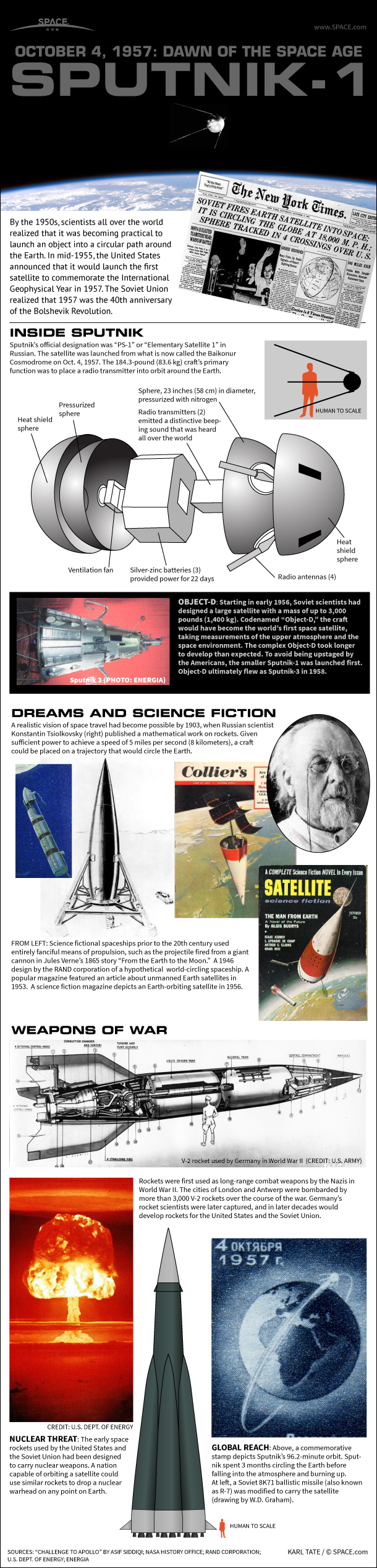
Sputnik 1 lives on in models of the world's first satellite

In 2017, I was lucky enough to be part of a UN workshop on the theme of women in space. Most of it was run at the offices of UN Women, but one session was in UN HQ in New York City.

I was delighted to see a model of Sputnik 1 suspended from the ceiling in the lobby. The model was presented to the UN by the USSR in 1959. 

The satellite itself of course no longer exists, having re-entered after three months in orbit in January 1958. I wonder what you would find if you made a catalogue of all the Sputnik models that existed in the world - a footprint of its cultural influence? The catalogue would include the model that usually resides on my office desk, for example. You'd never be able to track them all - there must be so many small ones produced as models or toys dispersed throughout the world. Some would be in museums; some in public institutions like the UN; others in universities. The rest would be in schools, people's houses and who knows where else.

Models don't have to be accurate, either. Perhaps there are some that are larger than the original satellite, which was 58 cm in diameter. Many would be smaller. They may use different materials, or get the angle and size of the antennas wrong. But they'll all have a shiny sphere with four long legs, the essential features of this space object which have come to symbolise the early Space Age.


Sunday, October 11, 2015

Satellites are little knots of materiality in an invisible electromagnetic tapestry

Satellites go beyond the limits of human bodies to be our senses in the void. They are conduits of information in the form of signals in different wavelengths, mediated and managed by the hardware of transponders, antennas, modulators, processors, and data storage facilities. Without communication, they have no function, whether this is gathering data from the solar system or deep space to send back to earth, or transmitting terrestrial telephone and television around the planet. These signals are the real purpose of the hardware. Satellites are little knots of materiality in an invisible electromagnetic tapestry.

In the nearly 60 years since launch of Sputnik 1, the rara avis has become a veritable flock. There are over 23 000 tracked objects over 10 cm, and over 100 million particles less than a centimetre in size currently located between Low Earth Orbit and the so-called ‘graveyard orbit’, approximately 36 000 km above the surface of the Earth. A mere 6% of these objects are operational spacecraft. Their chronological range is from 1958 (Vanguard 1, the oldest surviving spacecraft, with its upper launch stage and a loose clamp) until the present time. In weight, the accumulated debris is estimated to be 6000 tons. But I argue that this ‘space junk’ represents far more than just a risk or hazard to operating spacecraft and satellites, as it is regarded by space industry, or an all-too-familiar pollution problem: it is the repository of human ideologies and values – capitalist, communist, mercantile, colonial, gendered, scientific, environmental and cosmological.  As junk, it is the proper study of archaeologists, who excavate through what is discarded in the garbage heaps of history, to find the significance in what people consider to be without value.


(This is a passage I removed from a recently submitted paper, but I quite like it despite that)


Thursday, November 22, 2012

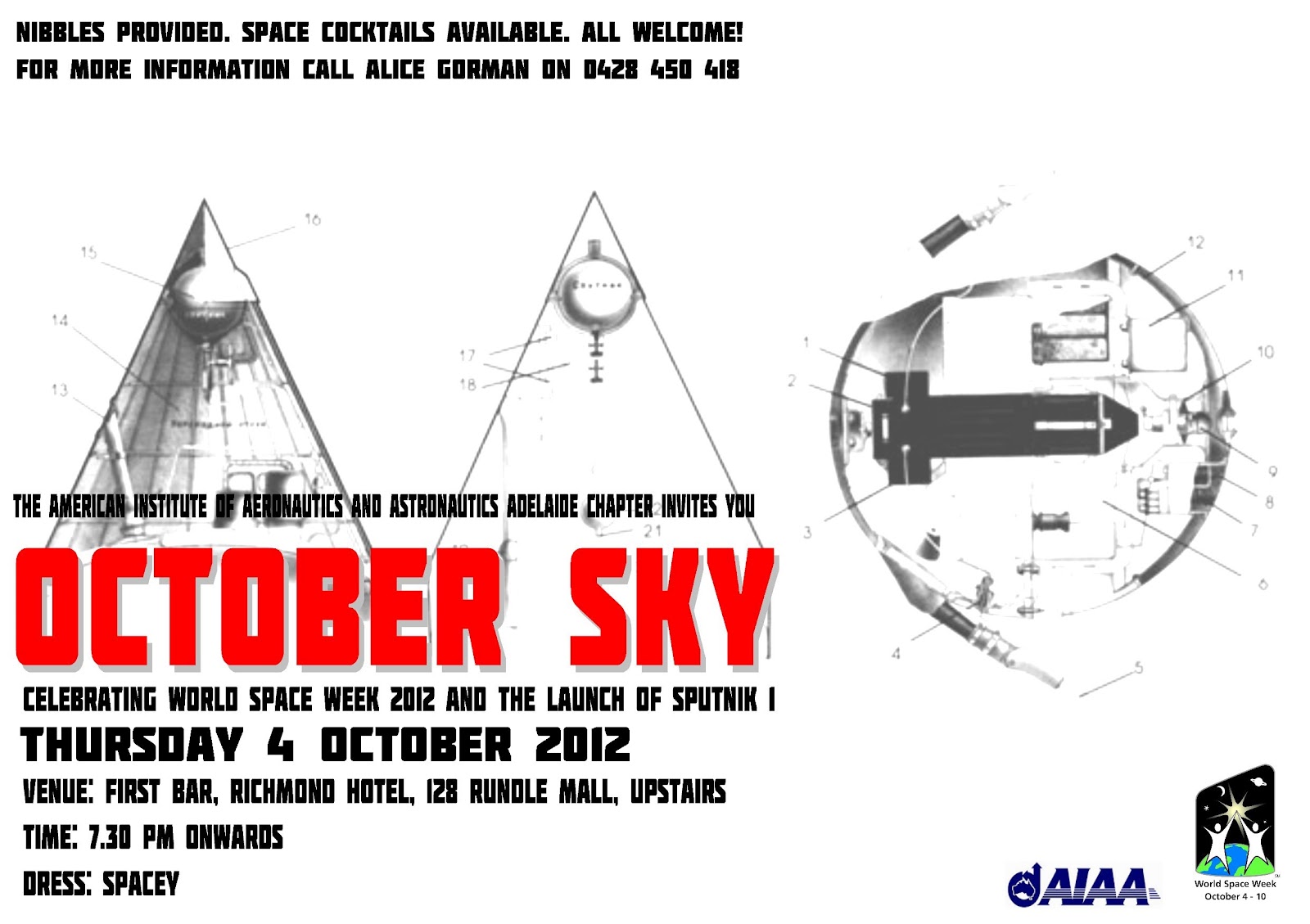
Space cocktails #3: the October Sky

Ok, so it's November now, but I think this creation is timeless. Jack the clever bar person at First Bar, Richmond Hotel, in Rundle Mall, made this for our World Space Week party last month. It was rather delicious, rather too delicious actually, so I extracted the recipe from him and share it with you here.

45 ml Gin
15 ml Maraschino liqueur
30 ml lemon juice
Dash of elderflower syrup (Monin brand)
15 ml Alize (blue - a blue Curacao, I think?)

Then you go S & S (I've forgotten what this means but he shook it with ice and drained it, I remember that much) and pour it into a martini glass. Garnish with a cherry.

I could check but I think the other cocktails I've discussed here are the Sputnik and Ti-Punch from Kourou in French Guiana. And who can forget Vostok space beer? Future space tourists will thank us for having made these explorations on their behalf.


Monday, September 03, 2012

The giraffe on the Moon: Peter Cook and Britain's Cold War space programme

The comedian/satirist Peter Cook (1937-1995) made numerous references to Britain's Cold War space programme, some of which appear in an anthology of his work (Cook 2003).
The grasshopper is an interesting creature. It has a disproportionate leaping ability. It's the powerful hind legs that cause it. You can see them hopping over grassy terrain. That's why it's called a grasshopper. But it is its leaping ability that interests me. Do you know that if the giraffe had the same leaping ability, pound for pound, he'd be able to jump onto the moon and Britain would be the first in the space race? (Interesting Facts, from Pop Goes Mrs Jessop, Cambridge Arts Theatre, 1960)

Since 1946, Britain had been involved in a joint missile/space programme in partnership with Australia, based at the Woomera rocket range in South Australia. In the 1960s both nations were involved in the European Launcher Development Organisation (ELDO), aimed at putting a European satellite in orbit. By this time, however, only a few years after the launch of Sputnik 1 in 1957, it was becoming clear that Britain was probably not going to be a major player in space exploration. Hence Cook's gentle dig at Britain's technological capabilities ......


This one is from a parody of then Prime Minister Harold Macmillan (apparently quite shocking at the time as no-one had satirised a Prime Minister before!):

I then went on to America , and there I had talks with the young, vigorous President of that great country, and danced with his very lovely lady wife. We talked of many things, including Great Britain's position in the world as some of honest broker. I agreed with him when he said that no nation could be more honest, and he agreed with me when I chaffed him and said no nation could be broker. This type of genial, statesmanlike banter often went late into the night. Our talks ranged over a wide variety of subjects, including that of the Skybolt Missile programme. And after a good deal of good-natured give and take I decided on behalf of Great Britain to accept Polaris in place of the Skybolt. This is a good solution because, as far as I can see, the Polaris starts where the Skybolt left off - in the sea.

I was privileged to see some actual photographs of this weapon. The President was kind enough to show me actual photographs of this missile, beautiful photographs taken by Karsh of Ottawa. A very handsome weapon - we shall be very proud to have them. The photographs, that is. We don't get the missile until around 1970. In the meantime, we shall just have to keep our fingers crossed, sit very quietly, and try not to alienate anyone. This is not to say that we do not have our own nuclear striking force. We do. We have the Blue Steel, a very effective missile, as it has a range of 150 miles, which means we can just about get Paris. And by God we will.
(TVPM, John Golden Theatre, New York 1962)

The US president was, of course, John F. Kennedy. In 1962, he and Macmillan met in the Bahamas and as part of the Nassau agreement the UK agreed to replace the US's cancelled Skybolt missiles with Polaris missiles. Britain of course had cancelled its own intermediate range ballistic missile, the Blue Streak, in order to buy US products. Blue Steel was one of many missiles tested at Woomera. (And now, of course, it's better known as a "look" by model Derek Zoolander).


References
Cook, William (ed) 2003 Tragically I was an only twin: the comedy of Peter Cook. Century


Monday, March 14, 2011

Yuri Gagarin's Australian story lost in space

On the eve of the 50th anniversary of Yuri Gagarin’s space flight, Flinders University space archaeologist Dr Alice Gorman (pictured) reflects on the significance of that feat – with an Australian twist.

Photograph by Ashton Claridge
“Australians were fascinated by the idea of the first man in space, if media coverage around the 12 April 1961 mission is any indication, and they remain so,” Dr Gorman said. Her survey of newspaper accounts reveals the official reception of Gagarin’s achievement was tempered by Cold War hostilities.

“Leaders all over the world were congratulating the USSR but Prime Minister Menzies wouldn’t. He made no public statement,” she said. “Journalists turned to scientists for comment, particularly at Woomera which had been the first tracking station to acquire Sputnik 1 in orbit. They didn’t manage to track Gagarin’s flight, however, which led some to speculate whether it really happened.”

Dr Gorman said a comment by prominent Australian physicist and nuclear scientist Professor Harry Messel reflects the mood in some circles. “There was an element of doubt in his comment: ‘If what the Russians claim is true, then it is a triumph over the free world…Scientifically, I’m happy; but from a Cold War perspective, I’m sad’.”

Menzies’ silence may have led to Moscow’s lack of response when an invitation was issued for Yuri Gagarin to visit the 1961 Sydney Trade Fair, which featured life-size models of several Soviet spacecraft. Gagarin bypassed Australia in his world tour that year.

Australian journalist and Communist sympathiser, Wilfred Burchett weighs into this story, too. “Burchett, whose passport was lost or stolen, moved his family to Moscow in 1956. He and Anthony Purdy were the only Western journalists allowed to have a face-to-face interview with Gagarin.
“They subsequently wrote a book together, Cosmonaut Yuri Gagarin: First Man in Space.”

Dr Gorman stumbled across a photograph of Wilfred Burchett’s father, George, presenting Gagarin with a boomerang in Moscow.  The caption reads:

Mr George Burchett presenting Yuri Gagarin with a boomerang on behalf of Australian peace workers with the hope that he and his fellow compatriots in their journeying to the stars will, like the boomerang, always return to Earth safely and to a world at peace.

With human spaceflight programs increasingly under threat and technology able to accomplish many tasks remotely, Dr Gorman said it is easy to underestimate Gagarin’s feat. “Until Gagarin came down in one piece, we actually didn’t know if it was possible for a human to survive in space,” she said. “What is commonplace now was a mystery then. It was less than four years after the first satellite had been launched; can you imagine trusting your life to such untried technology! I think Gagarin demonstrated for the first time that we are all citizens of the cosmos; he was the first person to see the Earth from the outside.”

Story by Vince Ciccarello, Flinders University.  Published 7th March 2011


Tuesday, January 18, 2011

Consuming the Space Age: the cuisine of Sputnik

Ever since my esteemed colleague Dr Lynley Wallis made a special batch of cup cakes decorated with spacecraft to help me celebrate the 50th anniversary of Sputnik 1’s launch in 2007, I’ve had a bit of a thing for rocket cakes. They are a staple of children’s birthday parties and represent youthful dreams of being an astronaut – the feeling that anything is possible, our potential is infinite, and we can reach for the stars.  
Dr Lynley Wallis' special Sputnik cakes


The rocket cake is a charming example of the influence space exploration has had on terrestrial food.  This influence, it seems to me, falls into roughly three categories:
• Food decorated or shaped like spacecraft or celestial bodies.
•  Food devised to commemorate a space event
• Food from terrestrial places associated with space exploration

In this post, I want to consider the first category, in the form of food that evokes the Sputnik 1 and 2 satellites.  These recipes and dishes can be regarded as a sort of performance, half way between tangible and intangible heritage, as they exist only in the moment of their manufacture and disappear in the act of consumption.

The USSR’s successful launch of Sputnik 1 in 1957 caught the USA by surprise; and the reactions of panic have been well documented. Suddenly, the night sky was transformed from a serene celestial dome to a place of menace, from which unseen attacks could be launched on the capitalist world.  At the same time, there was tremendous excitement that the shackles of gravity had been broken at last and human dreams of space were about to be realised.

While the US military and government were grappling with the political implications of Sputnik 1, one of the ways in which ordinary people responded was to translate the body of the spacecraft into something familiar and edible.  The humble olive, with the addition of three or four toothpicks to represent antenna, became a symbol of the satellite.  This was an excellent garnish for a martini, sandwich or the quintessential American food, the hamburger.


The caption from this newspaper photograph reads:  

Not to be outdone – Harriet Phydros samples a Sputnikburger which an Atlanta café rushed onto the menu. It’s garnished with Russian dressing and caviar, topped by satellite olive and cocktail hotdog.  
The hot dog is a reference to Laika the dog, who went into orbit in Sputnik 2 later in 1957.  Despite Laika’s sad demise, the visual word play is appealing; but the “not to be outdone” requires further unpacking.  Does this imply that Harriet’s imminent consumption of the Sputnikburger will somehow restore the balance of power?  Or that eating it is a small conquest of space in its own right?  In any case, this potential weapon of mass destruction has become a commodity rather than a beacon of communist ideology.  According to Lisa Parks, ‘mainstream American culture commodified and domesticated Sputnik, positioning it within the discourse of American nationalism rather then leaving it to circle the earth on its own accord” (Parks 1995:16).

The toothpick antenna appeared in other Sputnik foods.  A photograph on the cover of a 1957 Life magazine showed a young woman about to tuck into a Sputnik sundae, surmounted by a ball of icecream studded with toothpicks.  A popular hors d’oeuvre of the 1960s featured cubes of cheese, fruit and sausage threaded on toothpicks, then stuck into oranges or melons.  Another version of the hamburger combined both concepts.  The top image below, from a book on children’s parties, shows a Sputnik cheeseburger (and other delicious space-themed party food).

Image courtesy of Amy Alessio at Vintage Cookbooks

And of course there were the Sputnik cocktails.  There are several versions of these floating around; this one seems to be the most common:


45 ml vodka
15 ml Fernet Branca (a bitter Italian digestive liqueur)

15 ml fresh lemon juice
1/2 tsp sugar

Shake all together and serve in a cocktail glass.


William E. Burrows, in his classic “This New Ocean:  The Story of the First Space Age”, described the USA’s reaction to the launch of Sputnik 1 as “the Sputnik cocktail: vodka and sour grapes” (Burrows 1998:187). The culinary metaphor continued: at the time, some US politicians, including Eisenhower, blamed the Soviet lead on the hedonist consumer lifestyles of Americans. As Burrows frames it, they effectively called upon US citizens “to push away their banana splits, hot fudge sundaes, malteds, cherry-lime rickeys, barbequed steaks, and hot dogs” (Burrows 1998:191), and make sacrifices in order to regain the upper hand in the space race. Capitalist ideology had been dealt a significant blow.

Sputnik-inspired food, however, meant different things in different places.  The journalist Fred Blumenthal, travelling though Asia following the launch, observed that

Sputnik just turned the East upside-down. As it did everywhere, I suppose it appealed to the imagination.  In the Philippines, the restaurants, movie houses and taxicabs were renamed Sputnik.  One restaurant even came up with a Sputnik sandwich, the feature of which was an olive with four protruding toothpick ‘antennae’.  More important was the diplomatic loss of face suffered.  In Hong Kong, Japan and the Philippines, there was a loss of confidence in the United States and, under the surface, a sort of secret glee that [it] had been toppled from the high horse (quoted in Dickson 2001:132). 

So here, the consumption of Sputnik was almost an act of resistance against US imperialist ambitions in that part of the world. We can see in these few examples that there was an ideological dimension to Cold War food, a literal internalisation of the values that Sputnik was felt to represent for its different audiences (not forgetting that Sputnik was also a sound ……). 

The culinary legacy of the Cold War in space, however, lives on in the 21st century.  Any dish which features long spikey things can be called a sputnik; I’ve seen potato sputniks, a scoop of mashed potato with carrot and cucumber sticks for antenna; and the famous exponent of French cooking, Anne Willan, created a baked Pineapple Sputnik with whole vanilla beans for antenna (Willan 2000).  The kohlrabi (a type of turnip) is frequently called the sputnik vegetable, particularly as its leaves are angled just like the satellite’s antennas.  I’m not a fan of anything turnippy; and I regret that I don’t like olives, as it’s hard not to appreciate the simple elegance of the olive sputnik.  But I think my summer will now feature many Sputnik cocktails ……..

References
Burrows, William E.  1999 [1998]  This new ocean.  The story of the first space age.  New York:  Modern Library
Dickson, Paul  2001  Sputnik.  The shock of the century.  New York: Berkly Books
Parks, Lisa 1995 Technology in the twilight:  a cultural history of the communications satellite 1955-58.  Paper presented at the 1995 Society for the History of Technology Conference, Charlottseville, VA

Vintage Cookbooks http://vintagecookbooks.blogspot.com/2010/08/sputnik-cheeseburgers.html
Willan, Anne 2000 From My Château Kitchen. Clarkson Potter/Publishers


Food for Thinkers is a week-long, distributed, online conversation looking at food-writing from as wide and unusual a variety of perspectives as possible. Between January 18 and January 23, 2011, more than thirty food and non-food writers will respond to a question posed by GOOD's newly-launched Food hub: What does—or could, or even should—it mean to write about food today? You can check out the conversation in full at GOOD.is/food, join in the comments, and follow the Twitter hashtag #foodforthinkers to keep up-to-date as archaeologists, human rights activists, design critics, and even food writers share their perspective on what makes food so interesting. 


Wednesday, May 06, 2009

My very own Sputnik

A wonderful archaeology student, Alex, made a 1/4 scale model of Sputnik 1 for his class today. It's absolutely gorgeous, and despite my protests, he has insisted on giving it to me. I am absolutely overcome with delight!


Tuesday, January 13, 2009

Sputnik racehorses

Further to an earlier posting (Jan 20, 2005) about my father's attempt to get one of our racehorses registered as "Little Lemon" in honour of Laika, it seems that satellites were a popular source of racehorse names in the 1950s:

The Jockey Club of New York, which approves the names of race horses, has recently announced that only one horse can be named Sputnik and that since that name has now been assigned, no more breeders need ask for the name.
'
From Ackerman, Louise M. 1958 Facetious variations of 'Sputnik'. American Speech 33(2):154-156

Around this time many space expressions, including Russian words, became common; and there are many articles tracking these changes in language driven by the popular interest in space exploration.


Friday, August 29, 2008

Rockets Galore


I love my students. They bring me all sorts of space things - plastic astronauts, pop-up books, science fiction magazines, records. A few days ago darling Martin gave me "Rockets Galore" by Compton Mackenzie, with the dustjacket intact. I read "Whiskey Galore" years ago, but did not know about this sequel, in which the British Government attempts to build a rocket range on some remote Scottish islands. It's fabulous. There's a German rocket scientist, Dr Hamburger, crofters turned off their land and forced to migrate (shades of the Kourou expropriations), protests, and, of course, a romance.

It was originally published in 1957, the year Sputnik 1 was launched, and 10 years after the establishment of Woomera, and was also made into a feature film. Haven't finished reading it yet but will be curious to see if they do mention Woomera ....


Friday, February 01, 2008

Sputnik apples

Yesterday I gave a lecture about Woomera to the University of the Third Age - a volunteer-run organisation aimed at retirees. There were quite a few people in the audience who had connections to Woomera of one kind or another. But the bit I liked most was the story of the Sputnik apples. To celebrate the launch of Sputnik 1 in 1957, one now-retired gentleman and his work colleagues stuck toothpicks into apples in Sputnik's antenna configuration and hung lots of them from the ceiling by string.

Bamboo skewers may have been a little more to scale but they are not such easy things to find in an office. A spray of silver paint would have been marvellous too (I'm getting ideas, you see, on the space party theme .... )

The literature, and my own discussions with people, suggest that in Australia the reaction to Sputnik 1 was very different to that in the USA. It was not perceived as a threat, it did not cause a national crisis of confidence. (Although it should be noted that not all scholars agree that that was the general reaction in the US). Instead, people found it interesting and exciting.


Tuesday, October 09, 2007

Sputnik cakes endorsed by Nicey

Nicey did like Dr Lynley Wallis' special sputnik cakes. Here is what he says on his fabulous website:


"Its always good to hear from NCOTAASD's favourite space archaeologist. We too were excited about the 50th anniversary of Sputnik, which for good reason is the artificial satellite that I most often think of. Despite all the hundreds of other ones up there routing our phone calls, guiding our transport and keeping an eye on the weather, Sputnik is the only one with its own vegetable. The Kohl-Rabis that turn up in our weekly delivered veggi-box are the spit of it, and very nice in a stir fry it is. 

I'm impressed that each cake seems to be unique in its design and colour scheme and I note that Dr Wallis didn't spare the food colouring. I hope this didn't render all your students hyper-active with attention deficit issues. Granted the latter is always difficult to diagnose in students although working in such a stimulating field I'm sure you don't suffer from such things".


I had to think a bit about the kohlrabis. The cakes were the least of our worries at the masterclass, as we had provided suitable beverages appropriate to any archaeological discussion.

Is any serious research going on here at the moment? I don't care as long as I remain NCOTAASD's favourite space archaeologist.


Monday, October 08, 2007

Sputnik cakes

Last Thursday was Sputnik's 50th birthday. My esteemed colleague Dr Lynley Wallis demonstrated the depth of her friendship and her love of space hardware by making a batch of special sputnik cakes, that were consumed by participants at our cultural heritage masterclass that afternoon.

It turns out it's not so easy to make pictures of rockets and satellites with stupid kiddie icing tubes and chocolate sprinkles. My esteemed colleague was most incensed when I opined that her home-made rocket stencil looked more like a turtle than a V2, and there was a free-hand star that resembled a dog .... however recognising that my access to cake was being put at risk by this somewhat negative commentary, I refrained and assisted her in making lopsided moons and sputnik shapes that looked like sea urchins on a bad hair day.

Kelly Wiltshire took a spifflicatingly good photo (see right). They were most splendid cakes and I think that Nicey (from A Nice Cup of Tea and A Sit Down) would have approved.


Thursday, July 12, 2007

The first seven years in orbit

The ICOMOS Australia conference is on in Cairns next week. John Campbell and I are convening a session on space heritage, and we're very excited, because Beth O'Leary from New Mexico State University is visiting Australia for the first time. Beth has been researching Tranquility Base and will deliver one of the keynote talks.

As per bloody usual, I'm writing my paper at the last minute (why, oh why, do I always do this?). I'm looking at the material record in orbit from 1957, the launch of Sputnik 1 into Low Earth Orbit, until 1963, when Syncom 1 is launched into geosynchronous orbit. Only seven years to get from LEO to GEO, and then another seven years until people land on the Moon. Pretty astonishing.

Looking at the figures has raised some interesting points. I expected to see a more or less equal distribution of USA/USSR satellites still up there. But the satellites remaining in orbit from the first seven years are almost entirely US, the main exception being Canada's Alouette 1. What happened to the Russian satellites?

One reason they are underrepresented is because during this period the USSR was focussing on the Moon, so quite a few have ended up in lunar orbit or cislunar space. (This makes me realise I don't know much about how lunar orbits work, in the absence of aerodynamic drag. Must find out). (And isn't cislunar a fabulous word?). Numerous other missions were crewed, and thus returned to Earth.

Another explanation may be that USSR satellites were injected into lower orbits than USA ones and have decayed at a greater rate. I won't have time to pursue this before the conference unfortunately.

I am going to imagine a scenario where all we have is the orbital material to work out how humans got into space. What will this first seven years tell us, and how might it differ from the documentary record?

I'm also going to take a closer look at the fascinating West Ford project ....


Monday, October 16, 2006

Don't disrespect Vanguard 1

Last night I watched Space Race, the series created by Deborah Cadbury. This episode was all about Sputnik 1 and Explorer 1, and their creators, von Braun and Korolev. Naturally, as a fan of Vanguard, I was disappointed at how the Naval Research Laboratory's satellite was treated in the documentary. There was no mention of the International Geophysical Year, or coherent explanation of the rationale behind preferring a non-military launch vehicle. The documentary maintained that James van Allen was called in at the last minute to build instrumentation for Explorer's experiments. The reality is that van Allen designed his experiment for Vanguard, but cunningly made it compatible with both satellites; when it became clear that Vanguard was under a cloud he transferred to Explorer. When Vanguard 1 was launched, it flew without its experiment packages.

Nonetheless, Vanguard 1 is still up there, and Explorer 1 re-entered in less than a month. Green and Lomask, historians of Vanguard, point out that its technologies are the basis of the USA space industry today.

Go Vanguard!


Monday, November 14, 2005

The Sputnik sandwich

One of these days I am going to write a space recipe book. I have a recipe for space food sticks (spookily enough) and a special Woomera hors d'oeuvre that I found in a community cookbook. And now - the Sputnik sandwich! In 1957, a Japanese chef came up with this one. I don't know what was in the sandwich but it was crowned by an olive with 4 toothpicks as antennae. Also a garnish that would work on a martini, it occurs to me.


Tuesday, September 21, 2004

Kaputnik

I have nine days to finish an article about the Vanguard 1 satellite, labelled Kaputnik because the launch vehicle exploded on the stand in one launch attempt. It's hard not to like Vanguard 1. It was nearly the first satellite in the world, but was beaten by Sputnik 1, and it was nearly the first US satellite, but was beaten by Explorer 1 .... James Van Allen devised instrumentation for it but when he saw which way the wind was blowing he transferred his project to Explorer. (Fickle bastard). As a result Explorers I and II had the honour of discovering the Van Allen radiation belts when it should have been Vanguard. I think my Australian tendency to favour the underdog is definitely aroused by poor old Vanguard! And yet it provided the technical foundations for the contemporary US space industry, and it is still in orbit today when all those other early satellites have long since re-entered.


Tuesday, September 14, 2004

Remembering the Cold War

I've just moved from Adelaide to the southern Riverina. A few nights ago I went out for dinner with a number of more "senior" folk. I took the opportunity to ask them what they remembered of the launch of Sputnik and the Cold War activities at Woomera.

A few said that they were very aware of Sputnik 1, and even went out to watch it. There was no fear, nor a special sense of excitement; it was just an interesting thing going on. As for Woomera, no-one had been particularly aware of what was going on there at all.

What people did talk about was the bombing of Darwin in WW II. At the time it was downplayed, because the government did not wish to alarm people, and it is still not widely known even among Darwin residents, said Rachel who had lived in Darwin for the last few years.


Thursday, August 26, 2004

Gibber Gabber

Back from Woomera, utterly exhausted. The weather was glorious but I spent much of my time inside, at the Heritage Centre and the library, researching old newspaper clippings and the Woomera newsletter Gibber Gabber. And what a rich mine it turned out to be! I traced the activities of the Natural History Society, who collected artefacts and went looking for rock art sites, and of the Moonwatch group, formed to track Vanguard 1 optically in 1957. There were many notices about Moonwatch meetings but the Gibber Gabber was strangely silent on the event of Sputnik 1's launch. Later, however, the Moonwatchers were happy to report sightings of Sputnik 3. (The moon referred to was the artificial satellite). The idea of having volunteers undertake tracking was promoted by Fred Whipple of the US IGY Committee.

As well hard work, some happy hours were spent in the ELDO bar ....